International maritime design and engineering consultancy Houlder has begun a study into the potential marine application of carbon capture technology onboard ships.
It has partnered with PMW Technology, which has developed an “Advanced Cryogenic Carbon Capture” a process designed to extract carbon dioxide from marine exhaust gases.
The key points of PMW’s technology is that C02 would basically be extracted by being frozen out of the exhaust, then liquified and stored onboard at minus 40 degrees Celsius and at 10 bar pressure. The C02 would later be offloaded for geological storage in port.
The Houlder-study will evaluate the feasibility, costs, infrastructure, impacts, and potential benefits of using advanced carbon capture technology to decarbonise marine shipping.
A new alternative
Paul Willson, Director of PMW Technology, presents the technology as an alternative to new fuel types and vessel designs.
“The commitments made by the IMO for radical reductions in shipping emissions by 2050 will require major changes to fuels and vessel design. Current renewable fuel favourites such as hydrogen and ammonia will require global investment estimated to exceed $1 trillion,” he says.
There is one particularly interesting aspect to the process. Because oxygen molecules add extra mass during combustion, the resulting volume of C02 would have more mass and a greater density than the original fuel!
The bigger the ship, the bigger its fuel requirements and, if a carbon capture process is used, the bigger the volume of liquid C02 that would be produced. Ultimately, the C02 storage tank would have to be bigger than the original fuel tank.
Chemical bonds, atomic weights
Here’s how.
Energy is released as heat and light when the chemical bonds between atoms are rearranged during combustion. For illustrative purposes, consider that liquefied natural gas is the fuel being used.
LNG is the liquid form of the compound gas, methane, which is composed of four hydrogen atoms and one carbon atom. During combustion, the chemical bonds between the single carbon atom and the four hydrogen atoms break. The free carbon and hydrogen atoms then react with atmospheric oxygen atoms to make C02 and water.
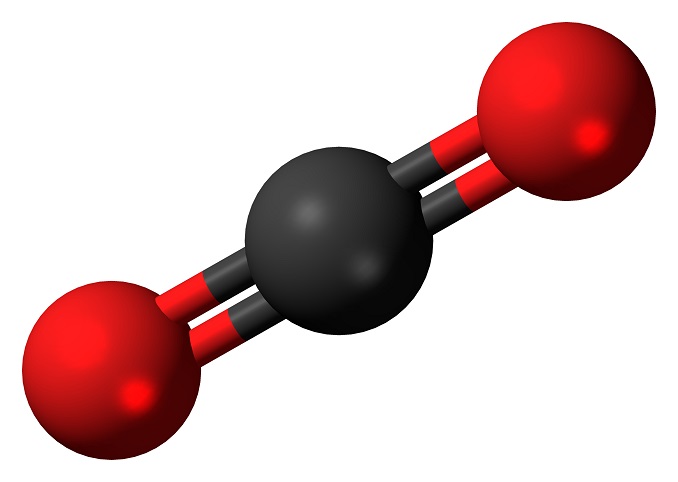
One carbon atom links with two oxygen atoms and that creates carbon dioxide. Every two hydrogen atoms link to a single atom of oxygen and that makes water.
Each single atom of oxygen has about 16 times more mass than a single atom of hydrogen. Because creation of C02 via combustion adds the relatively heavy oxygen and discards the relatively lighter hydrogen, that explains why PMW’s process creates more C02 than the original fuel.
Heavy fuel oil would produce even more liquid C02
Although the example above uses the relatively simple LNG for ease-of-explanation purposes, there would be a similar process and effect with heavy fuel oil. Heavy fuel oil would, in fact, result in even more C02 being produced because there is a lot more carbon in fuel oil than there is in LNG.
Future development work includes finding room for onboard storage for tanks, refrigeration equipment, powering the plant, creating shore-side infrastructure and developing geological storage.
Read more about the process at PMW Technology.