Sea-Intelligence, a respected international company of maritime analysts, has busted a “nefarious” myth surrounding blank sailings.
“The data is… clear: carriers have not reduced deployed capacity, despite having blanked some sailings,” reported Sea-Intelligence CEO, Alan Murphy.
Sea-Intelligence notes that shippers are becoming frustrated with the international logistics chain because of record-high freight rates, container and vessel capacity shortages, terminal and port congestion, and schedule reliability.
The company analyses the allegations made in various stakeholder discussions that there has been a “nefarious” use of blank sailings despite an acute shortage of capacity.
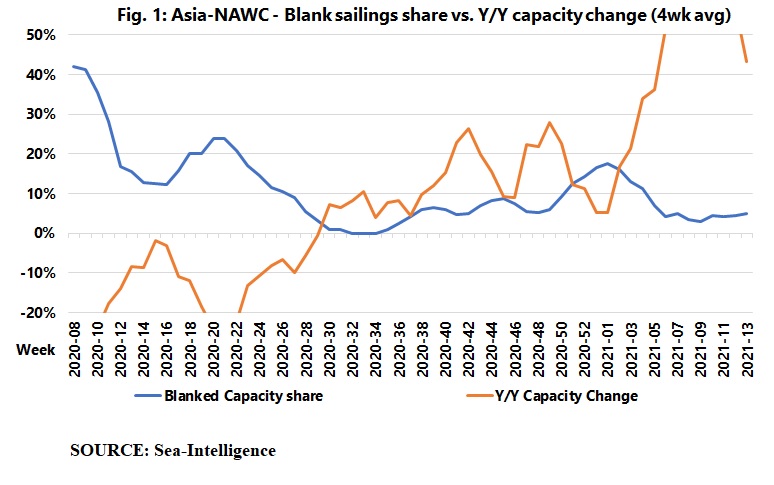
Sea-Intelligence examined blanked capacity and year-on-year capacity change on a key trade route using a running four week average, which eliminates data-noise, going back to February last year (for more details, see the graph, below).
The data confirmed that, in the early days of the pandemic when Asian production was adversely affected, blank sailings were high. Blankings reduced somewhat but were still high until about May.
Thereafter, in July and August, blankings slumped to zero.
There was a surge in blankings again in the end-days of 2020 which has been trending back down toward zero in the early days of 2021.
“So there has been [an increase] in the number of blank sailings, despite the current bottleneck problems, but this does not mean that the carriers have also reduced capacity, compared to a year earlier,” Mr Murphy revealed.
He added that extra capacity has been introduced into the global fleet through the introduction of larger vessels and extra loaders, “which has more than exceeded the amount of capacity removed through blank sailings. there have been periods where the growth in capacity injection was pushing 30% [year-on-year], despite some sailings being blanked”.
A similar pattern has been seen on a variety of key trade routes around the world, Sea-Intelligence indicated.