International ocean shipping giant Maersk has taken a big step in shaping the future of shipping by vowing to hit net-zero greenhouse gas emissions by 2040 across its entire business including its direct and indirect emissions.
This bold announcement from Maersk is far ahead of the International Maritime Organization goal of cutting greenhouse gases by 50% by 2050.
Maersk has 2030 targets as follows:
- Ocean: a 50% reduction in greenhouse emissions intensity
- Terminals: 70% absolute reduction of greenhouse gas emissions
- Air: at least 30% of cargo transported using sustainable aviation fuel
- Warehouses / depots: at least 90% green operations
By 2040, the company has vowed to hit net zero emissions across its entire business and across all emission scopes (scope 1, 2, 3, which refers both to direct emissions from operations, emissions caused as a result of buying energy and other emissions elsewhere in a company’s value chain).
In a statement, Jacob Sterling, a Maersk Board Member, declared that the company is going “ALL-IN on decarbonisation!”.
Maersk says that the targets are expected to align the company with the Net Zero criteria of the Science Based Targets Initiative pathway to limit global warming to 1.5 degrees Celsius.
The company also hopes to build a “Natural Climate Solutions” portfolio that will generate about five million tonnes of carbon dioxide savings a year by 2030.
“As a global provider of end-to-end logistics services across all transport modes, it is a strategic imperative for Maersk to extend our net zero ambition to the total footprint of the business. The science is clear, we must act now to deliver significant progress in this decade. These very ambitious targets mark our commitment to society and to the many customers who call for net zero supply chains,” said Maersk CEO Soren Skou.
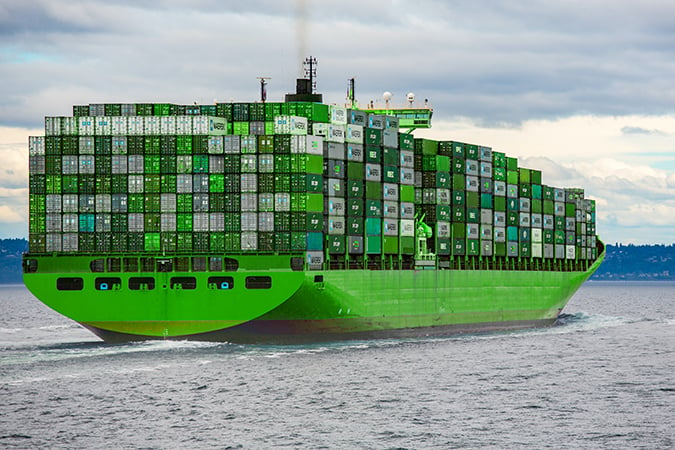
Meanwhile, earlier this week, Maersk also announced that it has ordered the construction of another four methanol-powered vessels. This newbuilding order with Hyudai Heavy of South Korea takes Maersk’s current total methanol-powered fleet to 12 ships. The deal is priced at US$700 million, according to the ship builder in a statement filed with the South Korean stock exchanged. The 12 vessels will together generate an annual carbon dioxide saving of 1.5 million tonnes.
Carbon dioxide is thought of as a “greenhouse gas” as it rises in the atmosphere to form a layer that encircles the planet. Energy from the sun normally reflects of the planetary surface, however, the carbon dioxide traps the heat in much the same way that a layer of glass traps heat in a greenhouse. Accordingly, the temperature of the planetary atmosphere increases over time which will lead to a global-scale series catastrophes if left unchecked.
Methanol is the simplest form of alcohol and it is composed of four hydrogen molecules, one oxygen molecule and one carbon molecule. It has an energy density of 22.7 megajoules per kilogram. As combustion draws in oxygen from the air, the products of combustion are carbon dioxide and water. Although combustion of methanol will produce carbon dioxide, as Maersk plans to source its methanol from renewably produced sources of methanol that use biologically produced carbon dioxide (e.g. from waste plant material) as a feedstock, then the carbon that is emitted into the atmosphere by the Maersk vessels will have originated from the atmosphere. Hence, the vessels are “net zero” in that they do not add any extra carbon to the atmosphere.