The UN Conference on Trade and Development has called for a smaller carbon footprint from the ocean shipping industry.
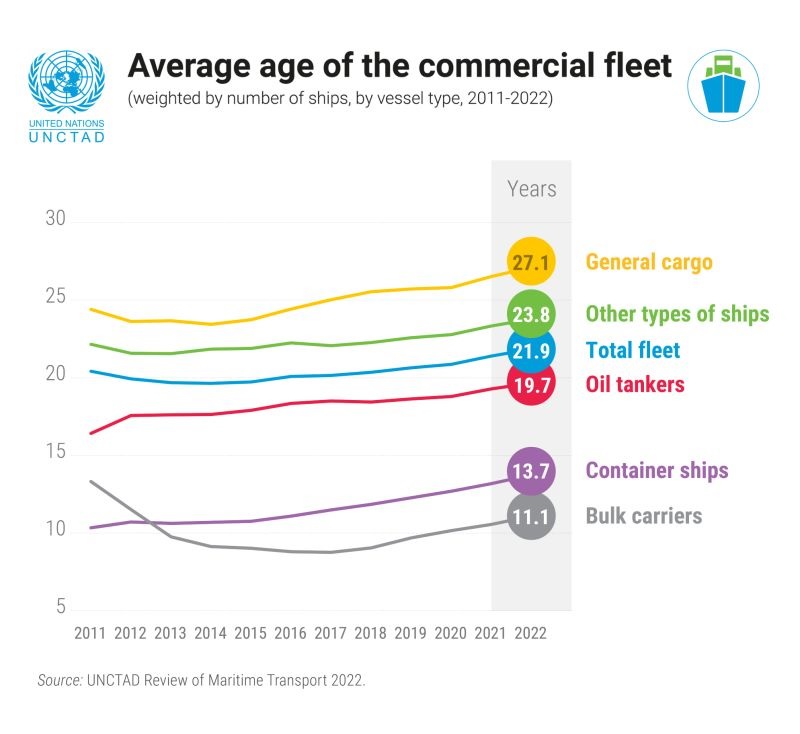
It has noted that the world’s ocean shipping fleet is ageing, which it describes as a “major concern” for the environment as older ships pollute more.
“Ships are getting older partly due to shipowners’ uncertainty about future technological developments and the most cost-efficient fuels, as well as about changing regulations and carbon prices. A new generation of low-carbon emitting ships with smart digital systems is needed to make maritime transport more sustainable and efficient,” the UNCTAD has said.
Accordingly, it has called for more investment in energy-efficient shipping technologies, an accelerated shift to alternative, low-carbon, fuels, a predictable global regulatory framework for investing in decarbonization and increased support for developing countries in energy transition.
Shipping Australia’s response
It’s all good and laudable stuff. But the age profile of the world fleet is quite likely to substantially change in the near future as freight rates fall. Falling freight rates = higher scrapping rates (it becomes unviable to keep older, costlier, ships in service when revenues fall).
Meanwhile, newer ships have to meet the Design Index; the IMO reckons ships entering service now are about 30% more energy efficient than ships entering service ten years ago.
Plus, in a few days (this article was written toward the end of December 2022) the new Carbon Intensity Indicator rules will kick in. These require existing ships to meet a certain benchmark for energy efficiency. Every year the rules will get a little more difficult to meet. The likely result is more energy efficient ships (more energy efficient processes, more energy-saving devices installed, slower ships) and, ultimately, it will help drive the older, less-efficient, ships out of the market.
And, as even a superficial skimming through the maritime press will reveal, the hot topic at the moment is green methanol. This is a an alcohol that can be used as fuel and, if produced in a green way, can substantially reduce the amount of carbon emissions from ships. It can – potentially – even become carbon-negative i.e. it could draw carbon out of the atmosphere on a planetary scale. Interesting stuff.
It’s also worth noting which ships are the youngest and the oldest.
Containerships and bulkers account for about 30% of the world fleet (2020 data; Equasis) and they are the youngest of the fleet. Oil tankers (various kinds) account for about 27% of the world fleet.
Containerships and bulkers are already regularly renewed by shipowners and operators as it’s in their financial interest to renew frequently – they need very efficient ships to break even or make a profit. In relation to oil tankers, looking further forward, as nations use less and less crude oil and petroleum, there’s likely to be less demand for the carriage of crude and petroleum, so less need for oil and chemical tankers. Again, the older, costlier, ships are likely to be sent to the scrap-yard first.
The real concern seems to be the general cargo ships (non-container) which, as a category, make up the single biggest category of ship – about 30% of the total. Most of those, about 12,000 or 22% of the total, are “medium” cargo ships of 500 to 24,999 gross tons. About eight per cent, or 4,000 or so, are smaller vessels (100 to 499 gross tons).
It could be argued that future policy to tackle ocean shipping emissions ought to focus on these smaller-to-medium size general cargo ships.