
Korean container shipping line, HMM, has announced plans for field tests of an onboard carbon capture system for containerships in the second half of the year. The trial will be carried out in association with Samsung Heavy Industries and eco-technology provider Panasia.
HMM will operate the onboard system while Samsung and Panasia will provide facilities and will be responsible for engineering matters.
The shipping line and the engineering companies signed an agreement in September last year for research into, and the development of, shipboard carbon capture systems aboard a multi-purpose vessel. Among other things, the research looked into detailed design and technology effectiveness evaluation.
The study revealed that it is possible to install an onboard carbon capture system without changing existing equipment and that the system does not hinder vessel operations.
In very simplified terms, the flue gas from the engine is routed into a quenching tower, which cools the gas. The cooled gas enters an absorber tower in which it is exposed to chemicals that absorb carbon dioxide from the cooled flue gas. C02-rich fluid is then moved into a heat exchanger (a specially-designed system used to optimise the transfer of heat between a heat source and a fluid) which causes C02 to be partially driven-off. The C02-reduced portion is returned to the absorber tower which may then release treated gas. Meanwhile, the C02-rich portion moves into a stripper tower that further separates C02. The non-C02 remainder is sent to a re-boiler and back through the system until it is released as a treated gas. The C02 moves into a condenser that condenses gas into liquid, which is then captured as liquid C02.
The resulting liquid C02 could be put to further use, for example, for use as manufacturing dry ice.
C02 emissions cut in half over ten years
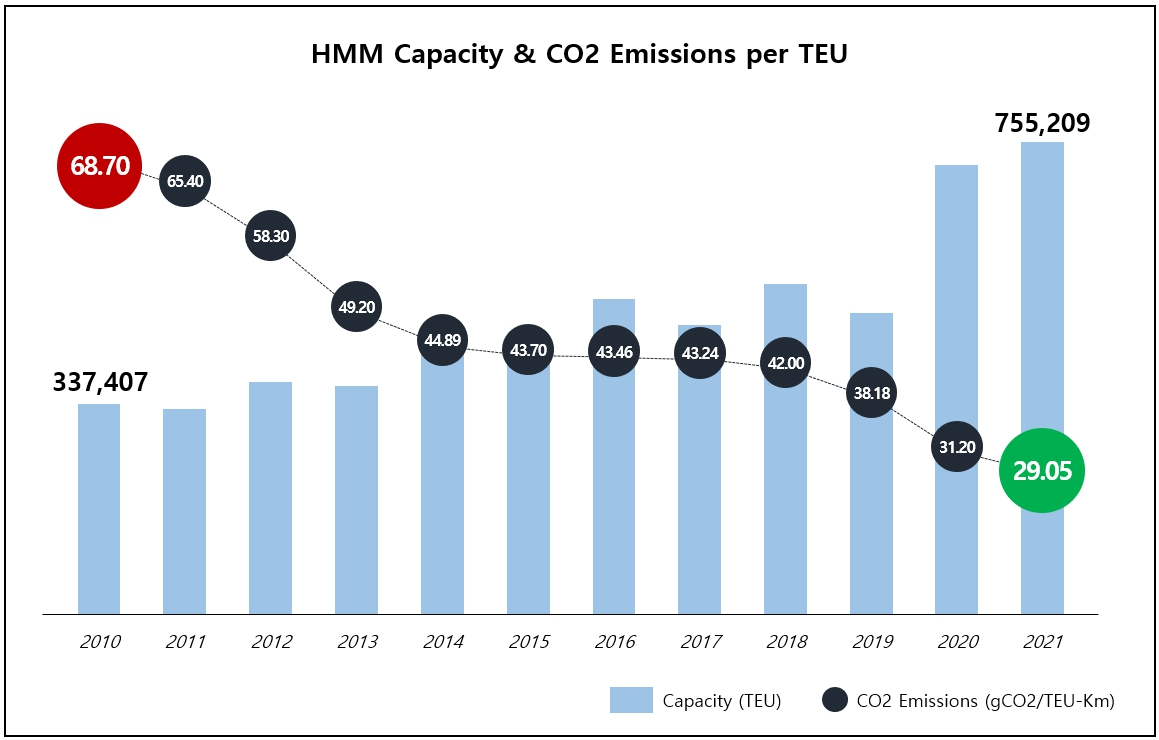
In other HMM-related news, the company has reported that it has cut its carbon emissions to less than half of 2010 levels. CO2 emissions per TEU per kilometre have fallen from 68.7 grams in 2010 to 29.05 grams in 2021, a fall of about 57.7%.
The company reports it has achieved its result amid a two-fold increase in fleet capacity from just over 337,000 TU to just over 755,000 TEU in the same period. It attributed its carbon success to fleet upgrades, the use of mega-vessels, anti-fouling paint, modification of the bulbous bow to reduce friction, optimising service routes, speeds and cargo stowage. The company also analyses real-time vessel operational data to reduce greenhouse gas emissions.
Better propellers
The company plans to invest in new propellers that are optimised for low-speed operation. Six container ships will receive the new propellers, which are anticipated to increase energy efficiency by about 8% to 9%.
HMM noted that it is acting in response to IMO regulations, specifically citing the IMO’s CII rating system, adding that it is working to carbon neutrality by 2050.
Methanol investment
Meanwhile, in February this year, the company announced it had ordered nine container ships of 9,000 TEU that will use methanol (CH3OH) as fuel. Methanol contains four atoms of hydrogen, one atom of oxygen and one atom of carbon.
Methanol can be made using renewably sourced electricity to split water into hydrogen and oxygen, and then combined with organically-sourced carbon (such as from, say, agricultural waste). As the carbon in methanol originated from the atmosphere (plants draw down oxygen from the atmosphere) then combustion merely returns the carbon to atmosphere and doesn’t add any new carbon.
Intriguingly, if methanol fuel is combined with onboard carbon capture and storage then the result could be carbon negative, i.e. the operation of the ship would reduce the amount of carbon in the atmosphere.
Further reading
Evaluation study gets underway into onboard maritime carbon capture and storage
“K” Line installs world-first carbon capture plant aboard a coal carrier