Shipping Australia notes with disappointment the recent infrastructure funding announcements from the Federal Government.
It’s one thing to declare a review of previously announced but unfunded projects, as was done by the Federal infrastructure and transport Minister, Hon Catherine King MP on 01 May, but its another entirely to cut the infrastructure pipeline while the Prime Minister is committing $240m in a third (and therefore unnecessary) stadium in Hobart.
The demands on the public purse are infinite and the resources to fill the public purse are markedly less so. That’s why there needs to be particular care with spending (a) the government doesn’t actually have any money, it all has to be taken from the taxpayer and (b) there’s a massive massive massive opportunity cost. If the government is funding one thing then, with the same money, it cannot be funding some other thing.
So just how valuable is this stadium in Hobart? Well, put it this way, the business case (p18), states that the benefit-to-cost ratio has a low-end of 0.35, 0.5 at the median and 0.73 at the top-end. Ok, that’s econo-speak. We’ll put that into human language for you.
In the worst case scenario, the stadium will return 35 cents for every dollar spent and, in the best case, it will return 73 cents.
That’s a real bad deal.
There’s lots of other stuff that cash could be spent on. We also acknowledge that there are lots of pressing social issues in Australia and in Tasmania that the funds could be spent on. But, as we are freight-focused, we will limit ourselves to freight infrastructure.
Here’s a thought. How about helping to fund the proposed Burnie Gateway Initiative?
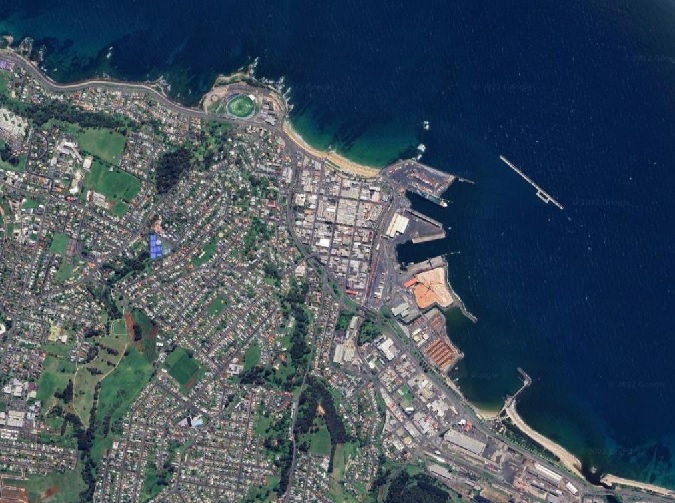
Attracting international shipping to the Apple Isle could help cut the landed cost of freight – thereby making it cheaper to live in Tasmania, and for sure would reduce the costs of exports as large bulk export ships could get commodities out to south east and north Asia. We understand that current mineral storage and ship loader constraints inhibit growth.
Want a more rigorous analysis than something we’ve knocked out? Fair enough.
Let’s see what the policy analysts at Infrastructure Australia say…
Oh, look at that, the “Port of Burnie Capacity” programme is on the national infrastructure priority list.
Who’d a thunk it?
Let’s read what IA has to say about expanding the PoB:
“Port capacity and infrastructure at Port of Burnie, on the north coast of Tasmania, is limiting export opportunities… Port of Burnie cannot accommodate vessels larger than Handymax size, which carry less than 60,000 tonnes. These vessels are too small to service the supply chain. The export terminal space at the port is limited and not fit for purpose, and multi-commodity logistics infrastructure does not meet the ports requirements… the Tasmanian Government estimates that mining and minerals exports from Tasmania are capable of growing from 0.5 million tonnes per annum in 2019 to 6 million tonnes per annum by 2029. However, the current port capacity will limit this growth and increase supply chain costs for bulk exporters… Potential options to address the identified problems include additional berth and terminal capacity to support larger ships at Burnie Port, such as channel works to accommodate Panamax vessels (up to 14.6 m draft and carrying 65,000–85,000 tonnes)”.
Mighta been nice if some of that stadium money could have been re-directed toward further studies toward expanding the Port of Burnie in an attempt to cut the cost of living and improve prosperity.
It’s not just Burnie, either.
The Port of Hobart supports a variety of industries, including bulk log exports, container exports, bulk fuel imports commercial fishing, Antarctic exploration and cruise ships. The current state of the wharfs limit opportunities to grow tourism, trade and Antarctic exploration. But what’s that against a shiny new third stadium, eh?
How about the Burnie to Hobart road and rail corridor? This would connect regional producers to Tasmania’s ports and (on the assumption that port expansion goes ahead) would help Tasmanians bring their produce to world markets, thereby helping secure Tasmania’s economic prosperity.
But, no. Stadium (x3) is clearly more important.
It is therefore somewhat sour to criticise the previous Federal administration for lining up a series of infrastructure projects and then funding – to the tune of hundreds of millions of dollars – wholly unnecessary stadia in Tasmania when the Apple Isle is crying out for freight-related infrastructure investment.
Shadow Minister for Infrastructure, Transport and Regional Development, Senator Bridget McKenzie said Labor’s lack of infrastructure ambition represents a plan for gridlocked city streets, unsafe regional freight routes and less family time at home.
“Continually cutting back on infrastructure projects will be a handbrake on economic growth and a barrier to driving national efficiencies needed to support budget repair and tackling inflation.”
“At the very time when the Government’s budget repair strategy should be to invest in productivity enhancing capital and cut back on unnecessary recurrent expenditure, Labor seem determined to do the opposite, dooming the nation to a slow and painful recovery.
“While taking the razor to infrastructure projects, Labor is failing to address the structural challenges on the spending side of the budget, ignoring the advice of key economic commentators… it appears as if investing in these projects will come at the expense of starving congested suburban roads and city streets of long overdue funding, as well as neglecting productivity-enhancing upgrades to strategic regional freight routes”.
“Hear, hear“, Senator, “hear, hear”.