Russia’s government terminated the international agreement to allow grain and fertiliser (ammonia) shipments across the Black Sea, it was reported by the Russian state-owned news agency, TASS, on Monday. Moscow argued that obligations toward Russia had not been fulfilled.
“The Black Sea agreements are no longer in effect. The deadline, as the Russian president said earlier, is July 17. Unfortunately, the part of the Black Sea agreement that concerns Russia has not yet been fulfilled. As a result, it has been terminated,” Russian Presidential spokesperson Dmitry Peskov said.
“As soon as the Russian part [of the deal] is fulfilled, the Russian side will immediately return to the implementation of this deal,” Peskov added.
In a statement from the Russian Foreign Ministry, as reported by TASS, “If Western capitals really value the Black Sea initiative let them seriously ponder meeting their commitments and actually removing Russian fertilizers and food from sanctions. Only with concrete results, not promises and assurances received, Russia will be able to consider the resumption of the deal,” the ministry concluded.
According to reporting by TASS, Russian conditions for resuming the Initiative include “lifting sanctions on Russian grain and fertilizer deliveries, removing all obstacles for Russian banks servicing food supplies to the global market, including their connection to SWIFT, resuming deliveries of components and spare parts for agricultural machinery and fertilizer production to Russia, resolving all issues with ship chartering and insurance of Russian food exports, resuming operations of the Togliatti-Odessa ammonia pipeline, unblocking Russian agricultural assets, and restoring the grain deal’s original humanitarian intent.
Russia criticised effects of the initiative as being contrary to the humanitarian goals, stating that the “food was almost immediately shifted to a purely commercial basis and until the last moment was aimed at serving the mercenary interests of Kiev and its Western sponsors. The facts and figures, as they say, speak for themselves. For the duration of the Black Sea initiative a total of 32.8 [million] tons of cargoes were delivered, of which more than 70% (26.3 mln tons) were supplied to countries with high and above average levels of income, including the EU. The poorest countries, Ethiopia, Yemen, Afghanistan, Sudan and Somalia in particular, accounted for less than 3%, or 922,092 tons,” TASS reported a Russian official as saying.
Effect of termination – ships could be targeted
The termination of the Initiative means “revoking navigation safety guarantees, closing the maritime humanitarian corridor, going back to a situation where the northwestern waters of the Black Sea will be temporarily risky to cross,” reads a statement from the Russian Foreign Ministry, as reported by TASS.
Russia warned that it will view all ships crossing the Black Sea to Ukrainian ports as potentially carrying military-purpose cargoes and added that the flag states of such vessels will be viewed as participating in the Ukrainian conflict as being on the side of Kiev. Mariners were warned that a number of sea areas in the northwestern and southeastern international waters of the Black Sea have been declared temporarily dangerous for navigation.
Black Sea Initiative in brief
The Black Sea Initiative was set up to contribute to the prevention of global hunger, to reduce and address global food insecurity, and to ensure the safety of merchant ships delivering grain and foodstuffs.
TASS notes that an agreement was struck in Istanbul, Türkiye, on 22 July 2022 enabling shipments of food and fertilizers to the international market. Shipments were disrupted from 24 February 2022 after Russia escalated its war on Ukraine by carrying out an invasion.
The Black Sea agreements were originally concluded for a period of 120 days. They were extended for the same period last November. On March 18, 2023, Russia announced the extension of the deal for 60 days. The grain deal was extended for two more months on May 18.
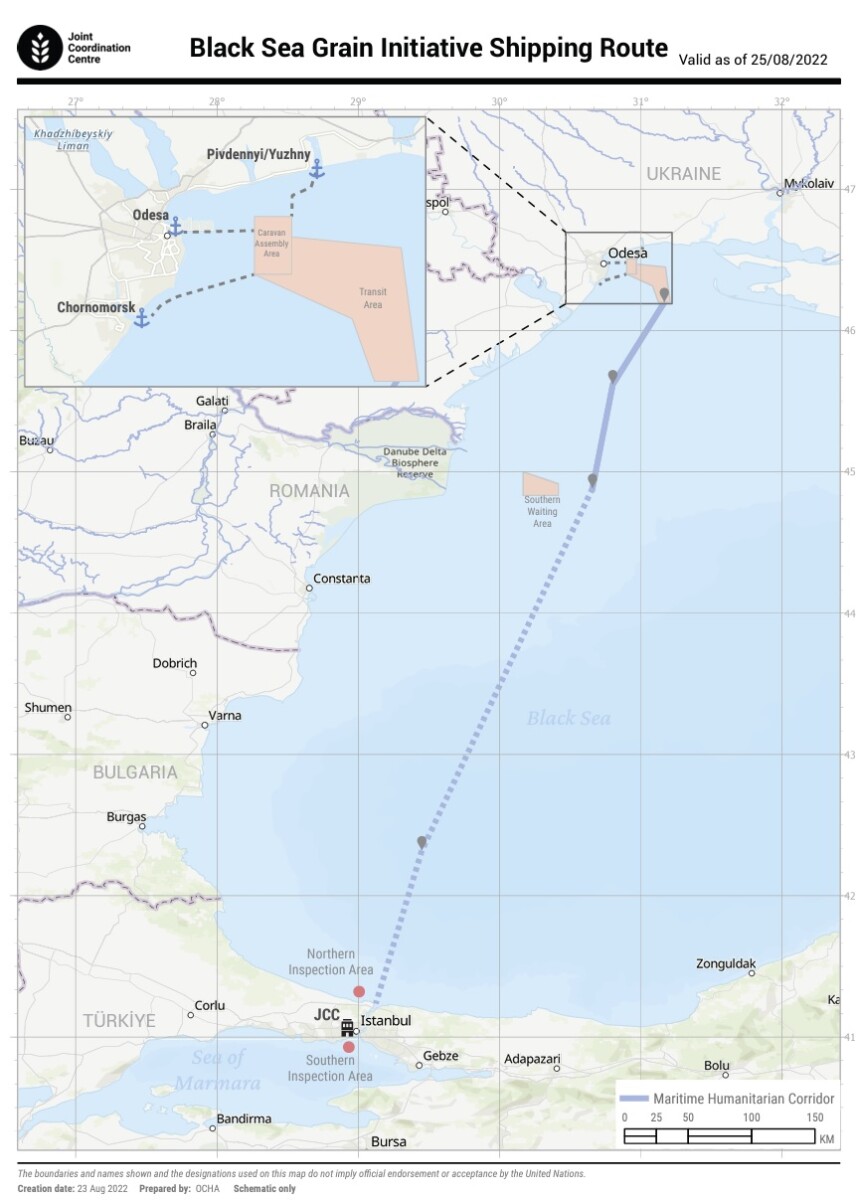
The deal enabled the seaborne shipment of commercial food and fertiliser exports from three Ukrainian Black Sea ports – Odessa, Chornomorsk, and Yuzhny / Pivdennyi. According to the UN, Ukrainian vessels guided merchant ships into international waters of the Black Sea, avoiding mined areas. The vessels then proceeded towards Istanbul along an agreed maritime humanitarian corridor. Ships heading to and from the Ukrainian ports were inspected by teams comprised of Russian, Turkish, Ukrainian and UN inspectors.
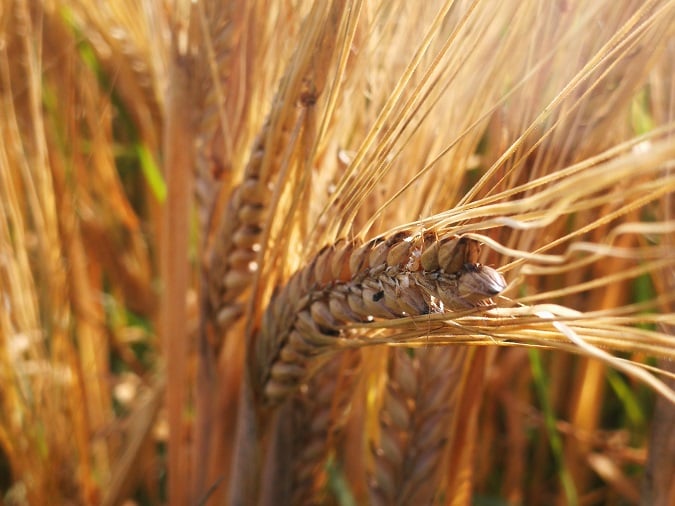
In just under one year, the Black Sea Initiative nearly 1,000 vessels from the global fleet – vessels primarily flagged under open registries – transported just under 33 million tonnes of food-cargo to world markets. About 51% (16.9 million tonnes) was corn; 8.9m (27%) was wheat; and the rest was a mix of food commodities such as sunflower meal, barley, soya beans, peas, rapeseed, other similar foodstuffs, and various different types of vegetable oils (21%).
Food was sent to 45 different countries and most of it (57.35%) was sent to developing countries and about 5.77% (1.9m tonnes), was sent to the least developed countries. Over the course of a year, the Black Sea Initiative enabled the World Food Programme to transport more than 725,000 tonnes of wheat to help people in need in Afghanistan, Ethiopia, Kenya, Somalia, Sudan, and Yemen. UN Secretary General Antonio Guterres noted that the Initiative was responsible for “relieving hunger in some of the hardest hit corners of the world, including Afghanistan, the Horn of Africa and Yemen”. He added that the Initiative had helped reduce global food prices by over 23% since March last year.
Economic impacts
On the day of the Russian termination announcement, the price of wheat futures on the Chicago Mercantile Exchange rose by 3.37%. A couple of days later, and the five-day price of wheat rose by 11.05%. Similarly, the price of corn futures rose by 13.68% over the same five-day period, TASS reported.
The price of wheat futures per tonne on the Chicago Board of Trade jumped from USD$653.75 / tonne on Monday 17 July to USD$727.75 / tonne by close of business on Wednesday 19 July. That’s a difference of US$74 / tonne. It’s also an 11.32% increase.
Egyptian economic experts worried that Russia’s decision to terminate would cut the supply of grain to the world market. “It means that developing countries will not be able to buy cheap wheat and grain,” Rashid Abdou of the Egyptian Economic Research Forum reportedly told the Al-Ahram newspaper. “What is happening now will trigger higher inflation in many countries, especially in Egypt.”
“Egypt has agreements with Russia that envisage that the country will meet its demand in Russian wheat, [but] negative impacts will still be felt because grain prices will go up,” he added.
Russian grain experts noted that the termination of the agreement will likely have a positive impact on the Russian grain market, arguing that, as a result of the Black Sea Agreement, Russian wheat was trading at a discount of $10 to $20. “The Russian grain market will only benefit from the termination of the grain deal,” Arkady Zlochevsky, President of the Russian Grain Union, told TASS.
Since the termination of the deal, Russia has carried out a series of attacks on southern Ukrainian port infrastructure, oil terminals, and grain logistics infrastructure – reportedly destroying 60,000 tonnes of grain in the process.
Limited effect on global dry bulk market
Dry bulk shipping analysts at global shipping brokerage, Simpson Spence Young, noted that, as Russia has been stating for months that they saw no reason to extend the Black Sea deal, then “uncertainty had rippled throughout the supply chain”.
The shipping markets had apparently already priced-in the termination of the deal and there were few outbound bulker voyages in July and no inbound vessels from late June. Approximately 20 plus bulkers ballasting in Turkish waters will now need to source alternative cargoes in the short run.
Dr Roar Adland, Global Head of Research at SSY, noted the Black Sea Grain Initiative trade was highly inefficient and that the vessels formerly sailing that trade “will now be more efficiently employed elsewhere, increasing effective supply… the impact on the fundamental dry bulk market balance is expected to be modest”.
SSY notes that alternative routes to market for Ukrainian grain – through river ports, over Ukraine’s western landside borders, and also via the port of Constanza in Romania – are inefficient and expensive, which will decrease the global competitiveness of Ukrainian grain on world markets. The ability of Ukraine to replace seaborne grain volumes is limited by local infrastructure and a re-bounding global grain market, which has been boosted by record Brazilian grain production.
“More price competitive long-haul suppliers, such as Brazilian corn into the Far East, look able able to pick up the slack, leading to an expected slight increase in tonne mile demand,” Dr Adland observes.
World community expresses regret
Dignitaries from around the globe, from international institutions and governments, expressed their regrets at the termination of the deal, pointing out that it will hurt people – particularly the poorest people – around the world.
Moussa Faki Mahamat, African Union
Moussa Faki Mahamat, the Chair of the African Union, said in a statement: “I regret the suspension of the Black Sea Grain Initiative for which the African Union had been an early advocate. I urge parties to resolve any issues to resume the continued safe passage of grains & fertiliser from Ukraine & Russia to where it is needed, particularly in Africa”.
Anthony J. Blinken, US Department of State
The U.S. Secretary of State, Anthony J. Blinken, who heads up the U.S. Department of State (the arm of the U.S. government that handles foreign policy) said: “the United States deeply regrets Russia’s decision to suspend participation in the Black Sea Grain Initiative. The Russian government’s continued weaponization of food harms millions of vulnerable people around the world… the United States is thankful to the UN and Türkiye for their work to extend the lifesaving Black Sea Grain Initiative and bring both Ukrainian and Russian grain to world markets. We urge the Government of Russia to reverse its decision, to resume negotiations, and to extend, expand, and fully implement the Initiative immediately for the benefit of the millions of people who depend on Ukrainian grain”.
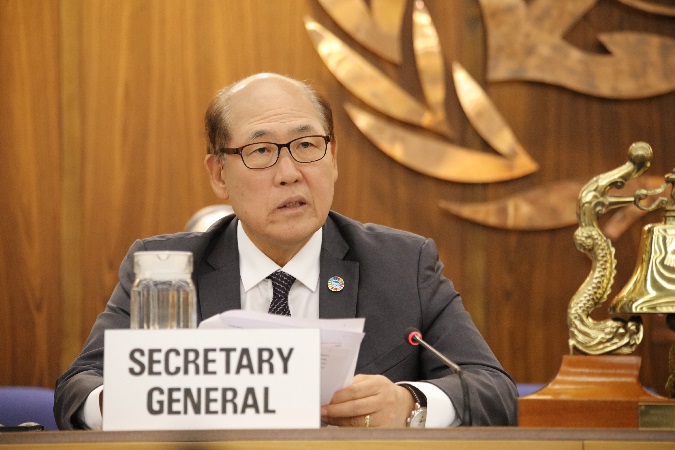
IMO Secretary-General Kitack Lim
IMO Secretary-General Kitack Lim commented: “I deeply regret to learn of the disruption to the Black Sea Initiative. The unimpeded flow of shipping around the globe is of critical importance and central to the work of the IMO. The movement of ships through the Black Sea Initiative and its impact in getting food to those who need it most, as well as stabilizing world food prices, is proof that shipping must always continue to move. IMO remains ready to support the UN’s efforts to find pathways for solutions to preserve the global supply chain and food security.”
UN Secretary-General António Guterres
UN Secretary-General António Guterres added: “I deeply regret the decision by the Russian Federation to terminate the implementation of the Black Sea Initiative – including the withdrawal of Russian security guarantees for navigation in the northwestern part of the Black Sea. The Black Sea Initiative — together with the Memorandum of Understanding on facilitating exports of Russian food products and fertilizers — have been a lifeline for global food security and a beacon of hope in a troubled world.
With the decision to terminate the Black Sea Initiative, the Russian Federation also terminated its commitment to “facilitate the unimpeded export of food, sunflower oil, and fertilizers from Ukrainian controlled Black Sea Ports”… Ultimately, participation in these agreements is a choice. But struggling people everywhere and developing countries don’t have a choice.
“Hundreds of millions of people face hunger and consumers are confronting a global cost-of-living crisis.
“They will pay the price.”