World economic growth will slow from 3% in 2022 to 2.4% in 2023, the UN Conference on Trade and Development, has warned.
Arguing that the world economy is “at a crossroads, where divergent growth paths, widening inequalities, growing market concentration and mounting deb burdens cast shadows on the future”, the body has called for a change in policy direction. Brazil, China, India, Japan, Mexico, Russia and the United States have demonstrated economic resilience while other economies face “formidable challenges,” the UNCTAD says.
Call for policy changes
UNCTAD has called for a reform of central banks’ mandates to move beyond inflation-targeting to balancing the priorities of monetary stability with long-term economy sustainability. The body has also called for greater policy co-ordination through multi-lateral institutions, particularly to mobilize resources for countries in a position to deliver faster growth. UNCTAD also called for a more balanced policy mix of fiscal, monetary, and supply-side measures to achieve financial stability, boost productive investment and to create better jobs.
The body has warned that many economies will grapple with divergent recoveries, deepening inequalities, mounting debt, and that global growth is unlikely to rebound sufficiently to pre-pandemic levels.
“Compounding these issues is the absence of adequate multilateral responses and coordination mechanisms. Without decisive action, the fragility of the global economy and an array of diverse shocks risk evolving into systemic crises. Policymakers must navigate these challenges on multiple fronts to chart a more robust and resilient trajectory for the future.
Chinese recovery from COVID underway; economy undermined by real estate weaknesses
Lifting of anti-COVID restrictions has helped sustain the Chinese economy and has helped a revamp of industrial production, while the country’s reliance on exports has declined. However, persistent weaknesses in the real estate sector pose “challenges, including potential financial stress,” the UN body says. It adds that escalating geopolitical tensions are disrupting how China dominates global value chains. The impact of the policy response, which includes monetary expansion, supply-side incentives and regulatory tightening, is uncertain on both China and neighbouring countries. Shipping Australia note that the East Asia region (which excludes Japan / Korea) accounts for about 40% of Australia’s total box trade; containerised exports (excluding empties) from Australia to East Asia account for about 31% of the Australian export box trade while containerised imports from East Asia account for about 45% of the Australian containerised import trade.
United States: both resilience and a heightened downside risk
Resilience has been on display in the United States through two years of rising inflation and a year of blanket disinflation policies comprising of 11 interest rate hikes in 18 months alongside “sporadic” financial market disruption. Parts of the economy have sustained consumption and spending as they have been buoyed by employment and nominal wage growth. Unemployed is at a historic low while the employment rate stood at 58 per cent of the population, the UNCTAD reports. Shipping Australia notes other sources put the US employment at 60% plus. Weakness in the manufacturing sector has “heightened the risk of a sharper slowdown”. The UNCTAD adds that a “soft landing” is possible for the United States. Shipping Australia notes that that about 7% of our box trade is with North America (i.e. Canada and the United States); containerised exports from Australia (excluding empties) account for about 6% of the total box export trade and imports to Australia from North America account for about 7% of the total import box trade.
Deteriorating European economic health
UNCTAD has pointed to the “deteriorating economic health” of the European economy, UNCTAD notes that growth in Europe has decreased approximately 70% (seventy per cent) compared to the pre-COVID average of 2015-2019. As Europe has an approximately 18% share of the global economy (by purchasing power parity) “the global consequences of the slowdown in Europe are at least twice as heavy as those of the slowdown in China”, UNCTAD says. Shipping Australia notes that about 12% of Australia’s total box trade is with the European geographic region (which includes the UK); box exports (excluding empties) from Australia account for about 4% of the containerised export trade and imports to Australia account for about 16% of the total import box trade.
Global goods trade slows significantly
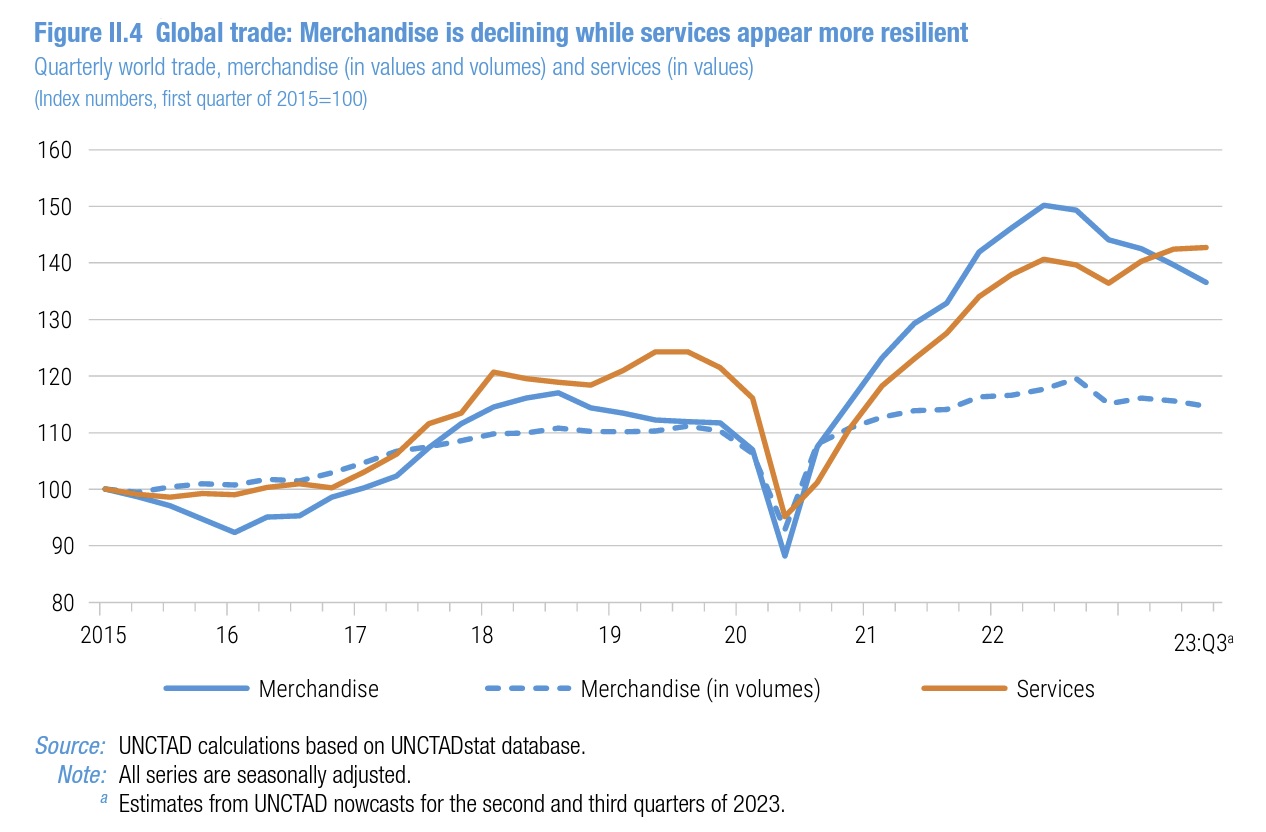
International trade in goods and services is forecast to grow about one per cent this year, which is “significantly below” world economic output growth. If that’s not bad enough, that’s a growth rate that is lower than the average growth registered during the last decade, “itself the slowest average growth period for global trade since the end of the Second World War”. For the shipping industry, this appears to be particularly bad news as the trade numbers appear to have been dragged down by “merchandise trade” i.e. the trade in physical, tangible, goods that are imported / exported from countries, which has “hovered around negative territory in 2023”.
Merchandise trade peaked
The UNCTAD noted that merchandise trade peaked sometime during the second or third quarters of 2022 (this varies depending upon exactly what measures are considered) and declines have set in. “This was unexpected to most observers, who had anticipated a significant rebound owing to a normalization of the inventory cycle and the relaxing of the pandemic restrictions in China. Preliminary estimates for the second and third quarters of 2023 confirm the downward trend… expectations about international merchandise trade prospects have deteriorated,” the UNCTAD warns, adding that multiple downside risks remain, which could further impact the trade outlook (adversely, one presumes), and these include ongoing trade tensions, the weakening of global demand and growing geopolitical uncertainties.
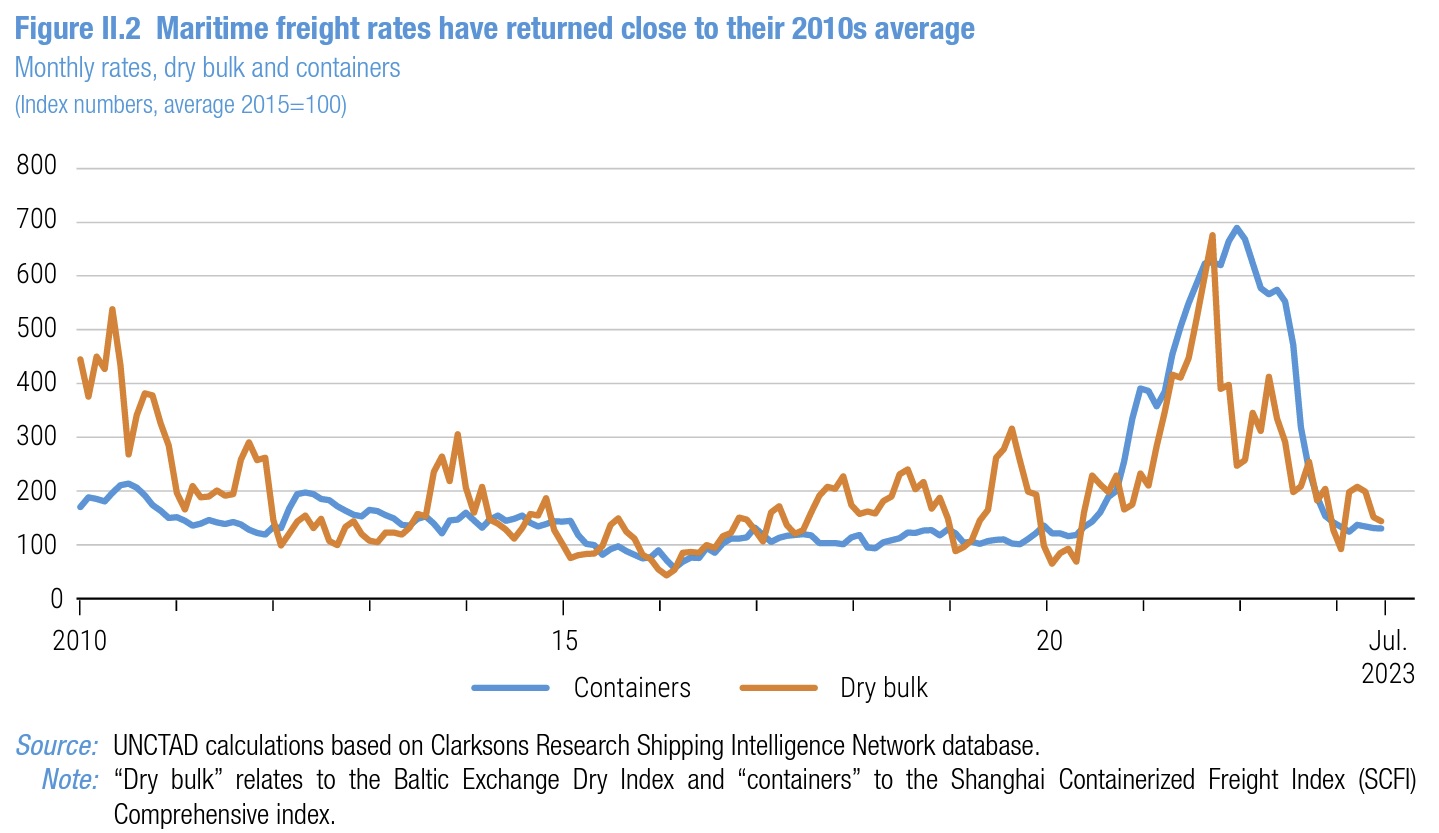
UNCTAD also noted some forms of return to normalcy. These include an end to the major supply-chain disruptions between 2020 and 2022, the normalisation of trade composition after the COVID-induced boom in demand for manufactured goods, and a general stabilisation of transport logistics for goods in developed countries. The UNCTAD also noted the “sharp drop” of international maritime freight rates for containers and dry bulk during the latter half of 2022.