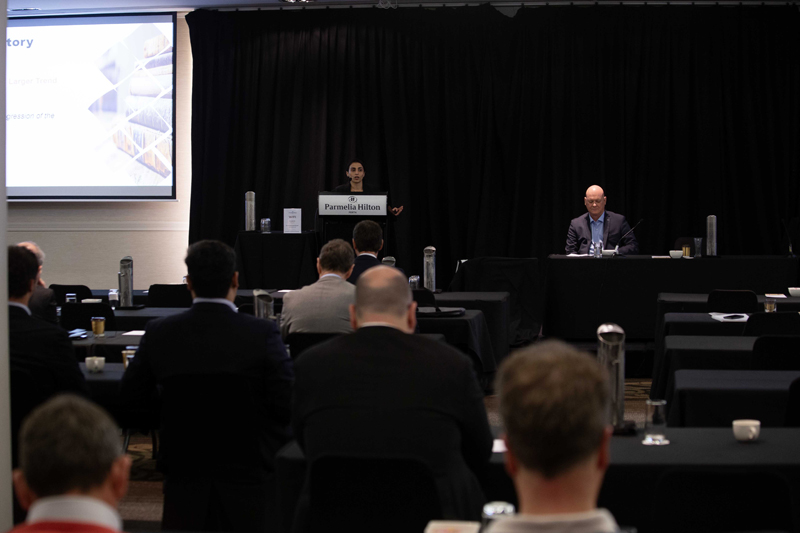
Shipping Australia’s own Mehrangiz Shahbakhsh explained how autonomous shipping is developing and gave insights into its human elements at a prestigious law conference recently.
Speaking at the 48th National Conference of the Maritime Law Association of Australia and New Zealand (MLAANZ), which was held between October 4-6 in Perth this year, Ms Shahbakhsh explained that autonomous shipping is a natural progression of the shipping industry from its current state. She added that the concept of autonomous shipping manifests the adaption of industry 4.0 technologies both onboard ships and ashore.
She then turned to the transition period and focused on the human elements of autonomous shipping, which is the subject of her current research interests.
Addressing the key questions of what autonomous shipping means for the future of seafarers and whether seafarers are a dying breed in the maritime industry, Ms Shahbakhsh emphasised that the the roles of seafarers in autonomous shipping are evolving rather than vanishing.
She informed delegates that humans are essential for designing, testing, and predicting autonomous ship performance. And members of the species Homo Sapiens will find that their roles will shift from being onboard to working behind the scenes. She advised that there will be a growing need for highly educated and skilled professionals to operate highly automated ships in workplaces that have become more technical and complex and which feature embedded innovative technologies.
Over time, seafarers will need to understand different intelligent systems, be able to combine data from different sources, and to troubleshoot system issues. They will also need to learn how to trust in advanced technical data to make informed plans; they will also need to adopt a lifelong learning attitude in response to evolving technological advancements.
She also discussed the concept of the “double D” of autonomous shipping encompassing digitalization and decarbonization, noting that not only ship navigation systems, but also ship engine rooms and propulsion systems, must undergo transformation.
Other speakers at the conference discussed a variety of other at the conference including maritime security laws; the future of the bill of lading in the era of blockchain; cyber security; biofouling management platforms; windfarm technology components and regulation; environmental issues; and more.