Ballast water management systems generally perform well, a major international study has found, with kill rates in the order of 93% to 95%. While 11% of systems may fail at installation, the sources of failures can be corrected, the study found, as the failures were largely due to contamination from uncleaned tanks or non-treated ballast water present on board. Additionally, sampling in a steady, uniform, manner (“isokinetic sampling”) to obtain a representative sample was found to be the cornerstone of compliance monitoring of the Ballast Water Management Convention.
Analysis of data from over 2,0000 ballast water management systems was provided to the International Maritime Organization at the Marine Environment Protection Committee (No. 82), by Global TestNet, a not-for-profit industry association, with about 17 members (institutions and companies) all highly expert in ballast water management systems. Several Global TestNet members shared data from 2,052 tests carried out over what appears to be a near four year period (from 2019 to 2023 with some break in between).
Global TestNet members’ observations are consistent across regions and testing approaches and “therefore should be considered representative of such activities, globally”.
Key findings
No specific treatment approach was found to perform better than others at installation; the performance of the management system reflects the performance of the individual system, as well as ship-specific design, planning, and installation. About 48% of systems used non-active substances e.g. ultra violet light, pasteurization and so on. The other 52% used active substances such as chemicals, ozone, electrochlorination etc.
It was found that there was a greater than 93% reduction of living organisms – it was about 93.3% for organisms equal to or greater than 50 micrometre, and 94.4% for organisms in the 10 to 50 micrometre organism size. “These results prove that, when BWMS [ballast water management systems] are properly installed, they consistently achieve a high efficiency in removing organisms,” Global TestNet said, adding, however, that this efficacy may not be sufficient to meet the D-2 discharge standard. That standard is found in the Annex – Section D Standards of the
International Convention for the Control and Management of Ships’ Ballast Water and Sediments. The standard demands that less than 10 viable organisms per cubic metre of water can be discharged in each of the size groups. (i.e. 10 to 50 micrometres, and more than 50 micrometres).
The global dataset found that most failures occurred with organisms in the 50 micrometre or more size class, “therefore, this size class must be evaluated in compliance monitoring and enforcement as well as the future, regular testing regime agreed to at MEPC 81 (MEPC 81/WP.9)”.
Of particular note was that some testing found evident of more organisms in the discharged water than in the inlet water and this result suggest that “ballast water tanks were contaminated, valves were improperly closed, or both”. The submission to the IMO later picks up that theme, suggesting that the most common source of non-compliance was the contamination of treated water from dirty ballast water tanks and mixing of waters with unmanaged ballast water on board. this some times happens wen an uncleaned tank was used for the test. The second most frequent reason for non-compliance, was contamination of treated water with untreated water, and this typically occurs when valves were left open, or piping carrying untreated water was not properly flushed. The third most common cause of failure was human error. “A working BWMS will fail if the crew do no have sufficient training and thus cannot operated the BWMS properly. Some examples include not adhering to proper hold times after treatment, or not maintaining the systems to vendor specifications (e.g. cleaning lamp sleeves, not calibrating the sensors, etc).
It was agreed by Global TestNet members that routine compliance checks are required to evaluate the ongoing efficacy of ballast water management systems installed on ships.
“Without routine compliance testing of the treated discharge, it is impossible to know if a system is working properly. A false assumption can lead to the proliferation of harmful aquatic organisms and pathogens,” the submission to IMO reads.
About Global TestNet
Global TestNet is a not-for-profit industry association of ballast water management expert companies to develop standardization and comparability in ballast water management system testing. The first ever meeting of what was to later become Global TestNet, which is now an incorporated legal entity, was in 2010 under the umbrella of the Global Industry Alliance of the GEF-UNDP-IMO GloBallast Partnerships Programme.
“Global TestNet members promote comparable and accurate test results on the performance evaluation of technologies and methodologies to control the risk of bio-invasions and harmful species introductions by shipping, through an open exchange of information, transparency in methodologies and advancing the science of testing,” Global TestNet’s submission to the IMO reads.
The organisation had 14 members at its last bi-annual meeting in 2022, and has since attracted another three members. Its membership includes bodies such as the Ballast Water Detecting Laboratory of Shanghai Ocean University, the Korea Institute of Ocean Science and Technology, Marine Biological Research Institute of Japan, and the Norwegian Institute for Water Researcyh (Norsk Institutt for Vannforskning), among others.
Further reading:
The Ballast Water Convention (which is more formally known as “The International Convention for the Control and Management of Ships’ Ballast Water and Sediments, 2004“)
“Explainer: ballast water – the solution, the threat, the solution,” J Wilson, Shipping Australia, 21 April, 2023
Global economic costs of aquatic invasive alien species, Cuthbert et al, 2021, Science of The Total Environment, Volume 775, 25 June 2021, 145238 https://www.sciencedirect.com/science/article/pii/S0048969721003041
Featured image:
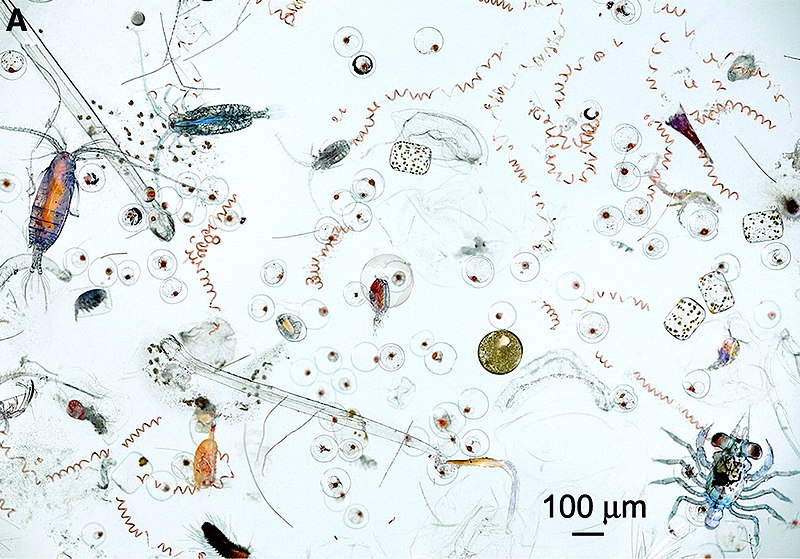
Pictured: (from Wikipedia): “Marine microplankton, part of the contents of one dip of a hand net, photographed on board the NOAA Ship Oscar Elton Sette (R 335) off Kona, September 20, 2006. The image contains diverse planktonic organisms, ranging from photosynthetic cyanobacteria and diatoms to many different types of zooplankton, including both holoplankton (permanent residents of the plankton) and meroplankton (temporary residents of the plankton, e.g., fish eggs, crab larvae, worm larvae)”.
See: “Microbial Morphology and Motility as Biosignatures for Outer Planet Missions,” for the original academic article and picture – viist: https://www.liebertpub.com/doi/10.1089/ast.2015.1376
See also: https://en.wikipedia.org/wiki/File:Marine_microplankton.jpg Jay Nadeau, Chris Lindensmith, Jody W. Deming, Vicente I. Fernandez, and Roman Stocker. Image courtesy of David Liittschwager. This file is licensed under the Creative Commons Attribution-Share Alike 4.0 International license.