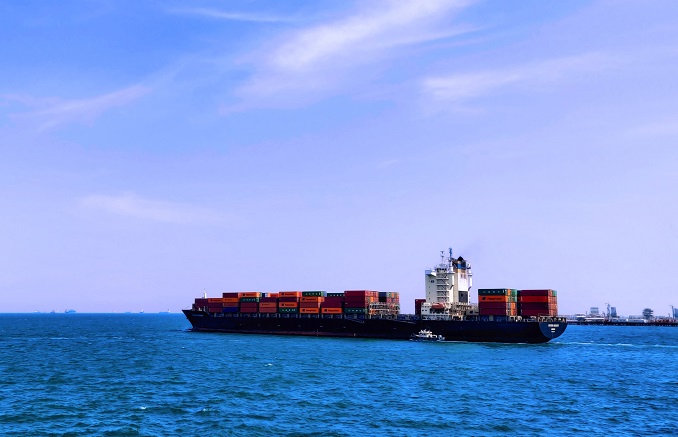

Container freight rates across the board are on the slide, or rather the plummet, with the news from Drewry Supply Chain Advisors that the Drewry World Container Index has fallen 10% to US$2,795 per forty footer.
Raters were at a recent high of $6k per forty back in July 2024 and that was followed by a long slump to $3k per 4o footer in late October. Since then there was a rally to $4k a box by late December. However, as the rates have slid slid slid away, that increase from late October to December now looks like it was a dead cat bounce.
Whipping out the magnifying glass and we can see that what was writ large was also writ small too. Rates are down route by route. Rates on the trans-Pacific East (Shanghai to New York) are down 13%; rates from Shanghai to Los Angeles fell 11% too. It’s a similar story on the Asia-Europe rates from Shanghai to Rotterdam falling 9% to USD$2,618 per forty. Rates on the trans-Atlantic were underwater too with rates on the Rotterdam-New York down by about $70 bucks, roughly 3%, to stand at US$2,394 per forty.
Drewry is forecasting a further fall next week as capacity increases.
Leading market commentator, Peter Sand, chief analyst at freight benchmarking platform Xeneta, notes that container carriers are seeking to capture greater volumes under contract as spot rates slide. Big discounts are being offered to entice shippers … provided they sign up to a contract greater than six months.
“This is a fascinating negotiating dynamic between the seller and buyer,” writes Xeneta analyst Emily Stausbøll. “On the one hand, you have the seller trying to incentivize longer-term agreements to manage risk and protect market share. On the other, you have the buyer doing everything possible to keep their options open for as long as possible while not spending more than necessary,” she adds.
Near future is highly uncertain owing to geopolitics
Looking into the near-ish to medium term and geopolitics rears its ugly head once again.
Leading container expert Lars Jensen notes that US President Donald Trump is reversing the US position on Ukraine and is beginning direct talks with Russia. The Atlantic Council, a US-based think tank specialising in US-European affairs, argues that “Europeans have awoken to the fact that the United States, now wants them [Europeans] to take the lead”. EU countries are already preparing a massive military aid package for Ukraine. Although many commentators are indicating that the European response to the new stance of the US is somewhat haphazard and flailing, there are some who are speculating that there will likely be a change in European military policy resulting in increased European military spending.
So, what’s this got to do with container shipping? Well, quite a lot.
Military spending don’t come for free, no siree. Bombs bullets and battleships have to be paid for in cold hard spondulicks, whether that’s of the dollar, pound, Euro or some other denomination. Europe basically has two ways to get its hands on the lucre – Euro-governments either borrow the cash or they raise taxes (or tariffs, or both).
As Lars Jensen points out, if increased military spending is paid for via heavier taxation then it will reduce the spending power of Euro-consumers and, as well all know, international goods trade is fundamentally driven by disposable income (or the lack thereof). If Euro-consumers are taxed more then there will likely be a negative impact on container volumes.
“If it is instead done through increased financial borrowing, it will contribute a positive impact on the magnitude of economic activity which, all else [being] equal, will result in an increase in container shipping volumes”, Mr Jensen writes.
Red Sea reduction forecast
Meanwhile, international sea freight analysts Sea-Intelligence is forecasting a sudden and sharp demand drop on the Asia-Europe routes.
Sea-Intelligence CEO, Alan Murphy, points out that when the Red Sea Crisis (which started roughly one-and-a-third years ago!) began, that the Asia-Europe supply chain became 7-14 days longer (depending upon port-pair configurations).
“When supply chains become longer, it effectively also means that most shippers increase their inventories by that amount, as the cargo on the vessels is de facto an inventory,” Mr Murphy writes.
Asia-Europe demand grew by 8.5% in 2024 on the back of the Red Sea Crisis (thereby pumping up the freight rates to the levels described earlier in this piece), which translates for various reasons into a demand growth boost of two to four percentage points purely due to increased transit times. However, it looks like the Red Sea Crisis might now be easing and, presumably, large container ships will revert to Red Sea sailings.
“When vessels revert to the Suez routing, supply chain will contract by the same amount as it expanded in 2024. The excess inventory held in the longer supply chain will be released, and for a temporary period, importers will curb ordering to mitigate this sudden excess inventory,” Mr Murphy writes.
So Sea-Intelligence reckons that, following the resumption of the Red Sea, the global shipping industry should expect a near three percentage points fall on Asia-Europe demand growth.
“However, the contraction of the supply chain is likely to play out over a much shorter timeframe than a full year, potentially increasing its severity”, Mr Murphy explains.
Eeeek! That does not sound fun, and it probably won’t be.
Sea-Intelligence has modelled a range of transition scenarios ranging from the unreasonably fast (two weeks) out to 12 weeks. Even at the 12-week transition period, Sea-Intelligence reckons there could be a reduction in Asia-Europe year on year growth by more than 10 percentage points.