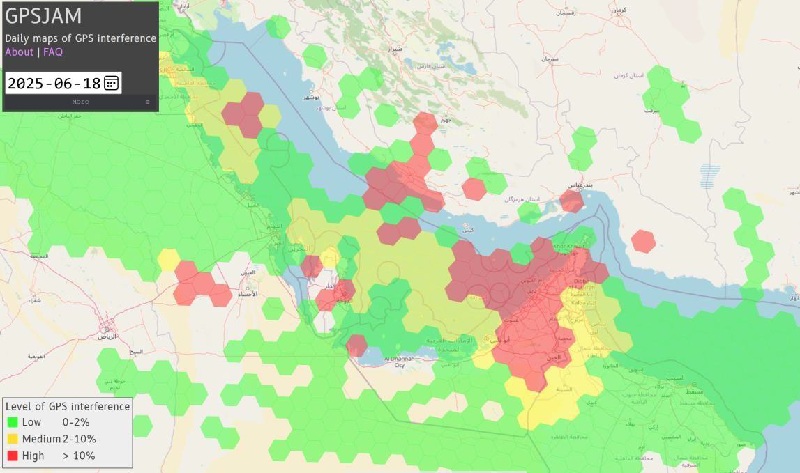
Extensive electronic interference with ships is being carried out in the southern and Middle Persian Gulf, the Strait of Hormuz, and the Sea of Oman, Western naval authorities in the region have reported. Similar reports have been carried in the trade media.
The UK Maritime Trade Operation, a programme of the UK Royal Navy that is active in the region has stated that it has received multiple reports of increasing electronic interference across the region, and that this interference is having a “significant impact on vessels positional reporting”.
The Joint Maritime Information Centre, which is the information arm of the Combined Maritime Forces – a 49 nation partnership based in Bahrain in the Persian Gulf – has commented that the disruption is posing operational and navigational challenges for maritime traffic. It adds that, in addition to AIS spoofing, there is “extreme jamming” in the area. Ships are recommended to closely watch gyro compasses as this are being impacted due to GPS latitude correction feed.
JMIC notes that the electronic interference stemming from the Iranian port of Bandar Abbas has seen a noticeable reduction, however, there is “excessive” electronic interference over the Central Arabian Gulf (this is an incorrect name that is commonly used instead of the correct name “Persian Gulf”).
The JMIC is recommending that all electronic aids and communication networks be closely monitored and that if electronic means of navigation are disrupted then ships ought to be ready with alternative options for navigation including radar and visual fixes.
Vessels are also recommended to make reports to the UK MTO using established reporting schemes.
The JMIC is noting that some vessels are now preferring to sail during daylight hours. There were 130 transits through Hormuz on 18 June and the month averaged 114 vessels a day, which the JMIC describes as showing consistency in Hormuz traffic. Mariners are also warned that travelling by the Abu Musa Island and the UAE mainland and waters north of Dubai is becoming congestion and, therefore, navigational care is required.