Japanese shipping major, “K” Line, has announced its first ever use of Bio-LNG, a potentially game-changing fuel for ocean shipping.
Bio-LNG was supplied by Shell Western LNG to “K” Line’s car carrier, Oceanus Highway (IMO 1046049) a Japanese-flagged, 2025-built, ship with a length and beam of 199 metres and 38 metres respectively. The ship took 500 tonnes of bio-LNG from Shell at Zeebrugge, Belgium, on 16 June 2025.
Hiroto Arai, the General Manager of the “K” LINE Environmental/Technical Strategy Group said, “our goal is to achieve net-zero GHG emissions by 2050, and reducing greenhouse gas emissions in maritime transport is one of our top priorities. Our beginning to use bio-LNG fuel is a significant step towards our net-zero GHG emissions goal”.
The fuel has been ISCC-EU certified to have a fuel of less than zero on a lifecycle basis, a company statement reads.
It’s worth noting that “K” operates a very large fleet – about 448 ships with a total deadweight of about 36.36 million tonnes.
About LNG
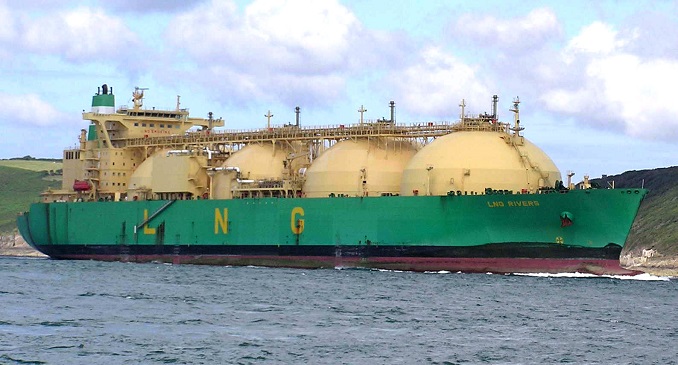
LNG is an acronym for “Liquefied Natural Gas”. Natural gas is basically methane, about 85 to 95% according to engine manufacturer Wartsila, and a variety of other gases like ethane, propane and so on, along with water, carbon dioxide, and other chemicals. The non-methane compounds are purged (and may be collected and sold), then the resulting methane is supercooled in stages to about -162 degrees Celsius. Cooling of methane induces a phase-change from gas to liquid which causes a 600-fold reduction in volume. “The same amount of natural gas that would fill a beach ball can fit in a golf ball when liquefied,” Cameron LNG, a U.S. energy producer, explains.
That reduction in volume renders the storage and marine transport of LNG economically and practically viable. After transport, the cooling process and phase-change is reversed and the gas can be made to flow in the local pipeline network.
Methane (CH4) is a compound gas with one carbon atom connected to four hydrogen atoms. Combustion of methane breaks the carbon / hydrogen bonds and bonds are reformed between the carbon and atmospheric oxygen to create carbon dioxide (CO2) and water (H20); the creation of new bonds releases energy in the form of heat and light. Methane contains a lot of energy; it has an energy content of about 55.6 mega-Joules per kilogram and about 35.8 mega-Joules per cubic metre.
Unfortunately, the burning of conventional (i.e. fossil fuel sourced) LNG puts carbon (in the form of carbon dioxide) back into the atmosphere millions of years after it had been drawn down by plants and later locked away in the Earth’s crust, thereby contributing to the global climate crisis.
However, that’s not the case for bio-LNG.
About bio-LNG
From any engine’s or power generator’s perspective, the origin or type of a methane molecule is irrelevant as each molecule is effectively identical to every other molecule and it all burns the same way, creating the same products, according to the laws of physics. This property is one of the reasons that bio-LNG is potentially a major net zero fuel. Any biologically sourced methane introduced into gas network, a ship’s engine, or a power generator, will behave in exactly the same way as a fossil fuel sourced methane molecule. That does away with any need for a lot of expensive up-front capital works, new infrastructure such as pipes, or new ship engines.
Bio-LNG is different from conventional LNG in that it’s not extracted from the Earth, it’s manufactured. If this is done with green power, such as that sourced from wind, wave, solar, or any of the other renewable energy forms, and if the ingredients are also renewably sourced, then the fuel is green.
As mentioned above, Methane is a compound gas containing carbon. That carbon is drawn out of the atmosphere by a plant which uses the carbon to build its body. The plant body is either directly harvested (e.g. forestry residue), or is turned into food that is wasted or fed to animals and manure is generated.
Such materials are fed to bacteria, often in an oxygen-free digester facility, which break the materials down releasing gases such as methane and carbon dioxide. These gases can be harvested and put to industrial uses.
This bio-methane can be collected, supercooled, and transformed into LNG, which can then be used, among other things to fuel ships.
Combustion of bio-methane does not add to the atmospheric carbon burden as it is merely returning the carbon dioxide back to the atmosphere from whence it originally came.
But, it potentially gets better.
As bio-methane producer, Nordsol, reports in the context of land vehicles, “Well-to-wheel, the GHG emissions balance of bio-LNG can be even negative. This is a result of the separation of biogas into methane and carbon dioxide. Nordsol captures the carbon dioxide for reuse, so it is not released into the atmosphere”.
Bio-methane and shipping
As “K” Line notes, bio-LNG is a drop-in fuel that is fully compatible with existing LNG infrastructure, “making it an effective means of decarbonization for the shipping industry”.
LNG produces low levels of pollution, such as sulphur oxides (implicated in acid rain formation, among other adverse effects), particulate matter, nitrogen oxides (damaging to plant, animal and human health), in addition to having generally lower levels of carbon compared to conventional marine fuels. Bio-LNG dramatically reduces pollution and enables ships to use LNG as fuel that complies with International Maritime Organization rules.
And, as engine maker Wartsila points out, opting for dual-fuel bio-LNG engines gives maximum flexibility as ships would be able to swap between conventional and bio-LNG fuels as necessary without an expensive retro-fit, and it’s a future-proof option. “If your vessel uses bio-LNG as fuel, it will be relatively straightforward to convert your engines to run on carbon-free fuels like green ammonia or green hydrogen once these are available at scale,” Wartsila says.
Current and future world shipping fleet
According to class society DNV, about 99.08% of the world’s shipping fleet in operation is currently operating on conventional fuels. Of the 0.92% that are operating on alternative fuels, 0.70% are operating on Liquefied Natural Gas. But it’s a fairly different situation when we look at the ships on order. About 83.90% ships on order will be conventionally-fuelled and 16.10% will be alternatively-fuelled. Of that alternative cohort, about 3.5% will be LNG-powered.
There are about 752 LNG-powered vessels (all kinds) in service today, of which 191 are box ships, 95 are car carriers, and 78 are crude oil carriers. Looking forward, there are 1369 LNG-powered vessels on order, of which 533 are box ships, 210 are car carriers and 124 are crude oil carriers.