A new, state-of-the-art, type of tug has been deployed to Newcastle.
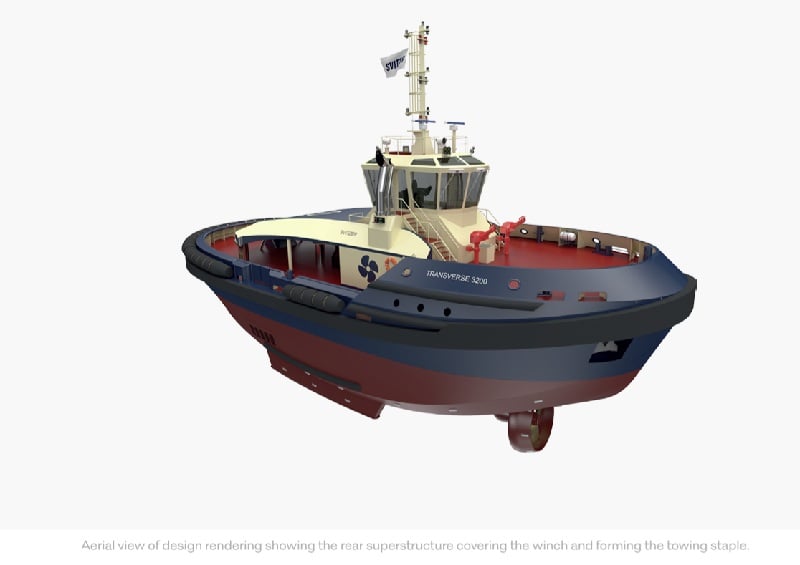
Towage provider Svitzer Australia has announced that one of its new TRAnsverse Tugs, the Svitzer Barrington, has been deployed to the port.
The 32-metre TRAnsverse tug represents a generational advancement in towage standards, innovation and performance Svitzer Australia’s Chief Operating Officer David Phillips said.
“This tug class is purpose-built for versatility and power, maintaining high steering and braking forces through a range of movements without losing the dynamism or responsiveness required by marine pilots,” Mr Phillips said.
“The arrival of Svitzer Barrington, soon to be joined by her sister tug, Svitzer Nobbys, represents our ongoing investment into Australian ports, helping them operate to the highest levels of safety, efficiency and in a way that helps our maritime sector grow in a more sustainable world.”
The TRAnsverse tug’s has unique design features, including a patented half-circle towing staple – able to support advanced towing manoeuvres – with a double-ended hull and propulsion layout that maximises the benefits of the staple design. In dynamic modes the TRAnsverse tug expands the operating envelope by around 50% compared to similar or larger ASD tugs. The TRAnsverse tug performs a wider range of jobs, faster, more efficiently and to a generally higher level of safety. The tug has also been shown to provide a fuel efficiency gain of 15%.
Svitzer Barrington has been deployed to the Port of Newcastle as it is one of the busiest ports in Australia and services a range of large vessel types in complex tidal and weather conditions. The Newcastle operations will serve as a proving ground for the TRAnsverse tug technology, validating its performance for broader global deployment across various towage applications.
“Towage provides a critical service within the Port of Newcastle, ensuring the safety and reliability of shipping and port operations. The new TRAnsverse tug class represents a significant uplift in capability, further enhancing the Port of Newcastle’s resilience and growth into the future. We look forward to seeing Svitzer Barrington’s performance on the water and the additional flexibility she provides to our operations,” Port of Newcastle CEO, Craig Carmody, said.
Svitzer has released a whitepaper on the new class of tug, which highlights the following benefits:
- Direct and indirect force: More direct and indirect force across the range of vessel speeds for arrival and departure, resulting in less time and fuel needed to achieve the required rate of turn (ROT) for the assisted vessel. The TRAnsverse tug can generate approx. 50% higher forces than an ASD of comparable size and engine power in dynamic modes (more than 2-3 knots).
- Push and sidestep: The ability to push and sidestep under the flare results in less time and fuel needed to achieve the required ROT for the assisted vessel. Furthermore, the TRAnsverse tug can side-push effectively in the full speed range up to 10 knots, allowing instant response to pilot commands as the tug can follow the assisted vessel in position ready to push.
- Manoeuvrability: Greater tug manoeuvrability means less power is required to position the tug as needed during operations.
- Hydrodynamic force: Better usage of hydrodynamic force during pulling means free force during braking. The TRAnsverse design can generate usable hydrodynamic force from lower speeds than predominant tug designs.
- Transition capability: Improved transition capability e.g. during direct pulling, changing from a 6 to a 3 o’clock position, will require less power, time and fuel than other tug designs.