
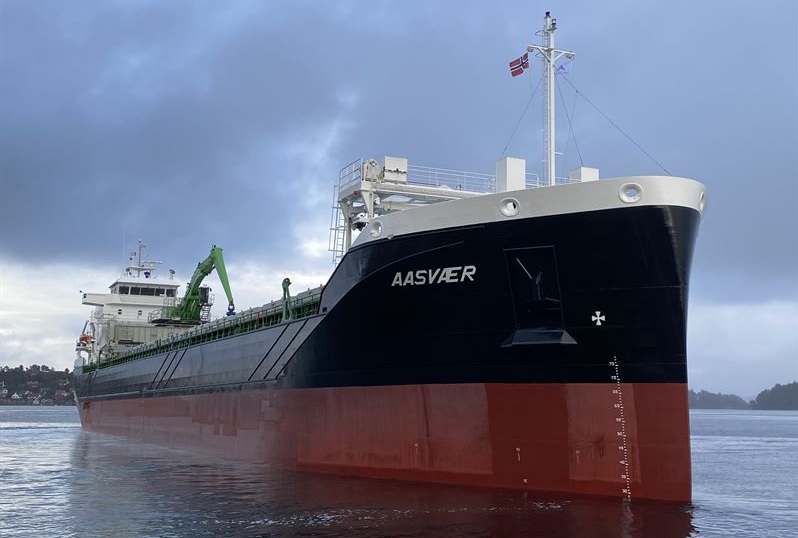
Technology group Wärtsilä will supply an integrated hybrid propulsion system for a bulk carrier vessel for Norwegian shipowner Aasen Shipping. It will be the latest in a series of six such vessels to operate with a similar system, the technology group reports.
The hybrid system combines a battery and a conventional engine. “Its foremost benefit is that it allows the engine to run on optimal load because the battery will absorb many of the load fluctuations and acts as spinning reserve. This saves fuel and reduces GHG emissions,” Wärtsilä says.
Torbjørn Torkelsen, CEO, Aasen Shipping, commented: “the support from Wärtsilä and the performance efficiency of their equipment with the earlier ships in this series have strongly contributed to our dedication to operating efficient and cleaner cargo transport. In addition, Wärtsilä’s 25 main engine is designed to be future-proof, meaning we can switch to sustainable fuels as they become available, further supporting our ambitions for long-term environmental sustainability”.
The 9,500 deadweight bulker will operate with one six-cylinder Wärtsilä 25 main engine fitted with a NOx Reducer, a gearbox and controllable pitch propeller with shaft line, and a Wärtsilä ProTouch remote propulsion control system. The hybrid system includes a DC hub and 620kWh battery capacity, as well as the control system, battery, power, and energy management systems.
The Wärtsilä 25 engine is a medium-speed 4-stroke marine engine designed to be upgradeable low or zero carbon fuels. It is available in 6L to 9L configurations with a power output of 1.7–3.4 MW and can be used as a main or auxiliary engine.
“The need to decarbonise shipping is driving the industry towards increasingly flexible, electrified and hybridised solutions, with sustainable fuel readiness also being built into newbuild solutions today,” comments Roger Holm, President of Wärtsilä Marine & Executive Vice President at Wärtsilä Corporation. “Our hybrid propulsion systems are designed to allow vessels to run efficiently across various operating modes, adapting seamlessly to changing conditions. This flexibility contributes to improved fuel efficiency and enhances overall performance.”