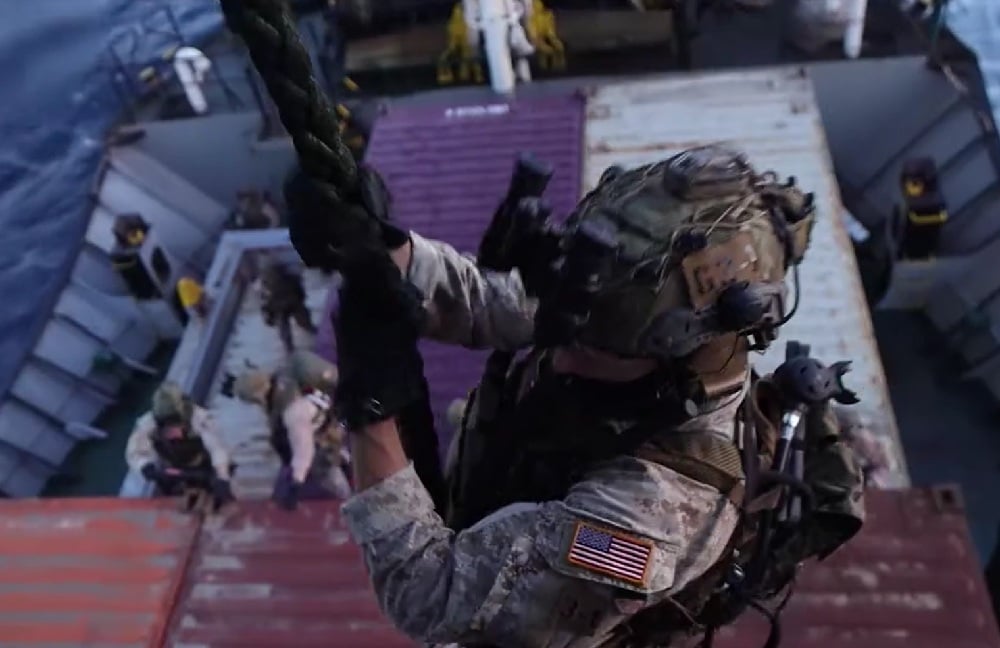
U.S. naval forces have attacked and disabled three ships within the last week that were allegedly attempting to run the U.S. blockade on Iran.
Marivex
On or about 08 June, U.S. Central Command (“Centcom”) disabled the Palau-flagged Marivex (IMO 9464156) as it transited international waters in the Gulf of Oman toward Iran. An F/A-18 Super Hornet (a multi-role fighter aircraft) from the U.S.S. Abraham Lincoln (a nuclear-powered aircraft carrier) fired a missile into the ship’s engineering and steering spaces after the crew did not comply with directions from U.S. forces. The 2009-built Marivex has the following approximate dimensions: length overall of 135m, a beam of 22m, a deadweight of 12,800 tonnes, and a summer draft of 8 metres.
Settebello – three seafarers are missing
On 09 June, the Palau-flagged Settebello (IMO 9162916), an oil tanker in the Gulf of Oman was attacked by a U.S. aircraft that fired a missile into the ship’s engine room after the crew repeatedly did not comply with directions from U.S. forces. Three seafarers were reported to be missing following the attack. The 1997-built Settebello has the following approximate dimensions: length overall of 182 m, beam of 32m, deadweight of 47,200 tonnes, and a summer draft of 12.6 m.
The International Maritime Organization condemned the attack on the Settebello.
Secretary-General Arsenio Dominguez said: “I strongly condemn any act from any party that endangers the lives of seafarers and the safety of international shipping. This is simply unacceptable. My thoughts are with the families of the three missing seafarers and with all those awaiting news of the crew members.”
The Secretary-General recalled the conclusions of the IMO Council at its extraordinary session of 19 March 2026, which underscored the need to protect seafarers, civilian shipping and the freedom of navigation at all times.
“All actions affecting international shipping must fully respect international law and the safety of life at sea. The protection of seafarers is a shared responsibility that must remain paramount,” he said.
As of 10 June, the IMO had verified 43 attacks on international shipping in and around the Strait of Hormuz since 28 February 2026, with 11 confirmed seafarer fatalities.
Jalveer
On 11 June 2026, U.S. Centcom directed an attack against the Guinea-Bissau flagged Jalveer, an asphalt / bitumen carrier, as it attempted to transport oil from Iran through the Gulf of Oman. A U.S. aircraft fired two Hellfire missiles into the ship’s engine room after the crew repeatedly failed to comply with directions from U.S. forces. The 2008-built Jalveer has the following approximate dimensions: length overall 119m, beam 16 m, deadweight of 6,400 tonnes, and a summer draft of 6.3 m.
As of 12 June 2026, Centcom forces have disabled nine ships, re-directed 135 ships that complied, and has allowed 42 vessels supporting humanitarian aid to pass since the U.S. blockade began on April 13 this year.
Centcom reports that the blockade is being enforced against vessels of all nations entering or departing Iranian ports and coastal areas, including all Iranian ports on the Persian Gulf and the Gulf of Oman.
It is recommended that all vessels interact with U.S. forces if their ships are hailed by U.S. forces as failure to do so could trigger an attack, such as a missile being fired into the engine room of a ship.