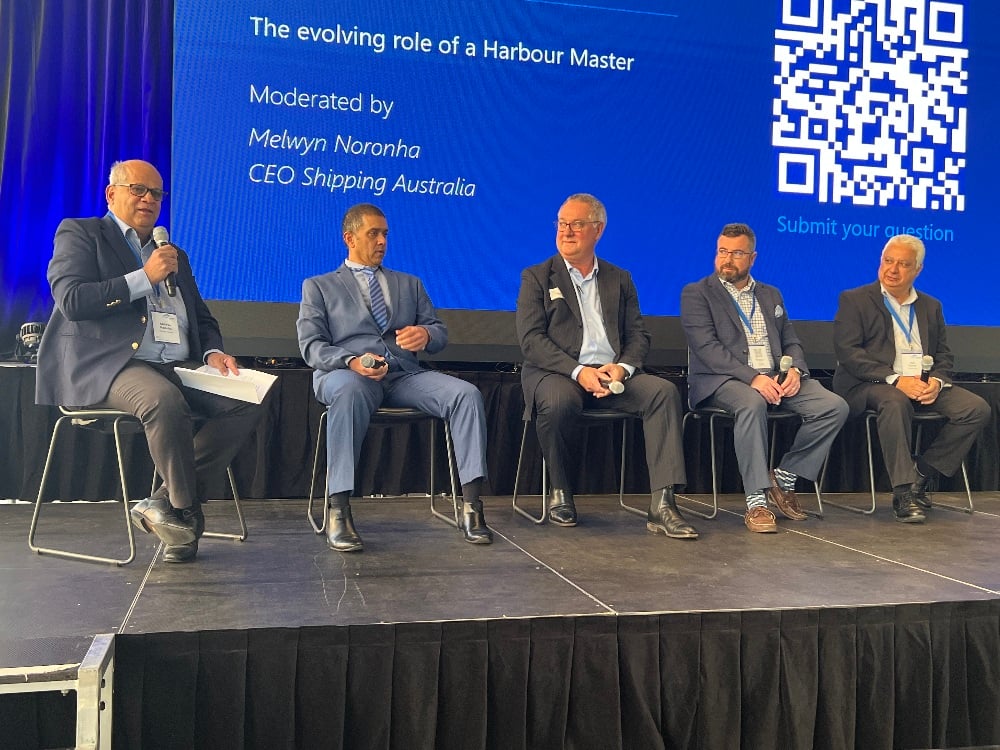
Shipping Australia CEO Capt. Melwyn Noronha put some pointy questions to harbour masters at the recent Safe & Efficient Port Operations Forum, organised and held by the Port Authority of New South Wales.
While moderating a panel discussion on Friday 04 September, Capt. Noronha asked: “many people argue that commercial pressures have never been greater. Are we reaching a point where commercial pressure is genuinely eroding safety margins in the industry? Where do you draw the boundary between efficiency and safety?”
Mick Wall, harbour master at TasPorts, took up the challenge.
“Some new starters at work asked me last week what the most frequent thing I do in my role is. My answer was: I say ‘no’. Probably 95 per cent of the time, I am saying “no”, or, at least, initially saying ‘no’.”
He added that while the commercial side of the operation “certainly matters,” everything must be done safely and sustainably. He clarified that the word sustainability has a wider meaning than environmentally-sustainable, and in this context includes the sustainability of the operation itself.
“You have to be able to keep everything flowing,” he told the audience, adding, “but where profit starts to come ahead of safety, that is where I draw the line.”
The position was nuanced, however.
Mick discussed a commerce vs safety issue in Tasmania. There might only be eight hours of daylight in the middle of winter in Tasmania and two high waters can potentially occur during the hours of darkness.
“Somebody might say,” Mick commented, ‘we’ll make all operations in this particular port daylight-only’. That does not necessarily work because it may not be operationally sustainable. You need to be safe. But you need to be sustainable”.
Capt. Noronha went on to challenge the panel, querying whether there is a healthy tension between safety and commercial outcomes, or whether the pressures are becoming increasingly difficult to manage.
The panel was of the view that, if there is a commercial approach without a safety focus, then there will be an accident. However, if the port is so risk-averse that the port is effectively not operating, then that is not workable either.
The harbour master needs to be challenged… appropriately, of course. Just because a ship cannot be brought in at a particular time in a particular way, does not mean the conversation has to end. There could be another way that the task can be done safely, the panel concluded.
The Safe & Efficient Port Operations Forum 2026 was held at the International Cruise Terminal, near Circular Quay, Sydney, on 04 September and was organised by the Port Authority of NSW.