
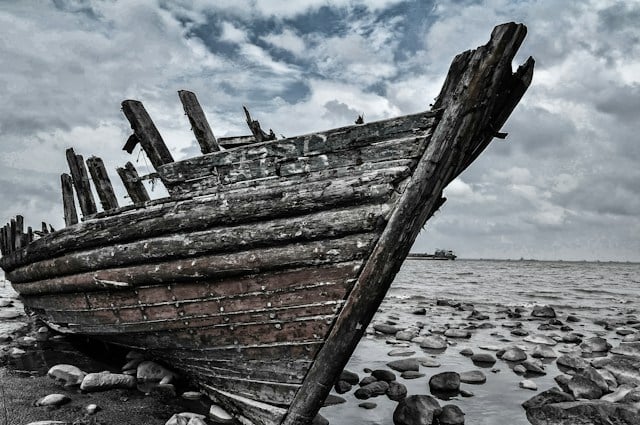
A shipwreck off the coast of Turkey is the oldest shipwreck in the world, our team of archaeologists believes.
There’s little left of the ship itself but based on clues from its cargo – including pottery vessels – a research team I was part of has tentatively dated the wreck to around 2700–2400 BCE.
That’s about 4,500 years ago. Prior to this discovery, the world’s oldest shipwreck was a wreck off the coast of Dokos, in Greece, thought to have been from about 4,200 years ago.
Much work remains to be done to finesse the conclusions, and a paper outlining the results is yet to be published in a peer-reviewed journal. Yet the discovery could transform our understanding of ancient Mediterranean connections during the Early Bronze Age.
Here, and perhaps even earlier, lie the foundations of extensive trade routes as we know them today.
Searching for clues
Associate Professor Hakan Öniz of Akdeniz University, Antalya, has worked along this coastline for decades excavating ancient shipwrecks.
Acting on clues from local seafarers, Öniz found a shipwreck in shallow waters off Kekova, west of Antalya in Turkey, in 2024. Earlier this year, he contacted me and asked if I would help date some of the pottery vessels found on this wreck.
As an archaeologist specialising in desert sites, this was a singular experience. New technology, water-logged methods of excavation and laborious conservation techniques were the new normal. Yet there is always room for learning new skills in life.
Of the ship itself there is now nothing to see, owing to underwater exposure. Yet the research team has now estimated the ship and its cargo dates to around 2700–2400 BCE. However, the precise dating is still under consideration. Earlier or later dates on either side of this initial determination are also possible.
A time capsule of ancient trade
This discovery promises to re-write our understanding of early trade networks from around 4,500 years ago.
The ship is a “missing piece” in the story of networks, trade and commodity exchange in the wider eastern Mediterranean. This era includes the pyramid age of Giza and its mighty pharaohs.
What remains under the sea is a time capsule of ancient trade.
Although its direction was not known, the boat was evidently travelling along the coast of southern Turkey.
Now resting on the seabed between two islands, it is apparent the ship likely sought refuge in the lee waters during a storm. One could imagine the terror of the sailors – possibly coastal people from the Levant region – as their ship crashed against the rocks.
While timbers from the ship disappeared long ago, the remains of its precious cargo were embedded in the rocky slope along the Kekova coast.
Divers worked over the past four months to extract its pottery from barnacles clinging to the rocky underwater slope.
A closer look at pottery
Pottery is like plastic: it never goes away and just breaks down into smaller and smaller pieces.
Yet humble pottery vessels hold many clues about the past.
In this case, the cargo included large ceramic storage vessels or amphorae which once contained products from regions of the eastern Mediterranean.
The pots were large ovoid, flat-based jars with two handles, many featuring a raised horizontal clay “belt” around the widest part of the jar.
Through these vessels was possible to ascertain many pieces of information. This includes the likely origin of the jars and the contents exchanged across the region.
Importantly, the shape and manufacturing technique of the pots themselves help us date the cargo. By extension, this includes also the date of other pottery, and the ship itself.
The bigger picture
Compared to later periods, trade and exchange in the eastern Mediterranean during the third millennium (3000–2000 BCE) is poorly understood.
Maritime voyages during the that period are known from Egyptian texts, pottery vessels and raw materials from ancient tombs.
Around the same time as this ship struck the rocks, the ancient Egyptians were trading in the eastern Mediterranean through the port of Byblos in Lebanon.
Commodities such as cedar, tin/lead, oils, tree resins, lapis lazuli and silver, all materials that Egypt lacked, were imported by the Egyptian state.
Recent scientific research also reveals that silver was acquired by the Egyptian state around 2600 BCE. Analyses showed this silver was acquired from the Lavrion mines east of modern Athens.
While it is unlikely Egyptian ships made this journey, boats like the Kekova ship may have used the route as part of an extended international maritime network.
And what was in the jars? Remarkably there were still residues visible to the naked eye. Again, scientific analyses are pending, but could be some of the products mentioned in the Egyptian texts, possibly olive oil, wine or tree resin.
The ship may have acquired its pottery from several ports on their journey. Our best assessment at this stage of research is that some of the “belted” jars (or clays used to make them) may have originated in the Central Jordan Valley.
The coast of southern Turkey is littered with ancient shipwrecks. While maritime archaeology is a relatively recent phenomenon, some of the world’s most famous wrecks have been discovered there. Who knows what other secrets these waters hold.
The research on which this article is based was led by Associate Professor Hakan Öniz, head of the Division of Mediterranean Underwater Cultural Heritage Research, and the Department of Restoration and Conservation of Cultural Heritage in the Faculty of Art at the Akdeniz University, Antalya, Turkey. 
Karin Sowada, Senior Lecturer in Archaeology and Director of the Australian Centre for Egyptology, Macquarie University
This article is republished from The Conversation under a Creative Commons license. Read the original article.