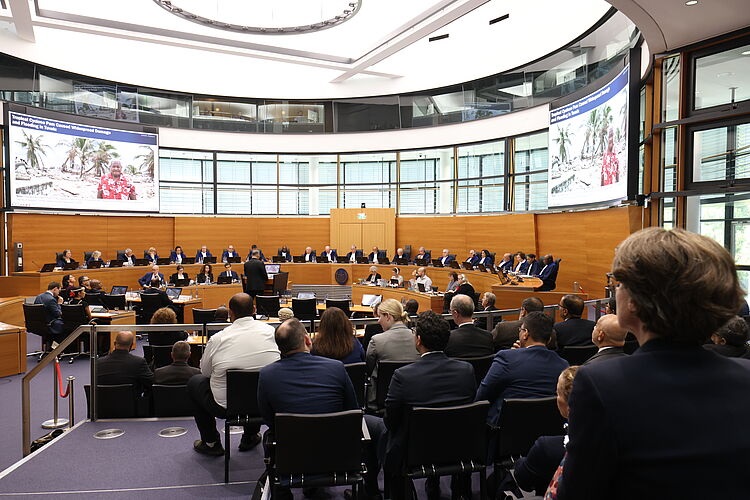
In a significant development for small island nations threatened by rising seas, the International Tribunal for the Law of the Sea (ITLOS) has found greenhouse gases constitute marine pollution.
The tribunal handed down a unanimous advisory opinion this week in its first climate-related judgement. It declared countries must take measures to combat climate change in order to preserve the marine environment under the law of the sea.
The ruling responds to a request from the Commission of Small Island States on Climate Change and International Law (COSIS). The commission sought to clarify whether obligations to prevent pollution and protect the marine environment under the United Nations Convention on the Law of the Sea (UNCLOS) apply to climate change and ocean acidification.
The tribunal’s answer was an emphatic yes. This means countries, including New Zealand, must now address climate change under both the law of the sea and international climate agreements.
This represents a significant step forward under international law. It clarifies that nation states have obligations beyond the current climate change regime to cut emissions and to take adaptation measures.

Background to the request
Members of COSIS are largely Pacific and Caribbean small island states. They are disproportionately vulnerable to climate impacts on the ocean. Threats include sea-level rise, severe weather events and the depletion of fish and other ocean resources.
The tribunal also received written submissions from 34 other states, including New Zealand and nine international and non-governmental organisations.
COSIS asked two questions:
- What are the specific obligations on state parties under UNCLOS to prevent, reduce and control pollution of the marine environment resulting from climate change or ocean acidification?
- What are the specific obligations under UNCLOS to protect and preserve the marine environment in relation to climate change and ocean acidification?

Preventing pollution and protecting the ocean
The obligations to prevent marine pollution and to protect the marine environment are key objectives under UNCLOS. But none specifically refer to climate change or ocean acidification. This is unsurprising since the convention was adopted in 1982.
Some institutions associated with UNCLOS, such as the International Maritime Organization, have taken steps to address climate impacts on the ocean. But countries have been reluctant to do so. They have often asserted the primary mandate regarding emissions reductions and climate adaptation lay with the UN Framework Convention on Climate Change (UNFCCC).
The tribunal’s advisory opinion confirmed, for the first time, that the 168 UNCLOS parties must address climate change and ocean acidification in order to comply with their obligations under the law of the sea.
First, ITLOS confirmed that greenhouse gas emissions and the heat generated by a warming climate meet the definition of “pollution” under Article 1(4) of UNCLOS. This is important because under Part XII of UNCLOS, states have obligations to prevent, control and mitigate pollution of the marine environment from any source.
Second, the tribunal confirmed the obligation under Article 194 of UNCLOS to prevent and control pollution applies to greenhouse gas emissions. This includes emissions already accumulated in the atmosphere. States therefore must take all necessary measures to address climate change pollution and ocean acidification.
The tribunal adopted a broad definition of “necessary”. It includes indispensable measures but “also other measures which make it possible to achieve that objective”.
Such measures must be underpinned by science, international rules relating to climate change, and the capacity of individual states.
The tribunal said states could draw on relevant rules and standards developed by the UNFCCC. But, importantly, it said complying with UNFCCC obligations was “not necessarily sufficient” for states to meet their obligations under UNCLOS.
Third, the tribunal interpreted the more general obligations under UNCLOS to protect and preserve the marine environment to apply specifically to climate change and ocean acidification. This includes the duty to cooperate, to carry out environmental assessments, and fulfil obligations in the context of fisheries management.

Global importance
Although only advisory and technically addressed to COSIS and its members, this decision is important for all states.
It clarifies that parties to UNCLOS have a duty under the law of the sea to address climate change impacts on the ocean. It also confirms that it is not sufficient to rely solely on measures under the UNFCCC to meet those obligations.
This means countries must explicitly consider their obligations under the law of the sea and the UNFCCC regime when authorising activities contributing to global climate change, such as offshore oil production, and when adopting climate adaptation measures.
Karen Scott, Professor in Law, University of Canterbury
This article is republished from The Conversation under a Creative Commons license. Read the original article.