Within the last day or so, the Hon Catherine King MP, Minister for Infrastructure, Regional Development and Local Government, issued an incredibly inadequate response to the Kimberley Crisis.
A bit of background: since early January (and possibly since late last year), a large region of north-western Australia has been cut off by road and rail from the rest of Australia.
This area that is cut off appears to be (based on our reading of ABC reporting) in the eastern Kimberley region, straddling the NT border. The countryside in that vast region consists of bushes, forest, ravines, creeks and the like. It is not easy to traverse. It is not easy to build transport infrastructure. There is a major road, Highway 1, which has been cut by floods at Timber Creek on the NT side and the distant Fitzroy Crossing on the WA side is no longer traversible. We understand that freight transport from the south is no longer possible either.
Freight – comprising fuel, food, household goods, general retail goods, business goods and the like – cannot reach the cut-off area.
Starving populations in Australia
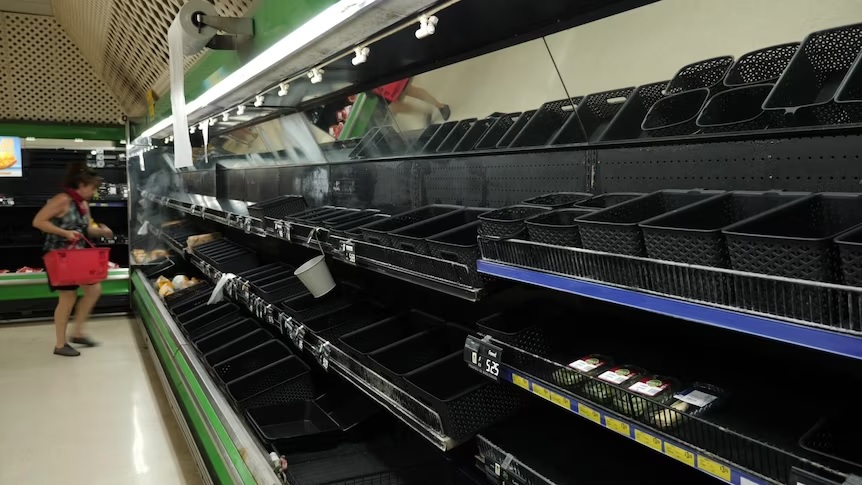
Local organisations have stated that local people are starving1. Other local residents are reporting that they have run out of fresh food for their kids. We understand that some populations in the Kimberley region are on the move and have arrived from the countryside into their relatives’ houses. What were houses with a few people in them have become houses with tens of people in them. Stresses are high, and rising. We have heard of worries and concerns that there could be public order offences (such as breaking and entering-type offences) as people begin to take measures into their own hands to gather food.
The Australian Defence Forces have been deployed to carry out an air operation to deliver fresh food to Kununurra, a small town near the NT border. However, something has gone wrong and, for some reason, the ADF have only so far (at the time of writing) managed to deliver dry goods. For some reason, the WA government is blaming a supermarket retailer2.
There is plenty of blame to go around. But none of it needs to be directed at the ADF, nor Coles.
The blame for failure to relieve the suffering residents in the eastern Kimberley lies jointly with the WA goverment and the Hon Catherine King. We explain how and why, below.
Ocean shipping is the answer
At the heart of the cut-off area, is a sea-port. The Port of Wyndham. It has a concrete and steel jetty that is 300 metres long and the water there is about 11 metres deep. That port is joined by road to the town of Kununurra and, from their via the Highway to the rest of the cut-off area.
Ocean going ships from the international fleet can dock at Wyndham. The general consensus that we have heard is that ocean going ships are needed and are the solution to deliver aid, food, fuel, household goods, and all the other essential goods that everyday Australians need.
Ships are very capable constructs for cheaply moving large volumes of goods. Ocean going ships from the international fleet could cheaply deliver large volumes of goods from Darwin to Wyndham. There are ocean shipping personnel based at Darwin and also at Wyndham.
Moving emergency goods cheaply and in large volumes by ocean going ship to desperate Australian families in the cut-off area can be done. And it could have been done weeks ago.
Political statements, ocean-shipping response
Earlier this week, Senator Bridget McKenzie, Leader of the Nationals in the Senate, publicised the fact that ocean shipping companies could deliver cargo to Wyndham. Shipping Australia then publicly supported her statements.
Shipping Australia knew by virtue of its general shipping knowlege, by researching details and by speaking to our members that it was possible that cargo could be brought into Wyndham by sea-going vessels from the international fleet.
Particulars of a response
Within hours of those statements going public we were advised that there are numerous vessels operating in the area, with shipping experts present in Darwin and Wyndham. We were advised that a multi-purpose vessel with two cranes each capable of lifting up to 60 tonnes, and which could carry 152 containers of twenty foot, would be available mid-April. (We have been generally advised that it would take at least a couple of weeks, no matter which shipping company responds, for the company to assess the situation, make a decision if they could help, and then to re-deploy ships to the area).
The distance between Wyndham and Darwin is about 262 nautical miles and this particular ship of which we have been advised sails at 12.5 knots (one knot is one nautical mile per hour), giving a total of 21 hours sailing time. Allowing a few hours for loading and unloading, then let’s say, 1.25 to 1.5 days per one-way trip, or roughly two to three days for a round-voyage of Darwin-Wyndham-Darwin.
The containers on this particular vessel are limited to 15,000 kgs of weight (containers typically have a payload of 28,400 kg). So this particular vessel would have a payload of about 152 containers of 20 foot in length x 15,000 kg of aid (all kinds of aid), which roughly equals 2,280,000 kg of cargo per trip. As there are about 9,000 people in the cut-off area, that’s roughly 253 kgs of cargo per person in the cut-off area.
That’s far more sustainable than ad-hoc air operations (which didn’t even include fresh food!) and a tug-and barge operation carrying four or so containers every few days.
Other ships might be available too – the government just has to ask
But that particular vessel is not the only vessel that might be available. There are other vessels that travel the area that could possibly be hired. There are shallow and short vessels with their own cranes that can carry many hundreds of twenty foot ISO shipping containers and which should have payloads in the 28,400 kgs range.
These vessels, being dedicated containerships, will be able to go far faster than tugs and barges. The exact details will depend upon the nature of a given ship.
Given that the authorities are talking weeks and months – and in some cases, years – to repair the road and rail infrastructure, and given that the wet season should arrive soon (more rain, more floods), we can only imagine that this situation is going to get worse and certainly not better.
Why aren’t ships from the international fleet already being used to deliver aid?
In short, because it is unlawful.
The Coastal Trading (Revitalising Australian Shipping) Act 2012 (Commonwealth) was introduced to Parliament as a result of the efforts of our current Prime Minister, Anthony Albanese, when he was the Transport Minister in the Gillard Administration.
Section 5 of that Act explains the law: “this Act regulates coastal trading by providing for licences to be granted that authorise vessels to carry passengers or cargo between ports in Australia. Using a vessel to engage in coastal trading without a licence may lead to a pecuniary penalty being imposed for the contravention of a civil penalty provision“.
There is a complicated and cumbersome set of licences to allow coastal trading. Most shipping companies do not take out a General Licence because it is all far too expensive, and difficult. There are Temporary Licences too, but we won’t get into the details. The Coastal Trading Act has been a terrible policy that has badly hurt Australia. There’s far too much to go into here, but we detail the many failures of the Coastal Trading Act extensively in this submission to government (see paragraphs 410 onwards).
The key points are that the owner of cargo cannot simply just pick up the phone to hire an international ship to carry cargo from one Australian port to another, not even in an emergency.
Commonwealth Government could have acted
But there are two main ways that emergency cargo can lawfully be carried by ships from the international fleet from one Australian port to another.
One way, under section 64 of the Act, is for an appropriate person to apply to “the Minister” (i.e. in this case the Hon Catherine King MP) for an emergency licence.
The other way, under section 11 of the Act, is for “the Minister” (i.e. the Hon Catherine King MP) to direct that the Coastal Trading Act does not apply to a given vessel or class of vessels.
What the WA Government and the Hon Catherine King knew – when and why – and why they are to blame for the current suffering
The first flooding event that started to cut off the road access to the remote communities in the eastern Kimberley was months ago. The last routes into the area, such as at the Fitzroy Crossing, were cut off in mid-January.
Throughout the crisis in the Kimberley, the ABC has been reporting on the increasingly desperate situation. We understand that elected government officials receive regular briefings in their state / throughout the country by public service officials.
Meanwhile, on the coastal shipping side, the WA Government is working on its coastal shipping policy. There is a WA Shipping and Supply Chain Taskforce which understands these coastal shipping issues. There are officials in WA who understand these issues.
On the Commonwealth side, the coastal shipping sector is very well understood. It was Prime Minister Anthony Albanese who sponsored the Coastal Trading legislation. There is a whole shipping business unit dedicated to ocean shipping in the Department of Transport. Officials who worked on shipping matters for the previous government continue to work in that Department.
The Commonwealth has a Maritime Shipping Taskforce which is looking at the development of national shipping policy. At recent Senate Estimates, it was revealed that the Department of Transport had spent AUD$170,000 on a secret report (which should be released to the public by the way) all about shipping.
And, in March 2022, then Transport Minister Barnaby Joyce issued a section 11 exemption to the Coastal Trading Act so that emergency cargo could be delivered to Western Australia by ocean going ships from the international fleet.
So, in summary, both the WA Goverment and the Commonwealth Government knew there was an escalating food, fuel, and other essential supplies crisis in the eastern Kimberley. And they also knew (or should have known) from previous events, and they should have known from access to the shipping expertise around them, that a section 11 exemption from the Coastal Trading Act would allow ocean ships to deliver food and other aid to the cut-off area.
With that knowledge and expertise, what did they actually do?
According to the ABC reporting, they apparently held negotiations for a week, or weeks, with unspecified freight operators (presumably land-side operators, but, hey, who knows? They’re not telling) who ultimately could not get freight into the cut-off area. They have directed the ADF to do air-operations and they have hired some kind of tiny tug and barge operation to carry a few boxes worth of aid.
That response is, in our opinion, inadequate when international shipping is available.
The most important actions the WA and the Commonwealth Governments could have done to mitigate this crisis would have been to have co-ordinated to (a) issue a section 11 exemption and (b) make it known to the ocean shiping community that they were seeking to fund an emergency service to get supplies into the cut-off area; (c) and then hire ships to carry aid.
They appear to have done neither of these things.
Hon Catherine King’s response – outrageously wrong in every way
Yesterday (10 March 2023), after the inadequate Government response was highlighted by Senator McKenzie in the Senate, Minister King spoke on a Kimberley radio show5. During that show she stated:
(a) If asked we’d certainly consider whether there’s an exemption needed to issue a licence to an international ship to do that.
(b) But this is the problem we’ve got, that I find it pretty bizarre that (b(i)) we don’t have Australian ships actually running along our coast being able to actually be called on to actually do that. And that’s because we’ve had a decade of the Liberal National Party basically driving Australian ships away from this country and we don’t have that many flag vessels (b(ii)). It’s why we’re establishing a strategic fleet for exactly these tasks and for these purposes to be able to call on in times of emergency (b(iii)). And we’re working our way through the detail of doing that.
(c) But I don’t have a request before me at the moment to issue licences to international ships…
(Lettering (a), (b(i-iii), (c) added by Shipping Australia).
So, in relation to Minister King’s claims (a) and (c). Section 11 does not require anyone to apply to the Minister. Section 11 states: “The Minister may, by legislative instrument, direct that this Act does not apply to (a) a vessel or class of vessels; or (b) a person of class of persons”.
By simple pen-stroke (and a short-period for tabling the appropriate instrument in Parliament), Minister King could have dis-applied the Coastal Trading Act thereby allowing international ships to deliver emergency cargo to the eastern Kimberley.
What is particularly disquieting about Minister King’s points (a) and (c) is that she seems to imply that making decisions about national issues and how to solve national problems is something that should be solved by the general public.
Is the general public now some kind of first emergency response agency? When did that happen?
And, in any case, decision making in the national interest is the reason why Cabinet Ministers are appointed, isn’t it? The Parliamentary Education Office certainly seems to think so. And these are national issues: the cut-off area stretches over two states, Australians across the region are affected, and it involves both international and national supply chains.
In any event, it is now somewhat incorrect to say there is no request for an exemption from the Act as Senator McKenzie asked for that exemption in the Senate on Wednesday.
Does the Minister understand her portfolio?
Incidentally, it looks like the Minister does not understand her portfolio as she made comments about exemptions to issue licences. But that’s not what happens. Section 11 allows the Minister to dis-apply the Coastal Trading Act – and that dis-application is the exemption. No licence involved.
Section 64, on the other hand, enables the Minster to issue an emergency licence upon application by a third party – there’s no exemption under section 64, there’s just the issue of an emergency licence.
It looks like the Minister has it all mixed up. Look, we understand, it’s all pretty nerdy stuff. But the Minister is a Cabinet Minister and her decisions (or, in this case, the lack thereof) are causing suffering to Australians. She should be across this, as was her predecessor Barnaby Joyce, and as was Anthony Albanese, another former office holder.
Political distraction techniques; Australian coastal shipping policy
Now let’s look at items we’ve marked b(i – iii).
Firstly, (b(i)), whereby Minister King finds it bizarre that we don’t have Australian vessels running along the Australian coast. That’s, firstly, just a political distraction technique as none of those policy issues are relevant to the situation at hand i.e. Minister King’s failure to use ships to get aid to the suffering people in the eastern Kimberley.
Secondly, there are a wide range of vessels sailing along the Australian coast. They’re nearly all international vessels and, as explained above, it was and is ALP party policy to prevent international ships from carrying cargo from one Australian seaport to another. Not only is it ALP party policy, it was our current Prime Minister, Anthony Albanese, who sponsored the Act that made it unlawful for international ships to undertake that business.
Adverse effect of ALP’s Coastal Trading Act
Let’s look at (b(i)) again in conjunction with (b(ii)), it was the ironically-named Coastal Trading (Revitalising of Australian Shipping) Act 2012 that made it too difficult and costly for ships to remain under the Australian flag. When that Act was passed, prices went up, costs went up, and many ships de-flagged from the Australian flag. That Act caused Australian businesses to shut down with the loss of Australian manufacturing jobs, the loss of Australian seafarer jobs, and the loss of Australian cargoes as Australian shippers sourced cargoes from overseas instead of from Australia.
This is not Liberal-National Party Policy. It wasn’t the Liberal-National Party that drove away ships from the Australian coast. The Liberal-National Party tried to change the ALP’s legislation several times during their time in government.
Let’s get our facts absolutely crystal clear on this point: it was ALP policy to restrict shipping. It was the ALP that advocated for, worked for, and enacted, the Coastal Trading Act. It was the ALP that blocked reform of that Act when its many failures were made clear. It is the ALP that continues to restrict shipping to the detriment of Australia. The reason that we don’t have “Australian ships actually running along our coast” is because of Australian Labor Party policy.
A political fleet will be subject to political failures
Finally, let’s look at Minister King’s statement (b(iii)). She says that “It’s why we’re establishing a strategic fleet for exactly these tasks and for these purposes”.
But the situation would suggest the exact opposite. The international ocean shipping community is ready, willing and able to respond and carry emergency relief. All it is waiting for is to be hired by the government and the government to make lawful the carriage of emergency aid by international ships.
It is a government failure, not industry failure, that has caused this suffering.
The Commonwealth Government chose not to act despite the fact that they knew the situation was dire, and they knew (or should have known) that ocean shipping was (and is) the solution, and that they knew (or should have known) that they could have used the ocean shipping industry to solve the problem.
But Minister King didn’t act.
For whatever reason, she did not act when she could have done so.
The people of the eastern Kimberley suffered as a result.
It was uncaring government inaction that caused this suffering.
Why then, would a government national fleet – controlled by politicians – be touted as the answer to crisis situations like the crisis in the Kimberely when it was goverment- and politician-inaction that caused this suffering for the residents of north west Australia?
The national fleet will not solve such crises because it is not market failure that caused the crisis. It was government failure that caused the crisis.
Minister King should take urgent action right now to relieve the suffering in the Kimberley.
Given:
- the ongoing shortages of food, fuel, and other essential supplies that are so desperately needed by everyday Australian families in the Kimberley;
- that there are vulnerable Australians in that region;
- how easy it is to make a section 11 exemption and to disapply the Coastal Trading Act, which would then, in turn, allow international ships to carry food, fuel and other aid to the Kimberley…
… Shipping Australia calls upon Minister Catherine King to:
- a) make a section 11 exemption to the Coastal Trading (Revitalisation of Australian Shipping) Act;
- b) publicly request bids for the seaborne carriage of cargo to Wyndham to aid the people of the Kimberley in their time of need
- c) hire a successful bidder to carry that aid.
Comments
- “A lot of our people, they’re starving. We don’t have fresh food on the shelves, we don’t have meat, fresh veggies”, statement by Marcia Gerrard, MG Organisation, as stated on video segment “Australian Defence Force to help re-supply East Kimberely amid food shortage due to NT flooding,” “, Hayes, J, and O’Connor, T, ABC Kimberley. Statement occurs approx 00:23 seconds from start. The report then goes on to show empty supermarket shelves and Mr O’Connor reports that the situation (as of Wed 08 March 2023) had been that way for three days.
- “Lack of fresh food on Kimberley supply flight Coles’ fault, government says, after days of empty shelves,” O’Connor, T, ABC Kimberley.
- We have permission to share the details of this communication.
- A “geared” vessel has cranes built into the ship which means it does not need shore-side infrastructure. So this vessel has two cranes aboard and each can lift up to 60 tonnes. A container full of aid will normally have a payload of 28,400 kgs. We understand this particular vessel has a payload capacity of aobut 15,000 kgs per container.
- See: “Transcript – radio interview – ABC Pilbara, Mornings with Eddie Williams“