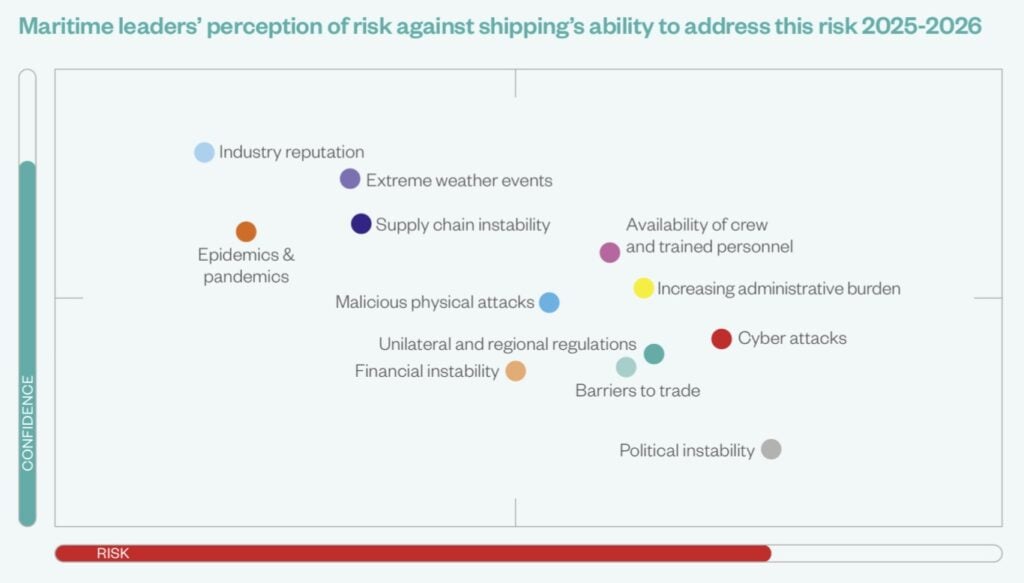
Political instability, cybersecurity, unilateral / regional regulation, administrative burdens, and rising barriers to trade, and are among the biggest maritime risks according to a global survey of maritime leaders.
The findings, reported by the International Chamber of Shipping in its Maritime Barometer Report 2025-2026, indicate that there is a more fragmented and less predictable operating environment for global shipping.
“Overall, the Barometer presents an industry navigating a period of sustained volatility with a focus on resilience, adaptability, and practical decision-making, with actors taking an increasingly pragmatic approach to their operations. Leaders are balancing immediate operational pressures with longer-term strategic objectives, adopting approaches that reflect both the scale of the challenge and the realities of the operating environment,” the ICS reports.
Crisis of confidence
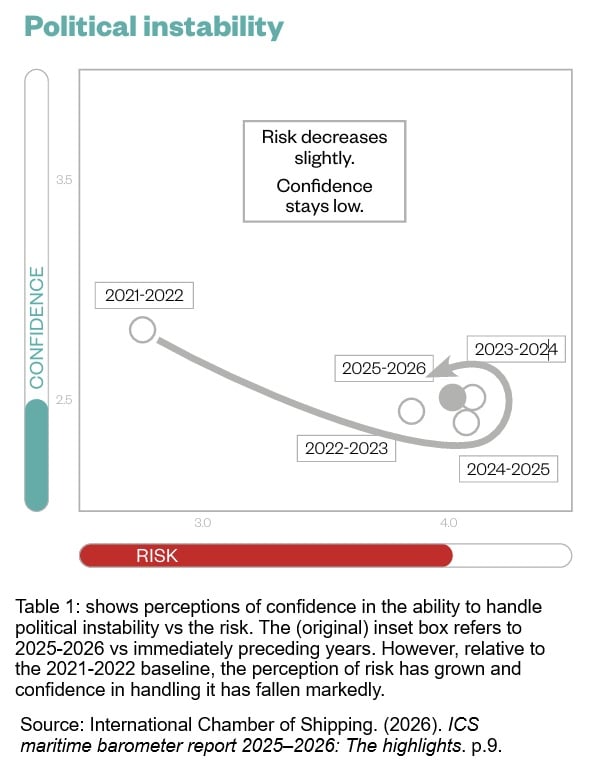 It is particularly notable that the industry perceives that, over the last seven years or so, political instability risk has massively increased while confidence in the ability to manage that risk has declined. A moment’s reflection suggests that the perception of increasing risk / falling confidence is extra-noteworthy as the base year for lower risk / higher confidence occurred during the COVID pandemic years.
Risk and political instability
The ICS Barometer shows that political instability is the highest perceived risk for the fourth consecutive year. The ICS argues that political risk is the primary driver or risk that is multiplying the effects of other factors.
It also shows that there is a clear divide between the perception of which risks are manageable and which are largely beyond industry control.
Political risk is understood as a cluster of inter-related risks, including sanctions, wars, tariffs, trade agreements, attacks on vessels, the sidelining of navigation and more, the ICS adds. Rising trade barriers, economic coercion, and strategic rivalry are increasing fragmentation and unpredictability.
Looking ahead, the drivers of political instability include strategic competition, regional conflict, protectionism and energy security.
“Political instability is expected to remain the most structurally embedded and operationally disruptive risk facing global shipping in the foreseeable future,” the ICS reported.
Cyber attacks
This was the second-highest risk category, with the lowest confidence, which indicates a widening gap between threat and ability to respond. The proliferation of artificial intelligence and persistent capability gaps will continue to pressure the industry, the ICS indicated.
Unilateral and regional regulations
This is the third-highest risk, with the fourth-lowest confidence. The ICS noted that countries are increasingly using regulation, tariffs and trade measures as instruments of leverage and protection. The ICS argued that a key driver is the growing link between political instability, economic competition and regulatory divergence. There is a weakening consensus in global rule-making and an acceleration of a move toward regional and nationally-aligned regulatory systems. Among the measures cited by the ICS were the Digital Economy Framework Agreement of the Association of Southeast Asian Nations (ASEAN); China’s co-ordinated industrial strategies; India’s “Made in India” initiatives; the EU Emissions Trading Scheme and the Fuel EUMaritime.
“Commercial impact is already visible. Shipping companies are adjusting fleet deployment, contracting structures, and investment decisions. Route planning and commercial strategy are increasingly shaped by regulatory differentials between jurisdictions rather than pure market logic. As geopolitical instability intensifies, it is acting as a catalyst for regulatory regionalisation, embedding fragmentation as a defining structural condition of global maritime governance,” the ICS noted.
Increasing administrative burden
This is the fourth highest risk, with the third lowest confidence in the ability to manage. This issues is tied to geopolitics (sanctions, tariffs, trade restrictions etc), which requires increasing due diligence such as vessel tracking and cargo verification among others. Then multiple regulatory systems compound the problem. For example, the ICS points out that ships operating under EU jurisdiction must comply with multiple overlapping, reporting and verification frameworks, each with distinct data, timing and submission requirements.
“Administrative burden increasingly requires investment in systems, specialist personnel, and continuous monitoring capabilities, which larger operators are better positioned to absorb,” the ICS comments.
Barriers to trade
This is the fifth-highest risk, third lowest confidence. Trade conditions are being reshaped by rising restrictions, policy fragmentation, and new trade agreements, the ICS reports. It adds that even though liberalisation is not disappearing, it is becoming more selective, regionally structured and strategically-driven.
“The OECD Services Trade Restrictiveness Index 2026 shows that in multiple services sectors linked to logistics and trade facilitation, regulatory and licensing barriers have continued to increase, with new requirements outweighing liberalisation in several jurisdictions,” the ICS reports.
Methodology
The survey was conducted by a third-party company and received 185 responses from c-suite executives from sectors across the maritime industry. Answers on risk-perceptions were weighted on a five-point scale. The geographic distribution of responses received was uneven with many responses received from the United Kingdom, the USA, Netherlands, Singapore and Greece. There were many responses from the rest of the world, with one to a few responses received from those other countries. All responses were received before the outbreak of major geopolitical events, such as the ongoing war(s) in the Middle East.
Further reading
Wilson, J. (2025). Risky politics hikes chances of a world recession. Shipping Australia.
https://www.shippingaustralia.com.au/risky-politics-hikes-chances-of-a-world-recession/
References
International Chamber of Shipping. (2026). ICS maritime barometer report 2025–2026: The highlights. https://www.ics-shipping.org/wp-content/uploads/2026/06/ICS-Barometer-2025-2026-Highlights.pdf