Liquefied gas transport specialist, Exmar, of Antwerp in Belgium, has reported the successful completion of the maiden voyage of the “Antwerpen,” which is said to be the first commercial seagoing cargo vessel powered by a dual-fuel ammonia engine.
According to a statement from the company, during a voyage from China to India, “the vessel achieved ammonia dual-fuel operation fully in line with our expectations and design, demonstrating that the technology works in commercial service. Together with our partners, we continue to fine-tune the systems as we build on this outstanding achievement”.
Exmar took delivery of the Antwerpen in early June this year. The vessel, which will be the first in a series of four ammonia dual-fuel mid-size gas carriers, was developed in collaboration with HD Hyundai Heavy Industries, WinGD, Nord Gas Solutions (formerly Wärtsilä Gas Solutions), and Lloyd’s Register. The Antwerpen can carry up to 46,000 m³ of ammonia or LPG and sail with close to zero emissions when using low-carbon ammonia fuel.
“Ammonia propulsion is no longer theoretical—we are deploying it. Change comes through execution, not debate. This achievement reflects collective expertise and our commitment to drive sustainable shipping forward,” said Carl-Antoine Saverys, Chief Executive Officer of EXMAR Group.
Vessel’s use of ammonia
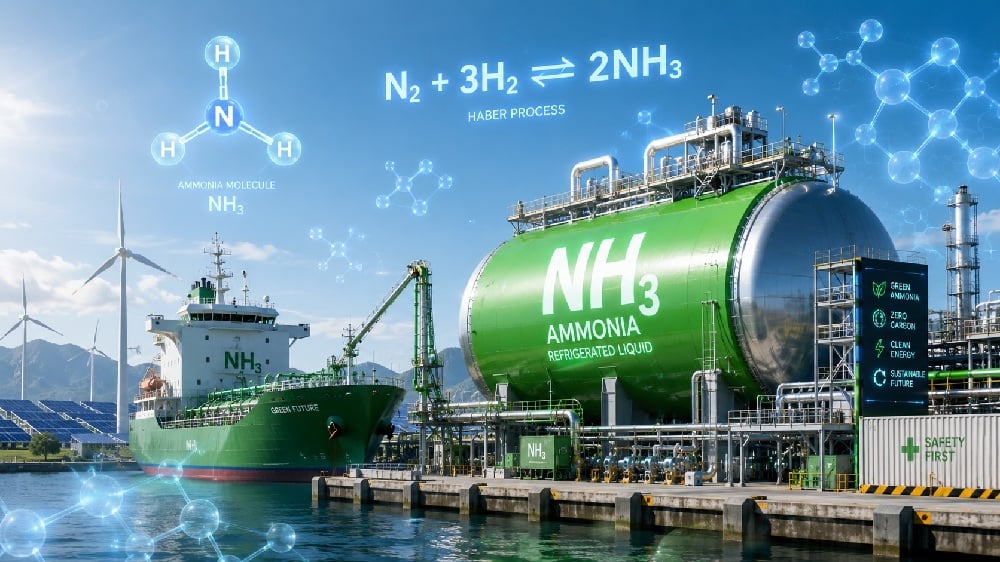
Ammonia is an inorganic compound of nitrogen and hydrogen (One nitrogen to three hydrogen, hence NH3), which, at ambient temperature and pressures, is a colourless gas with a strong odour. As it does not contain carbon, combustion does produce any carbon dioxide (the main greenhouse gas) and the emissions out of the stack are water vapour and nitrous oxides. At below 25% engine loads (for example, during manoeuvres), the vessel cannot operate the engine in ammonia mode so, during manoeuvres and in port, the vessel will switch to another fuel. Ammonia is used as fuel during the sea passage. Ammonia can be economically transported and stored when liquefied at a temperature of -33 degrees Celsius.
Safety measures
Unfortunately ammonia is known to be highly toxic. So Exmar’s vessels have been designed with a range of safety features including:
- Double walled piping in the engine room
- Ventilated annular spaces with exhaust routed to the vent mast
- Enhanced gas detection in both the engine room and the ammonia fuel supply room
- A dedicated ammonia fuel supply room, separated from the compressor room and unmanned during operations
- Installation of all ammonia fuel supply equipment within the cargo area
- Additional personal protective equipment for seafarers working in the engine room
- Engine design incorporates water cooling of the ammonia injectors, which absorbs residual ammonia
Production of ammonia
Ammonia can be produced using the Haber-Bosch process, which converts atmospheric nitrogen (N2) and hydrogen gas (H2) into ammonia (NH3) under high heat and pressure. Nitrogen is taken from the air. Hydrogen can be obtained in multiple ways, such as from the reaction of methane or natural gas (natural gas is basically methane combined with other trace gases) and steam at high processes, which releases large volumes of carbon dioxide into the atmosphere. This is known as “grey ammonia”. However, ammonia producers are looking at splitting water using electricity (a process called electrolysis) which, if powered by a renewable energy source such as wind or solar power, would be environmentally-friendly “green ammonia”. Splitting water with electricity results in the production of the gases oxygen and hydrogen. The oxygen can be caught and processed for sale if there is a nearby heavy user of oxygen, otherwise it is typically vented into the atmosphere. Properly vented, dispersed, and uncontaminated oxygen in the atmosphere is not considered a pollutant as it does not cause ecological damage. It will typically mix with the air and, over time, could be used in respiration by plants, animals, or microbes, or be involved in oxidation of rocks, metals etc.
About Exmar
Exmar is an integrated maritime company focused on shipping (Liquefied Petroleum Gas and ammonia), gaseous floating infrastructure (FSRU, FLNG, FPSO), and supporting services. The company’s fleet includes 2 FSRUs, 2 LNG, one offshore vessel, 4 suezmax tankers (under construction) and 39 LPG / NH3 ships. Exmar employs over 1,900 people, including 1,500 seafarers, across Antwerp, Belgium, Houston, Singapore, Mumbai, Shanghai, and at sea. The consolidated group reported revenues of USD$248.1 million at the end of December 2025, with an EBITDA of USD$101.6 million, and an EBIT of USD$75 million.