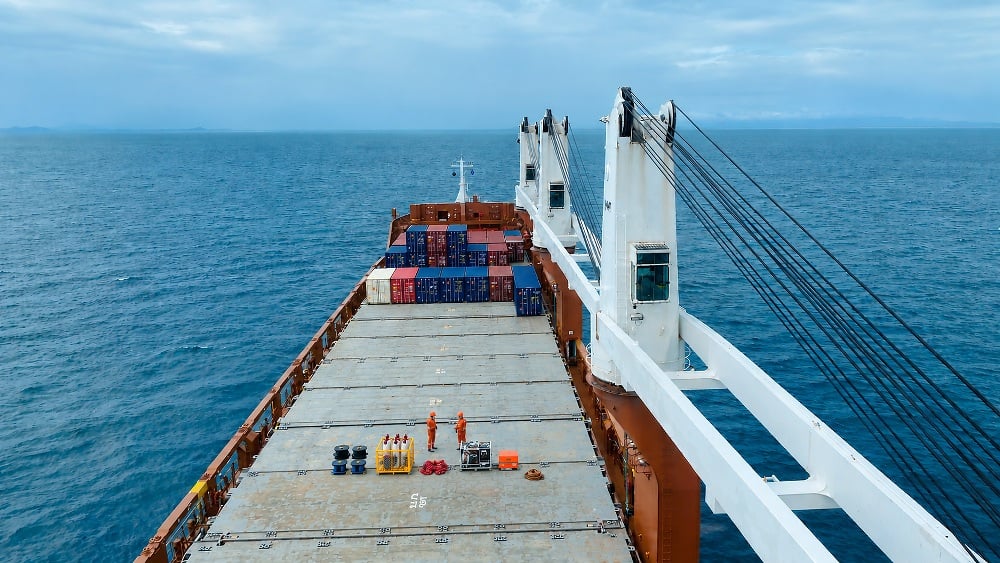
Maersk has announced the successful ethanol bunkering of the Maersk Halifax, a retrofitted dual-fuel vessel, in Singapore.
The event was the first time ethanol has been bunkered on a retrofitted ship in the Maersk Fleet.
Approximately 5,000 tonnes of ISCC-certified methanol were loaded onto the container ship, “providing valuable operational experience and insights into the infrastructure, sourcing, supply chain readiness, and vessel operations associated with using ethanol as a marine fuel,” a Maersk statement reads.
Earlier this year, Maersk carried out a series of successful ethanol trials on the dual fuel ships, Laura Maersk, Antonia Maersk, and Tangier Maersk.
About ethanol
Fuel ethanol / ethyl alcohol (C2H5OH) output reached 118.2 billion litres globally in 2024, according to the Renewable Fuels Association. Ethanol has a volumetric energy density of 21 Mega Joules per litre (standard heavy fuel oil has 37.3 MJ / L) and a lower calorific value of 26.8 MJ / kilogram. It has a flashpoint of about 13 to 15 degrees Celsius (so it is a low flashpoint fuel, necessitating a range of safety measures and vapour detection), a boiling point of 78 degrees Celsius, and a freezing point of -114 degrees Celsius.
Environmentally, it is of lower risk as it dilutes and biodegrades easily and partially evaporates. Ethanol combustion has negligible sulphur oxide production but it does produce carbon dioxide, which is a global warming gas. However, as ethanol can be made from plant material then net production of carbon dioxide from ethanol combustion can be very low or zero (as the plants draw carbon dioxide from the atmosphere during their growth phase and combustion basically returns the carbon to the atmosphere).