Three different, legislated, government bodies that had a defined rescue-role under legislation, and state and national plans in relation to emergency response did not believe that a response to a distressed bulk carrier necessarily fell within their responsibility, the Australian Transport Safety Bureau has said. These different understandings left a significant proportion of an emergency response in commercial hands, which were inherently limited, notably with an immediate lack of available and suitable assets for the task.
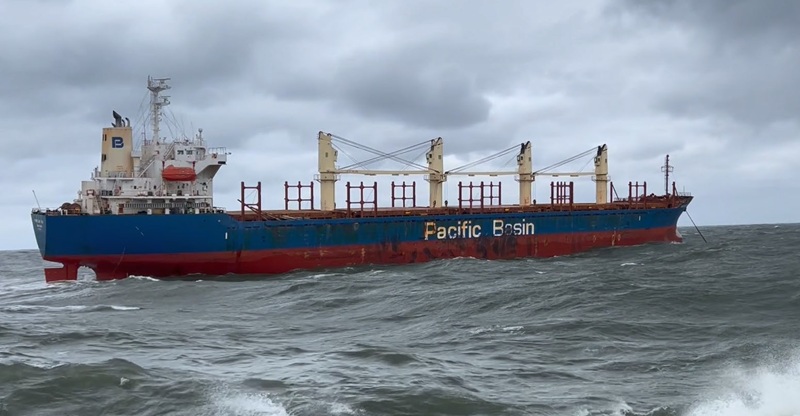
The bulk carrier Portland Bay was en-route north in July 2022, ex-Port Kembla, when it ran into very heavy weather to the south east of Sydney and lost power. It drifted toward the rocky shores of the northern part of Royal National Park, the major national park immediately adjacent to, and to the south / south-east of Sydney and near Cronulla (Sydney).
“The stranding on pristine national park coastline of a 170-metre ship carrying 950 tonnes of heavy fuel oil would have had internationally significant environmental and economic consequences, and as such this was one of the ATSB’s most comprehensive marine occurrence investigations in nearly two decades,” ATSB Chief Commissioner Angus Mitchell said.
Noting that the NSW and Australian national plans for managing maritime emergencies are designed to provided the best available actions in managing risks along Australia’s coasts, the ATSB Chief Commissioner, Angus Mitchell commented that: “AMSA and the Port Authority of NSW had not effectively implemented their respective procedures to comply with these plans, and NSW Maritime, the statutory agency responsible for ensuring the state was prepared to respond to this type of incident, had not effectively met this obligation”.
The ATSB found that a key factor in the emergency, in which a bulker was drifting toward rocky shores of Royal National Park having lost power in gale force winds, very rough seas, and a heavy swell, was that the relevant NSW authorities did not immediately pass on information to the Australian Maritime Safety Authority. The request was lost between the two agencies and was not followed up “for many hours”.
It took about 30 hours after the ship’s master had reported the ship’s disabling by an emergency MAYDAY broadcast for the designated emergency response vessel to arrive after a journey of 90 nautical miles from Newcastle in very rough weather.
The ship did not experience a “catastrophic stranding” on the rocky shores owing to a combination of the ship’s crew deploying anchors and the heroic efforts of the first responding tug crews.
“While the first responding tug crew have been praised for their efforts in what were very challenging weather and operational conditions, the three harbour tugs that were initially deployed to manage this emergency were not properly equipped, and ultimately were always going to be incapable of effectively towing the ship in the rough, open seas even though at 15,500 tonnes, it was less than half the weight had it been fully laden with cargo.
“It was only the emergency deployment of both anchors on two separate occasions that very fortunately prevented [the bulk carrier] from stranding in pounding seas, before the only capable ocean-going ETV in NSW arrived after an extended, unnecessary delay.”
The ATSB has made a variety of safety recommendations on matters to address failures in meeting management plans, and meeting their legal obligations, to AMSA, the Port Authority of NSW, and to NSW Maritime. A recommendation was also made to an emergency response company to ensure that the company’s capabilities and limitations are clearly made know to the master, owners, and managers of a ship under a salvage agreement.
Further Reading
The summary: “ATSB issues recommendations to government agencies, salvage operator, following near stranding of bulk carrier near Sydney“.
The full report: “Propulsion failure and near stranding of the Portland Bay on the coast 22km south of Port Botany (Sydney), New South Wales, on 4 July 2022“.