Japanese shipping major NYK, which is a Shipping Australia member, has announced the purchase of innovative energy company, “Sustainable Energy Co Ltd” of Sendai, Japan.
The company’s technology allows the conversion of organic wastes into biofuel.
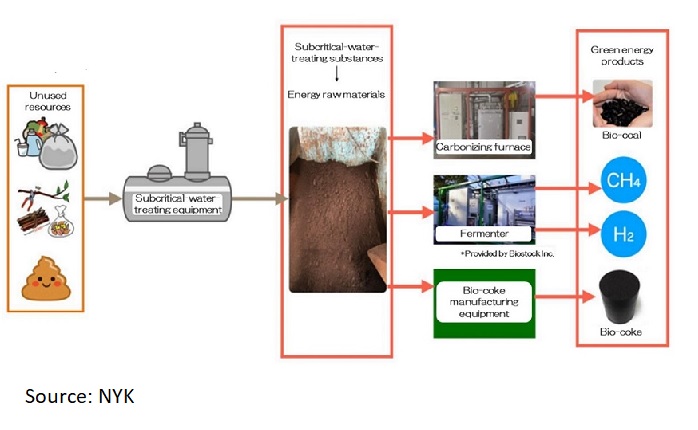
NYK has announced that it will now begin joint studies with its new subsidiary to convert organic waste, such as garbage and sludge, into a source of energy. Waste segregation is not necessary, and it is effective for flammable wastes, vinyl, plastic, styrene foam, clothing, food waste, organic sludge, animal manure and sludge, wood chips “and almost all other organic substances,” NYK says.
Sustainable Energy has developed an integrated, subcritical water, organic waste power-generating system.
Somewhat simply*, “subcritical water” is water that is pressurised and which is hotter than the standard boiling point of water (just under 100 degrees Celsius at sea-level) but lower than 374 degrees Celsius. Subcritical water displays a variety of properties that normal water does not. The strength of the hydrogen bonds in the water decreases which reduces viscosity (thickness) and surface tension while increasing the water’s ability to diffuse.
Molecules of organic matter become more dissolvable as water temperature increases and materials that normally cannot be dissolved in water can dissolve in super-hot water. Meanwhile, gases are also dissolvable in super-hot pressurised water.
Accordingly, it is considered that super-hot water can be a good solvent especially as there is no toxicity involved (unlike other chemical solvents) and there is no residual organic solvent in the final product. It is also non-flammable and non-explosive.
According to NYK, the system developed by Sustainable Energy will produce low-molecular-weight compounds in the form of a dry powder. NYK adds that this material can then be reused as a green energy product such as bio-coal, bio-gas, bio coke. It also does not generate harmful substances such as dioxins (a group of chemicals that persistent organic pollutant that can accumulate in animals and which can be toxic) which are produced by incineration.
*NOTE: scientific material and terminology can be somewhat complex. Shipping Australia therefore simplifies the material to achieve maximum accessibility for the non-scientific reader.