
Uncertainty as to the type of fuel that will be used in the future, and uncertainty over the scope of regulatory measures, are delaying investment in low-carbon fuels and the shipping fleet, the UN Conference on Trade & Development (UNCTAD) has asserted in a new policy brief.
The UN body adds that shipping cannot decarbonise by itself and that enhanced collaboration among key stakeholders both from within and outside the maritime sector is necessary.
“An economic measure in the form of a levy on fuels or a carbon price can help make alternative fuels more competitive, provide certainty to investors and generate funds that can support a green and just energy transition in shipping,” the UNCTAD argues.
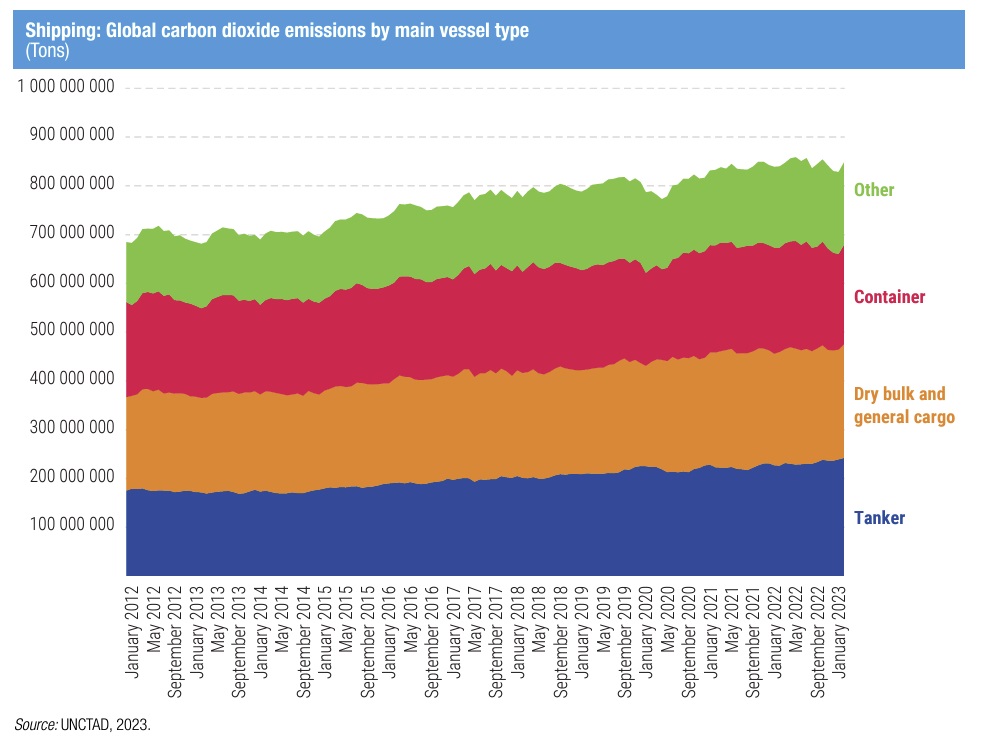
The UNCTAD notes that, although emissions of greenhouse gases per cargo unit and distance travelled (tonne-mile) have declined, the total emissions of the sector have nonetheless steadily increased over time.
Noting that the IMO set a goal in early July this year for international shipping to have net zero emissions by 2050, the UNCTAD observed that IMO negotiations are currently focused on candidate mid-term reduction measures, particularly, a goal-based marine fuel standard and an economic element based on some kind of gas emissions pricing mechanism.
UNCTAD also noted that the transition is underway in shipping, albeit in an infancy stage, and argued that the use of fossil fuels in shipping needs to be replaced as soon as possible with alternatives that do not emit greenhouse gas emissions across their entire life cycle (well-to-wake).
“Decarbonizing shipping is necessary, yet presents challenges, including high transition costs and uncertainty about the choice of the alternative fuels of the future and whether these will be readily available. In addition, uncertainty about the regulatory framework also presents challenges for shipowners, who need to decide whether to renew fleets now or wait until there is greater clarity and certainty about alternative fuels, green technology options and regulatory regimes,” the UNCTAD said.
And substantial investment is needed, with the UNCTAD quoting estimates of US$8billion to US$28 billion annually to decarbonise ships by 2050 and a further US$28 billion to $90 billion needed to develop infrastructure for carbon neutral fuels.
In 2021, UNCTAD conducted a comprehensive impact assessment of the short-term greenhouse gas emissions reduction measures proposed at the International Maritime Organization. In 2023, UNCTAD conducted a simulation showing that hypothetical increases of 10, 30 and 50 per cent in maritime logistics costs would negatively impact trade, with median reductions of 0.11, 0.32 and 0.60 per cent, respectively; and GDP, with median reductions of 0.01, 0.04 and 0.08 per cent, respectively.
The UNCTAD argued that shipping cannot decarbonise on its own and made the following policy prescriptions:
- A universal regulatory framework applicable to all ships should be supported, irrespective of flag of registration, country of ownership or area of operation, to avoid a two-speed decarbonization process;
- Regulations should minimize uncertainty, which restrains the investment decisions of shipowners, shipyards and ports;
- Investors and financial institutions should substantially boost funds for research and development in clean fuel shipping technologies and infrastructure;
- A levy on fuels or a carbon price could help close the price gap between traditional and low-carbon or zero-carbon fuels and make alternative fuels more competitive, while at the same time generating funds that can support smaller and vulnerable economies in achieving a green and just transition.
Read the full briefing
Policy Brief No. 112, November 2023, UNCTAD