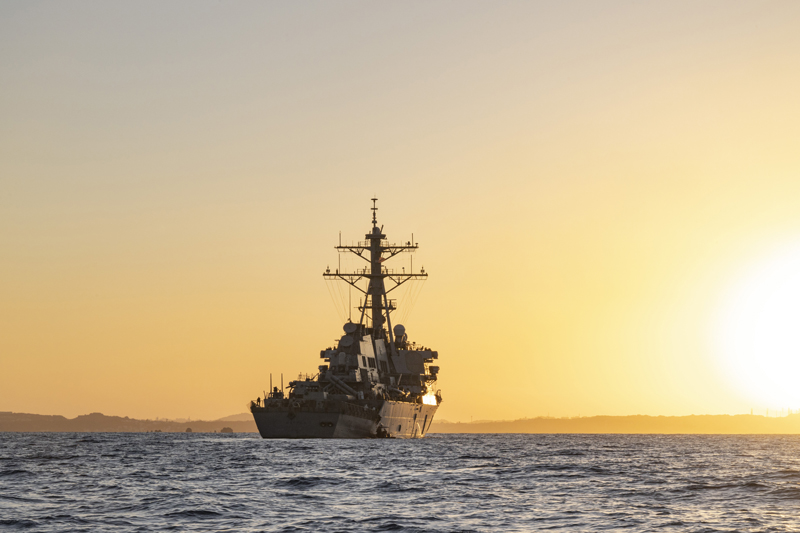
US Secretary of Defense, Lloyd J Austin III earlier this week announced the set-up of “Operation Prosperity Guardian“, a multi-national naval operation under the Combined Maritime Forces Coalition, to protect international shipping from terrorist attacks in the Red Sea.
After the outbreak of the 2023 Hamas-Israel violence in October 2023, the Yemeni-based armed political movement commonly known as the “Houthis” have have launched a series of attacks on commercial ships transiting the Red Sea to / from the Suez Canal from mid-November onwards. Attacks have included hijacking of vessels, drone strikes, anti-ship missile attacks and ballistic attacks.
International shipping companies have largely now announced that they will not transit via the Red Sea, which is a vital transit route in world trade – about 10 percent to 15 percent of global shipping passes over the Red Sea. They have typically diverted ships around the Cape of Good Hope (South Africa) until a safe passage can be guaranteed.
Reckless attacks
Announcing the set-up of Operation Prosperity Guardian, Secretary Austin commented: “the recent escalation in reckless Houthi attacks originating from Yemen threatens the free flow of commerce, endangers innocent mariners, and violates international law. The Red Sea is a critical waterway that has been essential to freedom of navigation and a major commercial corridor that facilitates international trade. Countries that seek to uphold the foundational principle of freedom of navigation must come together to tackle the challenge posed by this non-state actor launching ballistic missiles and uncrewed aerial vehicles (UAVs) at merchant vessels from many nations lawfully transiting international waters. This is an international challenge that demands collective action. Therefore, today I am announcing the establishment of Operation Prosperity Guardian, an important new multinational security initiative under the umbrella of the Combined Maritime Forces and the leadership of its Task Force 153, which focuses on security in the Red Sea”.
It is unknown how Operation Prosperity Guardian will work. In line with standard military communications policy, the naval forces aren’t saying much about how it will work other than naval vessels from a range of nations will be deployed to protect shipping. Air Force Maj. Gen. Pat Ryder at a Pentagon news conference yesterday that that naval forces will “respond to and assist as necessary commercial vessels that are transiting this vital international waterway”.
When asked about tactics and the like, the Major General declined to specific steps and likened the Reds Sea to an international highway and the operation as a “highway patrol of sorts. Patrolling the Red Sea and the Gulf of Aden… It’s a defensive coalition meant to reassure global shipping in mariners that the international community is there to help with safe passage”.
An international coalition, an international community
A variety of nations around the world have sent naval ships to take part in naval operation. To date, over 20 nations have provided support. Australia has, to date, announced that it is sending a small contingent of ADF personnel.
The Major General added: “Last thing I’d say on this is that the Houthis need to stop these attacks. They need to stop them now. You know, that’s clear and simple. And they really need to ask themselves if they’ve bitten off more than they can chew when it comes to taking on the entire international community”.
The Houthis, officially known as Anṣār Allāh, emerged in a western province of the country of Yemen, which is located on the south east of the Arabian Peninsula. It is adjacent to the Gulf of Aden on its eastern coast and the Red Sea and the Bab-el-Mandeb (usually translated as “the Gate of Grief” or “the Gate of Tears”) on its eastern coast. The Bab-el-Mandeb is a particularly important chokepoint for maritime trade as it is deep (over 300 metres) but narrow (about 26 kilometres).
How commercial shipping may be affected
Although, as might be expected of an event of this magnitude, there has been some quite frenzied reporting on the developments, international shipping analysts have been providing a more calm note. Noting that, yes there are vessels of large TEU near the Red Sea that have been diverted, analysts have pointed out that the TEU count refers to capacity and not to actual volumes of cargo. It was also noted that ships are not “stuck” and that some vessels were calling at ports on the Red Sea or where en-route back to eastern Asia when the situation escalated.
It is somewhat difficult to establish what the exact impact will be. Although there have been reports of huge increases in fuel costs because of the longer voyage around Africa, it must be borne in mind that fuel prices vary on a daily basis and that ships can slow down – which massively decreases fuel consumption. Conversely, reports of massive delays should be taken with a pinch of salt as ships can speed up (albeit at the cost of hugely increasing fuel consumption).
Freight rates are determined by a very wide range of factors. At the moment, freight rates are comparatively low, availability of ships are high, cargo demand is relatively low, and fuel prices are moderate (currently about US$600 per tonne of Very Low Sulphur Fuel Oil (Singapore); that price has been about north of USD$1,100 in the past.
The trade route that is most going to be affected are the Asia-Europe. Ships on that route will have to divert around the bottom of Africa. How significant this actually is will depend upon a multitude of factors but the three most obvious are demand for cargo, ship capacity / availability and fuel prices.
Obviously, re-routing will take capacity out of the market and will put extra costs into the market, so there will be upward pressure on freight rates. Price increases are generally passed along the supply chain until they ultimately land on the everyday ordinary consumer.
Impacts on Australia
However, here in Australia, our geographic position may be working to mitigate the harm somewhat, although Australia too will likely experience an increase in costs and delays.
Approximately 12% of our global box trade is with Europe. The rest is mostly with Asia. Nearly all of our bulk exports (grain, coal, iron ore and the like) goes to Asia.
Our main fuel imports are refined products which is sourced from Singapore mostly. Singapore gets its crude oil stocks from a variety of sources, so there could be a diversification of fuel sources – at least temporarily – from supplier nations to refiner nations.
We do not believe that re-routing vessels away from the Suez Canal will cause the same problems that we saw in the 1950s when the joint Anglo-French invasion of Egypt led to the Suez Canal Crisis. Back then there were far fewer supplier nations for goods and commodities of all kinds than now and that diversity will add resilience. There are a lot more ships now of all kinds, and the ships themselves are a lot more efficient (both in terms of their own energy consumption and other business inputs) and in terms of low cost cargo carriage. All of which will tend to mitigate against the problems in the Red Sea right now.
Overall, the situation is of course, far from good, especially as global shipping is also facing the problem of the drought in the Panama Canal, which is also adding delay and complexity – and therefore cost – the global picture.
Shipping will continue to serve the global community
One point, however, is clear.
Throughout history – throughout wars, insurrection, natural disasters and pandemics – shipping has always demonstrated resilience, adapted, sailed on despite the problems, and delivered the goods.
And we don’t expect that to change.