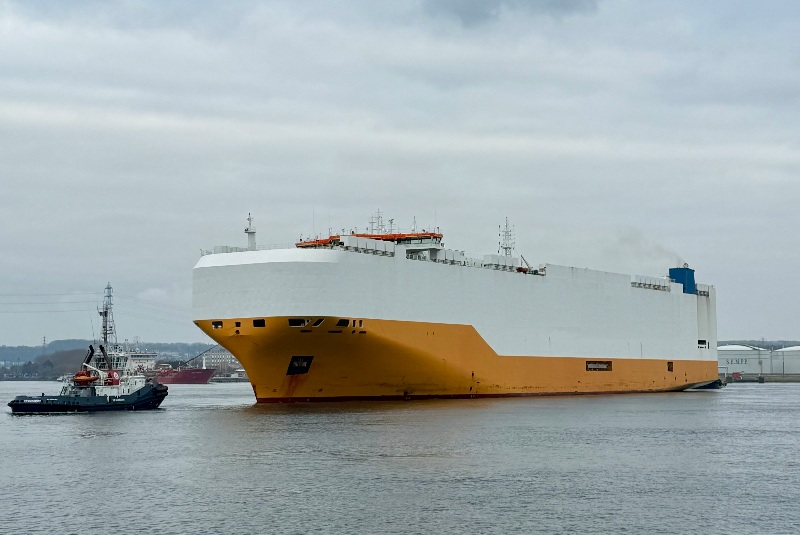
Proposed new rules that would see car carriers calling in United States port hit with steep fees should be withdrawn, the World Shipping Council has told the U.S. Trade Representative.
Referring to the part of the U.S. Trade Representative’s Notice that imposes fees on vehicle carriers, the WSC has declared in a further submission to the U.S. Trade Representative that “Annex III should be withdrawn in its entirety, and why modifications, though desirable, can only mitigate its harm”. The WSC then adds that without prejudice to its overall opposition to the fees and its argument that the fees are beyond the authority of the U.S. Trade Representative to impose, the WSC requests that that the fees ought to be withdrawn.
Economic harm to American consumers
Noting that in 2024, the U.S. exported approximately $60 billion in U.S. manufactured automobiles to foreign markets, half of which are transported by seaborne trade, the WSC observed that car carriers also transport construction and agricultural machinery, special purpose motor vehicles, and railway and tramway stock. The United States exported over $20 billion worth of these goods in 2024, the WSC notes, of which roughly one-third was transported by sea.
“The fees provided for in Annex III apply to all foreign-built vehicle carrier vessels, not just those built in China or those owned or operated by Chinese entities. Nearly all vehicle carrier vessels serving foreign ocean trades of the United States are foreign built. This means that these vessels, with minimal exception, would be subject to the fees provided for in Annex III. These fees could result in the unintended consequence of a reduction in service availability and will lead to cost increases for consumers and U.S. exporters,” the WSC asserts.
China will not be deterred by the fees
The trade association goes on to note the legal authority – or, rather, the lack thereof for the U.S. Trade Representative’s determinations – and further argues that the fees have no relation to tackling China’s dominance in the maritime industry, which is the stated reason by the U.S. Trade Representative for imposing such fees.
“Imposing penalties and fees on all foreign-built vehicle carriers will do nothing to disincentivize Chinese shipbuilding, nor contribute to a competitive U.S. vehicle carrier construction effort… It is inconceivable how imposing a fee on all foreign built vessels would deter or disincentivize the behavior by China that USTR found actionable. In fact, the inclusion of non-Chinese built vessels within the scope of the fees leaves China with its existing price advantage vis-à-vis third-country shipyards and therefore clearly does not incentivize China to alter its acts, policies, and practices,” the World Shipping Council states.
Background to the dispute
In the end-days of the Biden Administration, several U.S. labor unions sought an investigation by the U.S. Trade Representative on the grounds that China had successfully sought to target the maritime sector for dominance thereby hurting American shipbuilding and its shipping industries.
After the U.S. election, the President Trump appointed new Trade Representative issued a report finding that China had indeed successfully targeted the maritime sector and had caused harm to American interests. Since then, there have been a series of notices and consultations on the possibility of imposing fees on China-related ships and shipping so as to reduce that dominance. There’s a lot of detail, some of which can be found elsewhere on the Shipping Australia website.
From 14 October 2025, the U.S. Trade Representative has determined that a fee will be levied per Car Equivalent Unit on any non-U.S.-built vehicle carrier. That fee is set at $0 for the first 180 days, then it will hit US$150. Fee remissions are available for up to three years if the operator orders and takes delivery of a U.S. built vessel of at lest equivalent size. A “vehicle carrier” is defined if it is identified as such on U.S. customs documentation. The USTR determination notes, for information only, that vehicle carriers are ships that are designed for wheeled or tracked cargo that can load itself on-board. A U.S. built vessel must be (1) built in the US (2) documented under the laws of the US (3) have all major components of the hull or superstructure manufactured (including from the initial melting stage) in the US (4) a list of components, such as shipboard anchor, air circuit breakers, machine tools, auxiliary equipment and more, are built in the United States.