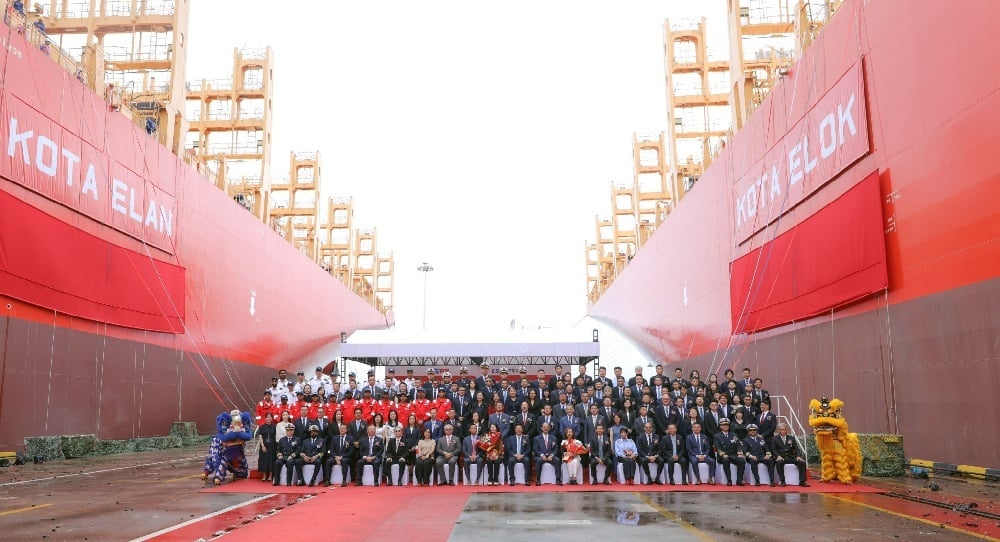
A sod-turning ceremony has marked the beginning of construction work on the Somerton Intermodal Terminal, which is set to become a major part of Victoria’s freight infrastructure.
James Kurz, a director at ship’s agency and logistics company Coastalbridge Agencies, and who is also the chair of Shipping Australia Victoria, commented: “this represents a significant milestone in enhancing efficiency, sustainability and connectivity within our region. By seamlessly integrating rail and port operations, we can unlock opportunities for economic growth and trade expansion, while reducing congestion and environmental impact. Additionally, it is vital that high-capacity rail connections are developed to all three Melbourne container terminals so as to support future growth and to improve those environmental outcomes.”
Price tag, dimensions, key facts
The open-access, independently-owned, terminal itself is privately funded with a price tag of $400m, 28 plus hectare of hardstand and should be ready for use by 2025. The fully-electric intermodal rail terminal will have a one million TEU capacity in its phase 1, will be able load / unload IMEX and inter-state trains (Inland Rail and East-West) and will be able to double-stack trains.
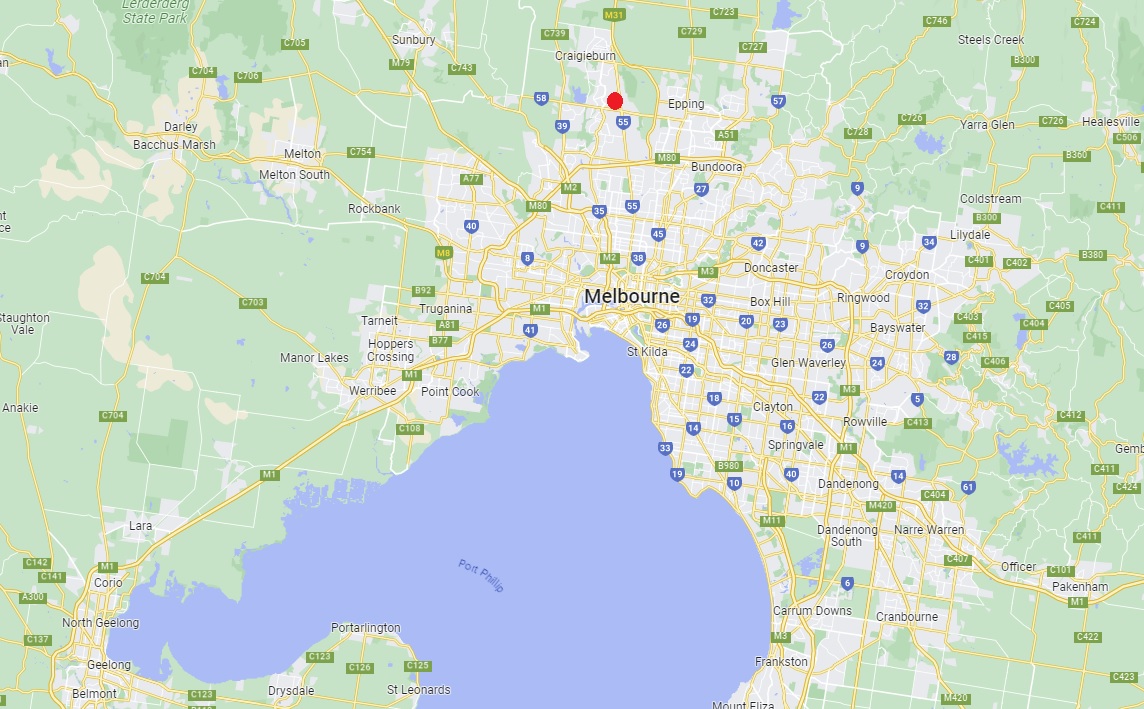
Somerton Intermodal Terminal, as its name suggests, will be located in the Somerton area, in the northern outskirts of Melbourne. The terminal is currently being built by Acciona Rail and it will be Australia’s largest rail terminal. It will be 21km from Melbourne CBD, 12km from Melbourne Airport, and 26km from the Port of Melbourne. The site is also located near the Hume Highway, which connects Melbourne and Sydney, and it’s approximately 20km south of the area of Beveridge, which is where the Inland Rail is currently due to terminate in Victoria. There is an existing rail link that runs through the area Beveridge and near the area of Somerton.
The new terminal will, initially, replace 500,000 truck trips (equivalent to 454 million truck kilometres) from inner Melbourne roads, thereby saving on road damage, traffic congestion, and pollution. It will save 451 million litres of fuel and cut carbon dioxide emission by 189,000 tonnes.
The owner-operator of Somerton is the Intermodal Terminal Company.
Major investments
The terminal will be a key hub in the $58 million Port Rail Shuttle Network, which will enable trucks to pick up or drop off containers from hubs in outer Melbourne instead of driving to the Port of Melbourne. The Port itself is investing $125 million in new rail infrastructure to cater for the shuttle trains.
Commenting on development, the Victorian Minister for Ports and Freight, Melissa Horne, said: “The investment by the State and Federal Governments and the private sector into the Port Rail Shuttle Network, enables these major investments to occur which will put more freight onto rail, take trucks off local roads and support exporters.”
Shipping Australia certainly welcomes and applauds the investment and efforts at Somerton. It is a great project, we can see it adds value to supply chain, and we wish it every success.
Looking at the wider logistics picture
Stepping back a little, and looking at the wider logistics picture, and we can observe that there’s a little growth / logistics connectivity problem in the wider region that really needs examining.
Shipping Australia notes, generally, ship sizes around the world are increasing. That means that all three of the container terminal operators in Melbourne, are, or will likely soon be, receiving bigger ships than previously.
That means there are now, or soon will be, even bigger container exchanges (i.e. boxes on and off ships). Volumes at Melbourne are only going to get bigger too; forecasts indicate that box volumes are going to increase from 3m TEU a year to about 9 million TEU a year. It’s very likely that the increase in volume will be spread out between the three different terminal operators.
Let’s have a look at the road and rail connectivity at Melbourne.
Shipping Australia notes that the Victorian government’s port shuttle rail project connects the Swanson, Appleton, and Victoria docks in the northern part of the port to the national rail network and thence to terminals like Somerton. These docks are also well-connected by road.
Limited road capacity, future growth in transport demand
Heading south around Fishermans Bend, toward Webb Dock, and there is limited road capacity, with little leeway to expand the local road network. “Future growth in road demand will constrain efficient freight movements,” Infrastructure Australia notes, and this will “lead to higher costs for importers and exporters, reduced efficiency of trucking… and reduced throughput for stevedores”.
It’s just as well then, that there are already efficient, frequent, high-capacity train services into and out of Webb Dock. Right? Eh? Right? Er, no. Wrong.
Infrastructure Australia notes that all freight to / from Webb Dock is carried by road.
It’s just as well then, that there is already advanced construction underway for efficient, frequent, high-capacity train services into and out of Webb Dock. Right? Eh? Right? Er, no. Wrong.
There is no advanced construction taking place.
It’s just as well then, that construction is about to get underway for…. … … oh, ok, well, let’s not bother with the rest of that sentence.
We all think it’s a good idea…
A lot of important bodies do think it would be a good idea to have a rail connection for Webb Dock. Infrastructure Australia has the “Rail Access to Webb Dock” project on its national Infrastructure Priority List. The Victorian Freight Plan “Delivering the Goods,” makes frequent references to rail connections to Webb Dock. Port of Melbourne’s 2050 Port Development Strategy also calls for a rail connection to Webb Dock by 2030-35.
A rail freight link to Webb Dock could be done. There used to be one, in fact. It was opened in February 1986 by Victoria’s then Minister for Transport, Tom Roper. It crossed the Yarra River via a bridge, ran westwards alongside Lorimer Street, and curved southwards running adjacent to Todd Road, before quickly whizzing around to the west of the West Gate Park, and then under the West Gate Freeway. In Ye Olde Days, it then doubled-back eastwards to connect to Webb Dock.
The rail link fell out of use in 1992 and part of the line was later built over. But much of the line west of the Bolte Bridge is still in existence and Infrastructure Australia notes that one option is to re-instate that old rail freight link. In “Our Plan for Rail 2020”, the Port of Melbourne sees any potential Webb Dock rail line as following that exact route although, we understand, there’s apparently a big debate whether the route should go over the Yarra River via bridge or under it via tunnel.
So, lots of good wishes and suggestions from important and credible bodies that there should be rail access to Webb Dock, but… as for anyone actually doing anything about it? Well, you can practically hear the crickets chirruping in the background.
Sub-optimal efficacy, efficiency, and investment
The key point is that, while it is great that Melbourne will have an excellent port-rail network that links the port to intermodal terminals, one of the three main terminals, Webb Dock, is not yet connected by rail to the rest of the rail freight network. Nor will it be any time soon because, y’know, no construction as yet.
And that’s not good.
As Webb Dock is one of the three main container terminals at the Port of Melbourne, then the lack of a rail connection renders the efficacy and efficiency of the rail and intermodal investments as very sub-optimal.
Especially as the project has been / is being paid for in advance by a $9.75 increase in tariff per TEU on full import containers. That’s double-especially-so when it is remembered that cargo imported via Webb Dock was also subject to the same fee increase despite the fact that there is no direct rail interface to Webb Dock and none has (as yet) been built, nor is in the process of being built.
Time to get into the right gear
Melbourne is one of Australia’s most important container ports. This nation’s international trade and economic prosperity depends upon all parts of the Port of Melbourne being connected to the rail freight network. Shipping Australia therefore urges, and calls for, the start of construction on Webb Dock’s rail access underway as soon as is humanly possible.
It’s time to get building.