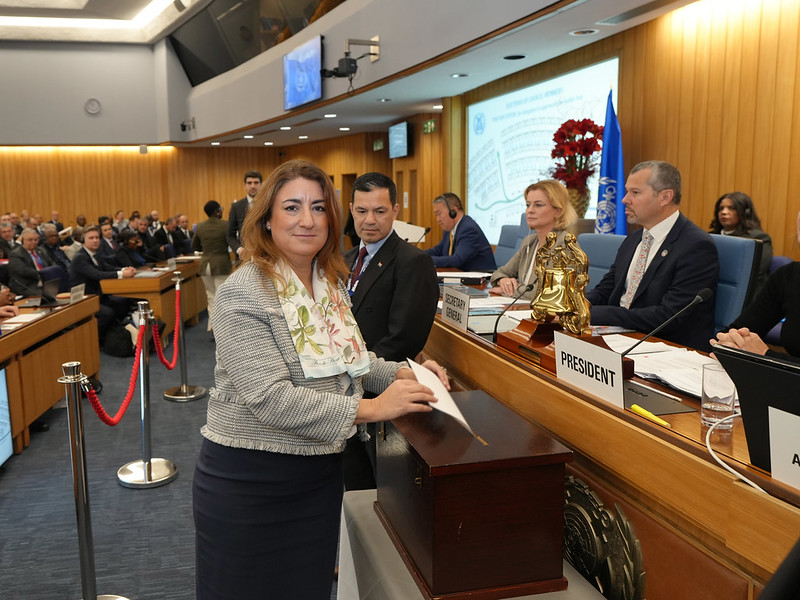
Australia was re-elected to the International Maritime Organization Council on 28 November 2025.
A seat has been secured by Canberra which nominated in Category B – one of the ten Member States of the IMO which has the largest interest in international seaborne trade.
The other countries elected in this category are
- Brazil
- Canada
- France
- Germany
- India
- Netherlands (Kingdom of the)
- Spain
- Sweden
- United Arab Emirates
Category A is for Member States that have the largest interest in the provision of international shipping services.
The countries elected to the IMO Council under Category A are:
- China
- Greece
- Italy
- Japan
- Liberia
- Norway
- Panama
- Republic of Korea
- United Kingdom of Great Britain and Northern Ireland
- United States of America
Category C is reserved for 20 Member States that have “special interests” in maritime transport or navigation.
Countries elected to the IMO Council under Category C are:
- Bahamas
- Belgium
- Chile
- Cyprus
- Egypt
- Finland
- Indonesia
- Jamaica
- Malaysia
- Malta
- Mexico
- Morocco
- Nigeria
- Peru
- Philippines
- Qatar
- Saudi Arabia
- Singapore
- South Africa
- Türkiye
The newly elected Council will meet for its 136th session on 4 December and will elect its Chair and Vice-Chair for the next two year period.
The IMO consists of an Assembly, a Council, and five main committees: the Maritime Safety Committee, the Marine Environment Protection Committee, the Legal Committee, the Technical Cooperation Committee and the Facilitation Committee.
There are a number of sub-committees that support the work of the five main committees.
The Secretariat of IMO consists of the Secretary-General and approximately 300 international personnel based at IMO HQ in London.
The Secretary-General of the Organization is Mr. Arsenio Dominguez who was appointed to the position with effect from 1 January 2024, for an initial four-year term. Mr Dominguez is the tenth person to hold the position of IMO Secretary General, since the organization was founded (as the Inter-Governmental Maritime Consultative Organization in 1958; it changed its name to IMO in 1982).
Article 1(a) of the IMO Convention sets out the main purposes of the IMO “to provide machinery for cooperation among Governments in the field of governmental regulation and practices relating to technical matters of all kinds affecting shipping engaged in international trade; to encourage and facilitate the general adoption of the highest practicable standards in matters concerning maritime safety, efficiency of navigation and prevention and control of marine pollution from ships”.