
When the IMO adopted the non-mandatory MASS Code in May 2026, it marked a historic moment.
Shipping Australia’s CEO, Capt. Melwyn Noronha commented: “let’s be honest, adopting the Code is the easy part in the entire process. The real test is whether it works when ships, systems, and people meet real-world conditions”.
That challenge begins now.
Whether what is written in the Code actually works in practice is a different question, and one that cannot be answered at IMO committee table.
That answer will come from the Experience-Building Phase, which should not be treated as a passive reporting exercise. It is more like a stress test for the non-mandatory MASS Code to show the workability of the Code in a real operational environment.
Why This Matters Now
IMO has established a clear roadmap for the development of the goal-based MASS Code. While the timeline may change as operational complexities emerge, the latest version sets out a clear sequence:
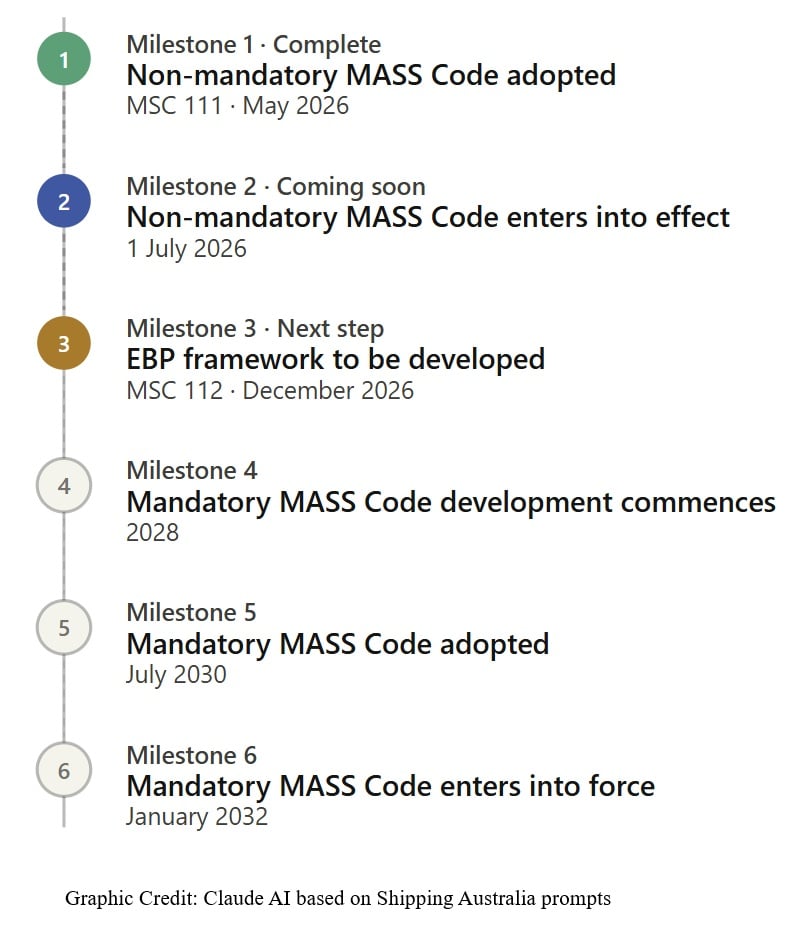
So, we are standing at the threshold, the Code exists, but real-world performance is untested.
MSC 112 in December is a critical IMO session. It will discuss the EBP framework, including data collection, evidence types, feedback structure, and other related matters.
Those decisions will shape the mandatory Code that follows and its credibility. If the EBP evidence is incomplete, selective, or disconnected from real operations, the industry risks carrying unresolved issues into the next stage.
The Risk of Getting the Experience-Building Phase Wrong
The risk is not simply that the EBP collects general data or too little information. The greater risk is that the framework is poorly designed, and the evidence comes mainly from narrow, promotional trials in highly controlled environments. That could create a false sense of confidence.
The real test of confidence in MASS will not be routine operation. It will come when something goes wrong with connectivity, handover, remote operator intervention, cyber threats, search and rescue response, or the chain of authority.
One incident may not invalidate the whole MASS Code, but it could expose weaknesses seriously enough to reduce confidence in the regulatory pathway and slow the move towards a mandatory framework.
What the Experience-Building Phase Really Is
An Experience-Building Phase, or EBP, is not a consultation exercise. It is a structured, evidence-driven process. It is a period in which IMO and Member States learn from practical experience before moving to the next regulatory step. Its purpose is to collect evidence, analyse operational experience, identify what is working, and decide what needs to be changed before a framework becomes mandatory.
IMO has used this approach before, including in connection with the Ballast Water Management Convention and underwater radiated noise.
Why the MASS Experience-Building Phase is Different
The MASS EBP is likely to be more complex and system-wide than earlier examples. Ballast water management and underwater radiated noise are important technical and environmental issues. MASS, however, goes directly to how ships operate and affects the entire maritime ecosystem.
It will involve a wider ship-shore-port ecosystem, including shipowners, crews, remote operators, ports, pilots, VTS, classification societies, technology providers, training institutions, and Administrations.
In some cases, ship operations may be distributed between ship and shore personnel, with intelligent systems and software involved in operational decision-making. This may require shared decision-making, shared responsibilities, and new forms of coordination between humans and systems.
That makes the MASS EBP more than a technical or technological review. It is a test of whether the Code can work across a distributed operational ecosystem.
How the MASS Experience-Building Phase Works
The MASS EBP is expected to be structured around three core workstreams:
- Data collection;
- Data analysis; and
- Code review, including the development of amendments and additions to the Code.
These workstreams will support the development of the EBP framework, reporting template, data repository, and analysis process. The results, together with review by relevant IMO bodies, will then support the development of SOLAS chapter XVI amendments and the mandatory MASS Code.
The key point is that the EBP is not simply about editing the wording of the Code. It is the main opportunity to test whether the Code is workable, practical, and safe in real MASS development, approval, and operation.
What the MASS Experience-Building Phase Must Examine
The IMO has already identified an initial list of EBP topics covering a range of themes. Those topics are important, but when read alongside the Code text, some practical matters deserve closer attention in a more distributed operational environment.
The difficult moments are unlikely to be routine operations. They are more likely to arise when a system fails, conditions change quickly, a handover is needed under pressure, or the chain of authority, intervention pathway, or system behaviour is not clear in practice.
The key areas that must be tested in this phase include the following:
- Shared responsibility and operational handover in practice
- Role-specific training and cross-functional competence
- Joint decision-making
- Joint operational procedures
- Cybersecurity assurance for MASS and Remote Operations Centre systems (scenario-based threat modelling and recovery)
- Software governance and responsibility
- Tiered emergency response arrangements
The EBP should also include clear prioritisation criteria. The Human element should not be treated only as a separate topic, because it cut across MASS design, operation, certification, remote operation, emergency response and ship-port interaction.
What Will Make or Break the MASS Experience-Building Phase: Data Quality
It is critical to make sure the data collected during the EBP explains the operational reason behind each experience, not simply that it occurred. The quality of this data will determine the success of this phase.
The quality of the data collected should include the following:
- Operational setting: open water, pilotage waters, port areas, channels, anchorage or berth vicinity
- Mode of operation and duration: mode used and time spent in each mode
- Experience type: trial, demonstration or commercial service
- Human arrangement: crew onboard, remote operators, ROC personnel, master location
- Responsibility: whether control was individual, shared, transferred, or unclear
- External interaction: pilots, VTS, tugs, terminals, or local port procedures
- Operational condition: normal, abnormal, degraded, fallback, or emergency
These details matter because the same MASS function may raise different issues depending on the operational setting. A function that appears effective in open water may create different safety, coordination, or intervention issues when the ship is in congested waters.
What Evidence Matters Most
EBP evidence should not be limited to successful applications or selected cases. Its reliability and neutrality will depend on whether it also captures operational difficulties, including near misses, unsafe states, failed transfers of control, machinery issues, human-machine trust issues, and procedures that did not work well in practice.
The EBP framework should allow both structured data and structured qualitative reporting. Numbers and checkboxes can show what happened, but they may not explain why it happened. Operators and stakeholders should be able to describe in detail what was unclear, what created workload, what affected trust, what made intervention difficult, and what was not workable under real operational conditions.
Final Thought
The industry now has the non-mandatory MASS Code. Commenting further SAL CEO said: “The strength of the mandatory Code will depend on the quality of evidence gathered during the Experience Building Phase. The EBP should challenge the Code to make sure it is genuinely fit for purpose”.
Further Reading:
A Revolutionary Turning Point in Maritime History: The IMO Adopts the MASS Code
Inside the MASS Code: Rethinking Maritime Safety in a Distributed World
New international framework will regulate ships operating with little or no human crew
The Experience-Building Phase Associated with The Ballast Water Management Convention