The importance of preserving navigational rights and freedoms in accordance with international law was reaffirmed by the Council of the International Maritime Organization (IMO).
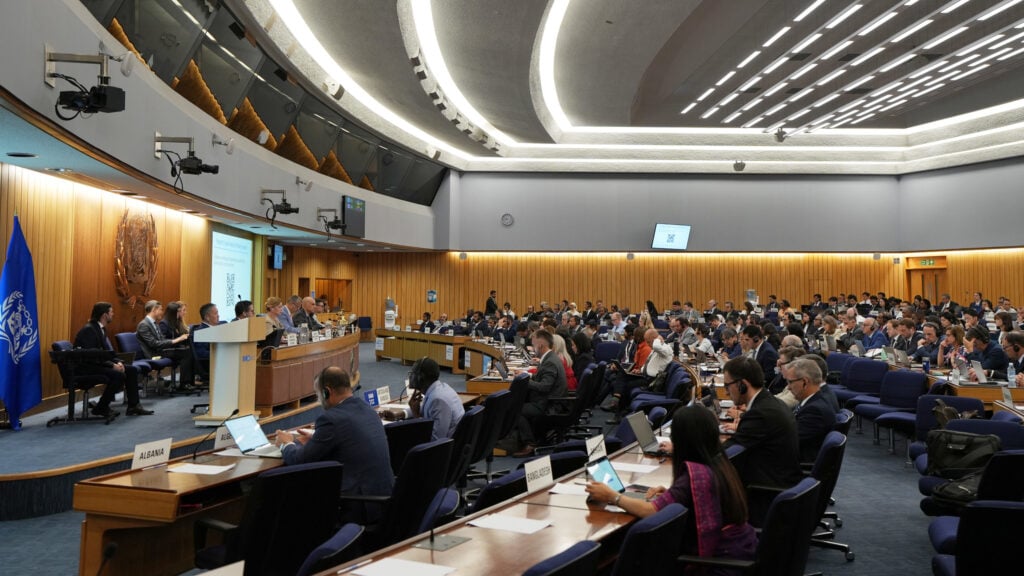
The IMO Council is the executive organ of the IMO and is responsible for the work of the IMO. In a resolution adopted during the 137th session (6 – 10 July), the Council stressed that the right of transit passage through straits used for international navigation should not be threatened, impeded, denied, hampered, impaired or suspended. In addition, the Council reiterated that any measures taken by coastal States to regulate traffic in vital shipping lanes should be done with accordance with IMO regulations under the International Convention on the Safety of Life at Sea (SOLAS).
In his opening remarks, IMO Secretary General Arsenio Dominguez commented: “I would like to take a moment to reflect on the human cost to the maritime sector due to the ongoing tensions around the Strait of Hormuz. Seafarers have tragically lost their lives in connection with this conflict, and the impact has been felt well beyond the region, with real consequences for global trade, energy and food security”.
Strait of Hormuz
The IMO Council condemned the attacks on civilian commercial ships and called for the de-escalation of tensions in the Middle East region. It stressed that any arrangement between the littoral States of the region shall guarantee the non-discriminatory and unimpeded right of transit passage of all ships, through the internationally recognised traffic separation scheme adopted by IMO in 1968.
The Council reaffirmed that passage through the Strait should remain free of any tolls and charges, in accordance with international law, including the IMO Convention. It requested the Secretary-General to explore options that advance safe maritime traffic and to work with littoral States, other Member States and the industry to ensure a coordinated and sustainable return to unhindered navigation through the Strait.
The IMO Council
The IMO Council has a complicated structure. There are forty members of the Council, and, in the context of war in the Gulf, it is notable one of the belligerents, the U.S.A., sits on the Council. Several of the countries in the region that have been attacked by Iran are also on the Council, namely, the UAE, Qatar, and Saudi Arabia. Although Iran is not represented on the IMO Council, it did join the IMO in 1958, and has been taking part in discussions and committees.
The members of the IMO Council for the 2026-2027 term are as follows:
Category (a): 10 States with the largest interest in providing international shipping services (listed in alphabetical order):
China, Greece, Italy, Japan, Liberia, Norway, Panama, Republic of Korea, United Kingdom of Great Britain and Northern Ireland, and the United States of America.
Category (b): 10 States with the largest interest in international seaborne trade:
Australia, Brazil, Canada, France, Germany, India, Kingdom of the Netherlands, Spain, Sweden and the United Arab Emirates.
Category (c): 20 States not elected under (a) or (b) above, which have special interests in maritime transport or navigation and whose election to the Council will ensure the representation of all major geographic areas of the world: Bahamas, Belgium, Chile, Cyprus, Egypt, Finland, Indonesia, Jamaica, Malaysia, Malta, Mexico, Morocco, Nigeria, Peru, the Philippines, Qatar, Saudi Arabia, Singapore, South Africa and Türkiye.