Shipping has always changed slowly, until it doesn’t.
At certain points, a new development becomes too significant to remain outside the regulatory system.
There are moments in maritime history when the industry shifts in ways that affect not only ships, but the wider system around them. The transition from sail to steam, the move from coal to diesel, and the introduction of electronic navigation, GMDSS and digital systems all changed how ships were operated, how safety was managed, and what skills the maritime workforce needed.
In May 2026, another significant moment arrived.
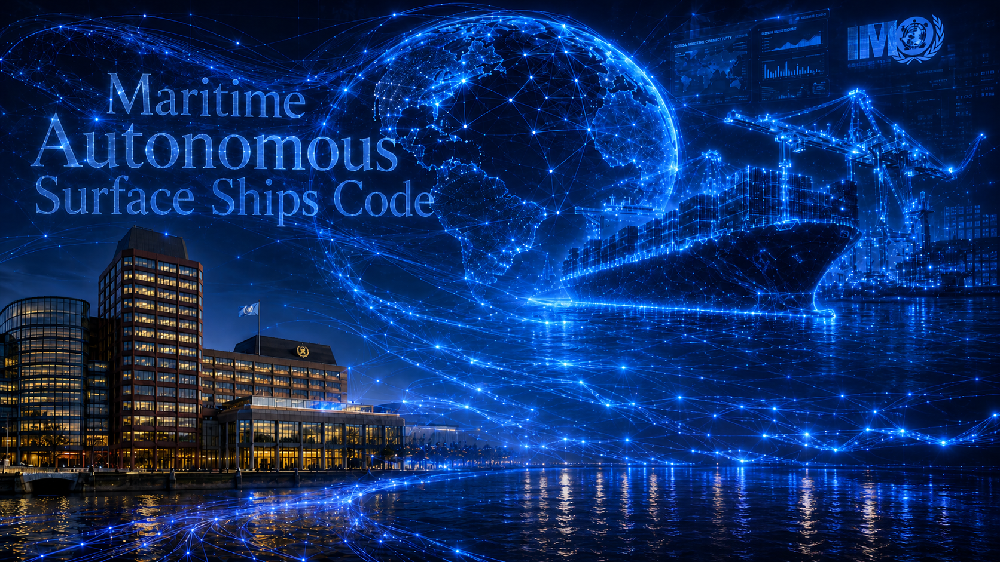
The International Maritime Organization (IMO) adopted the International Code of Safety for Maritime Autonomous Surface Ships, known as the MASS Code. Taking effect from 1 July 2026, this non-mandatory Code establishes the first global safety framework for cargo ships with autonomous or remotely operated functions, including their associated Remote Operations Centres (ROCs).
This is more than a regulatory milestone. It marks the point at which autonomous shipping moves from research, trials, and policy discussion into a recognised reality within the international regulatory system.
A Shift Comparable to the Greatest Transformations in Shipping
For years, autonomous shipping existed in a space of possibility. It was tested in pilot projects, debated in policy circles, explored in research, and discussed as part of the future of shipping.
That phase has now changed.
The adoption of the non-mandatory MASS Code places autonomous and remotely operated shipping within the wider history of major maritime transformations. Like earlier changes, it will affect operations, safety, regulation, training and the way maritime work is organised.
But this transition reaches deeper and carries wider system-wide implications.
Autonomy does not simply introduce new equipment on board. It changes where some decisions may be made, how responsibility may be assigned between humans and software systems, how human judgement works with intelligent systems, and how trust is maintained when some ship functions may be controlled, monitored or supervised from outside the ship.
In that sense, this transition is not only technological. It is structural, operational, regulatory and organisational.
Why This Moment Matters Now
Shipping has always been careful with change, and for good reasons. Safety, reliability, environmental protection and global trade consistency are central to how the maritime industry maintains trust. But caution has never meant refusing to move forward.
The MASS Code provides the industry with something concrete to work with.
It signals that autonomous and remotely operated ships are no longer only hypothetical. They now have a formal place within the international regulatory system. The discussion has moved from whether this may happen one day to how the industry prepares, tests, assesses, approves and builds confidence before the mandatory framework arrives.
A Decade in the Making, but a Clear Shift in 2026
The adoption of the non-mandatory MASS Code did not come suddenly. It is the result of nearly a decade of structured regulatory work, beginning in 2017 when IMO formally placed Maritime Autonomous Surface Ships (MASS) on its agenda.
From the beginning, the issue was bigger than technology. It raised practical questions about ship operations, remote control, human oversight, training, responsibility, approval processes and the wider maritime system.
That is why the significance of 2026 is not that the technology itself changed overnight, or that the Code was a sudden response to technology trends. What changed is its regulatory status.
That background matters because it gives weight to what has now been adopted. The Code gives autonomous shipping a recognised place in the international regulatory system.
Not Just Another Rulebook
The MASS Code should not be mistaken for a niche technical document relevant only to innovators or technology developers.
Its relevance is much wider because autonomous and remotely operated ships do not operate in isolation. They are part of a broader maritime system involving ports, pilots, regulators, insurers, training providers, seafarers, classification societies and many others.
Different parts of the sector may approach the Code from different practical angles:
- Ports: through ship–shore interaction and port entry
- Pilots: through vessel behaviour and control in complex waters
- Regulators: through approval, oversight and compliance
- Insurers and legal advisers: through risk, liability and responsibility
- Training institutions: through future competencies and training needs
- Seafarers and unions: through changing roles, workload, and responsibility
- Classification societies and surveyors: through assurance, verification and certification
That is why the Code matters beyond the ship itself. It gives each part of the industry a reason to consider how existing arrangements, responsibilities and skills may need to evolve.
The Importance of the “Non-Mandatory” Phase
The fact that the Code is non-mandatory does not diminish its significance. In many ways, it strengthens it.
For a subject of this complex, the non-mandatory phase should not be understood as a delay. It gives Administrations, industry and other stakeholders time to work with the Code, understand where it fits, where it creates difficulty, and what still needs to be clarified before the mandatory framework is finalised.
The value of this phase is learning before obligations are locked in.
However, there is a risk in misreading this moment.
Some stakeholders may treat “non-mandatory” as “not urgent”. That would be a mistake. Treating the Code as optional or distant would be like ignoring early electronic navigation when it was already clear that it was becoming part of the future of ship operations. A wait-and-see approach may feel safe in our cautious industry, but in this case, it carries its own risk.
The IMO roadmap reinforces this urgency. The Experience-Building Phase framework is expected in December 2026, work on the mandatory Code is planned to begin in 2028, adoption is targeted for 1 July 2030, and entry into force is planned for 1 January 2032.
While the exact timing of the roadmap may change as the work develops, given the complexity of shipping operations, the next stage has already begun. The non-mandatory phase should be treated as a working period, not a waiting period.
A Global Shift with National Implications
As with previous maritime transformations, the impact of autonomous shipping will not be limited to the countries where the technology is developed or where the ships are built.
Many maritime nations may become part of this transition through their ports and their existing roles as flag States, port States or coastal States. Autonomous and remotely operated ships may call at their ports, transit their waters, operate near offshore facilities, interact with VTS systems, or require inspection, emergency response, repair and support. Some countries may also host a Remote Operations Centre, or part of the shore-based operational arrangement.
This is why the MASS Code matters beyond technology developers and early adopters. It gives IMO Member States and industry stakeholders time to consider how the Code may work in practice, how it may affect national operations, policy, workforce planning and budget allocation for digital and physical infrastructure, and what issues should be raised before the mandatory framework is finalised.
Autonomous shipping will still depend on common expectations across the international maritime system. It will not work through isolated national approaches alone. Early engagement will help maritime nations test the Code against their own operational realities and contribute to a safe and consistent global framework.
The Practical Question for the Industry
The key question now is not whether autonomous shipping will emerge. It is how each part of the maritime system responds and prepares for it.
For organisations across the sector, the starting point is practical. The questions worth asking now are:
- Where does the MASS Code touch our existing work, operations or responsibilities?
- Which of our current arrangements are still fit for purpose?
- Which may need to change, and how?
- What needs to be clarified before the mandatory framework is finalised?
- What does this mean for workforce planning, training and future skills?
- How might legal responsibility, liability and accountability be affected in our area of work?
- How should cybersecurity, data integrity and access control be managed as maritime operations become more digital and connected?
The answers will differ across the sector, depending on each organisation’s role and exposure within the maritime system.
The point is not that every organisation needs to be ready to work with MASS tomorrow. The point is that each part of the sector needs to understand where autonomous or remotely operated functions, and any associated Remote Operations Centres, may affect existing procedures, funding decisions, and strategic planning.
These questions should not be left until autonomous ships become common. By then, the opportunity to shape the framework may be much smaller.
Conclusion: The Beginning of a New Maritime Era
The MASS Code does not mean remotely operated and autonomous ships will suddenly dominate global trade routes. Nor does it resolve the complex issues surrounding safety, liability, cybersecurity, insurance, training, the human element and operational control.
What the Code does is mark a clear shift. Autonomous and remotely operated shipping is no longer only theoretical; it is now part of the future regulatory and operational landscape. Like previous transitions, this moment may only be fully understood in hindsight.
The Code gives industry a starting point.
What happens next depends on how seriously this non-mandatory phase is used.
Commenting on the recent IMO developments Shipping Australia’s CEO, Capt. Melwyn Noronha said: “As someone who has spent a career at sea, I can say with certainty, the MASS code isn’t the future, it’s the present. Those preserving traditional approaches are missing the transformation. The real risk now is not change itself, but failing to move with it”
Final Note
On behalf of Shipping Australia, I would like to congratulate IMO, IMO Member States, and the international shipping and maritime industry on this significant milestone. The adoption of the non-mandatory MASS Code represents an important and encouraging step toward the safe and structured evolution of shipping. We look forward to a practical and constructive Experience-Building Phase as the industry transitions toward the mandatory framework.
For more information, please refer to the following IMO sources:
Maritime Safety Committee (MSC), 98th session, 7-16 June 2017
Maritime Safety Committee (MSC), 99th session 16-25 May 2018
Maritime Safety Committee (MSC), 100th session, 3-7 December 2018
PREVIEW: Maritime Safety Committee – 111th session (MSC 111), 13-22 May 2026