What do the United Nations and the IMO really matter? This author has certainly heard many insults and criticisms hurled at bodies like the U.N. and the IMO. They are distant, have no power, and are mere global talking shops, the critics say.
What value have circulars and missives against cruise missiles? Denunciations vs drones? Bureaucracy vs bombardments?
And yet, even though the roar of war rages across Hormuz and the Middle East, the warring powers and those that are affected by their war continue to yell and argue and debate at the IMO. The U.N. and the IMO say lots of things. The IMO passes lots of circulars. Oversees many conventions. Delegates to its assemblies engage in a lot of talk. As former British Prime Minister Winston Churchill might have put it, they engage in a lot of jaw.
Even now, despite a literal war being underway, there is a giant international argument being prosecuted at the IMO, with much of the world condemning Iran for allegedly breaching international maritime law. Iran denies in one breath that it is even subject to that law, and in the next relies on concepts from that international maritime law, such as the territorial sea and the exclusive economic zone, to push its claims. We have discussed the legalities of the situation – of UNCLOS, and international customary maritime law, elsewhere.
Nations around the world take the U.N. and the IMO, and international conventions extraordinarily seriously, even during wartime. They spend a lot of time, effort, and treasure preparing, travelling, attending, debating, enacting, implementing, and complying.
It clearly matters.
But why?
Bellum omnium contra omnes…
Freedom of navigation, and many of the other global benefits that have served to boost prosperity, ultimately depend upon finding a way to solve the problem described by English political philosopher Thomas Hobbes (1588-1679)*.
Hobbes would have found the current Hormuz situation entirely understandable.
He argued that each person has a variety of desires, and those desires vary by person. There are resources available for consumption to satisfy those desires but there are not enough to satisfy everyone at all times given the demand for, and the variability of, those desires. Additionally, every person is a judge, jury and executioner in their own case and is likely to act in their own interests.
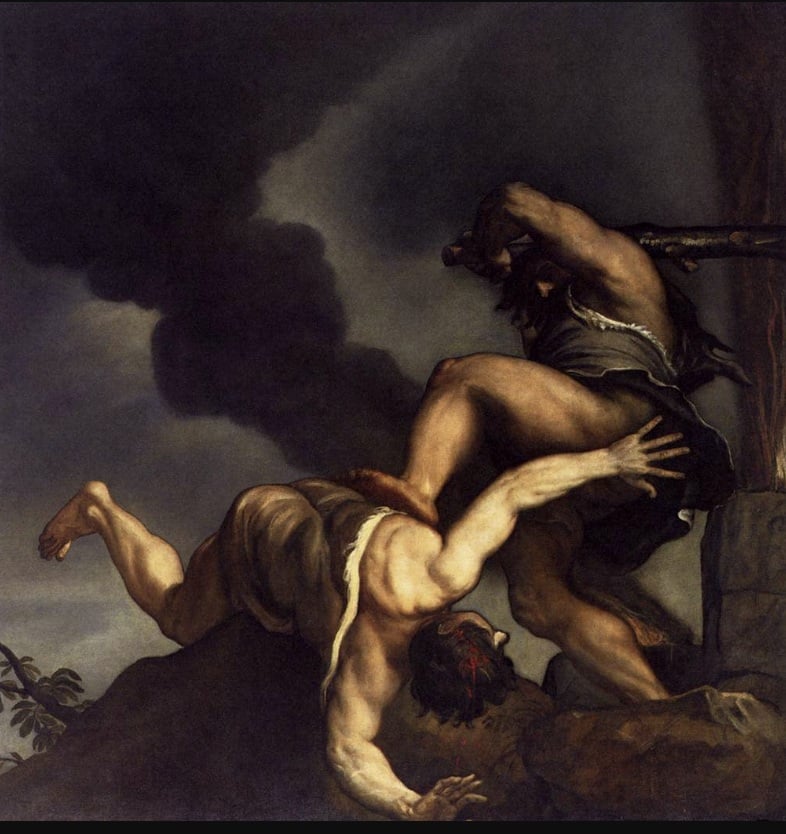
This was, and is, the state of nature. This is the situation in which all seek to satisfy their own desires at the expense of everyone else. Such a state was described as bellum omnium contra omnes – the war of all against all**.
There can be no respite in a state of nature, a state of war, as not even strength provides protection. Even the weakest can kill the strongest, if the circumstances permit. Even those who would otherwise willingly refrain from violence must be afraid that others will not, especially from the vain-glorious and those who are desirous of your land, your property, and your person. And so those who would exercise restraint, cannot. They must instead act.
Human civilisation was very difficult, if not impossible, according to Hobbes in a state of nature, and our lives were miserable:
“there is no place for industry, because the fruit thereof is uncertain, and consequently no culture of the earth, no navigation nor use of the commodities that may be imported by sea, no commodious building, no instruments of moving and removing such things as require much force, no knowledge of the face of the earth, no account of time, no arts, no letters, no society, and which is worst of all, continual fear and danger of violent death, and the life of man, solitary, poor, nasty, brutish, and short.”
To escape the state of nature, and the war of all against all, the people have expressly or impliedly entered into a mutual, near-irrevocable, social contract with each other. People agreed to cede their individual, personal, sovereignty to a sovereign institution. This is an entity that has the power to tie hands, to enforce restraint, to pass and enforce the laws so as to ensure the peace, security, and good order.
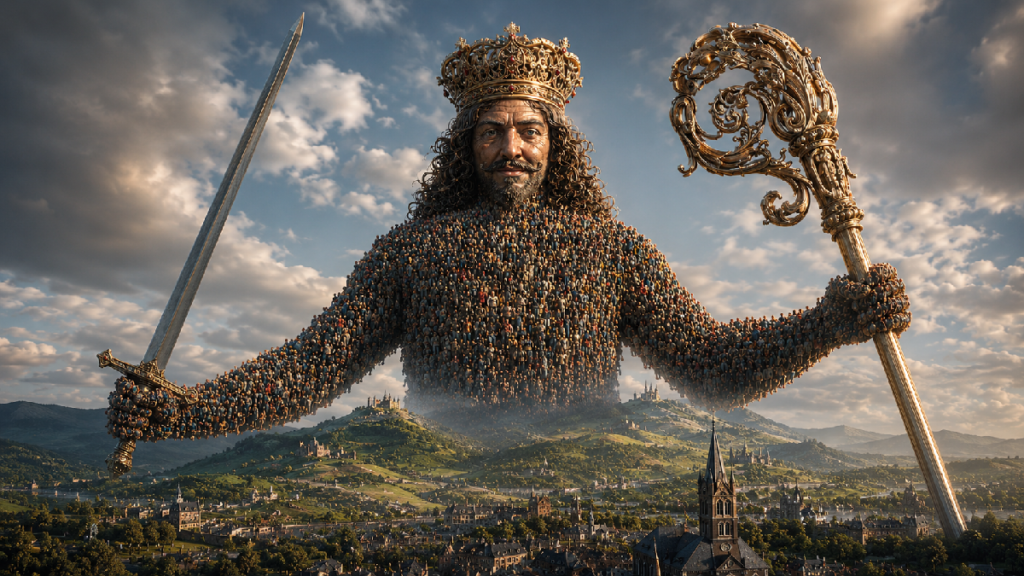
And that entity is Leviathan.
That entity is the State.
Leviathan only relocates the problem; Leviathan remains unconstrained
However, the problem is that the existence of Leviathan does not truly solve the problem of the state of nature. Leviathan merely re-locates the problem from the level of individual persons to the level of individual governments.
Under what later became known as the Westphalian system, several principles of international relations became widely accepted. These include the principles that every nation is its own sovereign, that states are autonomous, that states have territorial integrity (i.e. the right to maintain and defend their established borders) and that there ought to be non-interference by other nations in domestic affairs.
But that just means that every nation is potentially in a state equivalent to the state of nature that individuals were in as such nations are potentially in conflict with every other nation. All nations, like people, have their own desires and interests. The problem of vain-glory, and the competition for land, property, power, and resources remains and every nation is the judge, jury, and executioner in its own interests.
So, today, we see Leviathans fighting for control of Hormuz, although (currently at least), they have chosen to self-constrain somewhat. Hobbes described a mechanism as to how it was possible for a nation such as the USA to attack a nation such as Iran, and for how Iran could respond the way it has. This would likely have been unsurprising to Hobbes who argued that “covenants without swords are but words and of no strength to secure man at all”.
Little, for example, constrained the USA from attacking Iran over differences in armaments policy. Little constrained Iran from then lashing out at third-party nations, or in attacking the shipping of other nations in an attempt to impose costs so as to pressure a ceasefire. And, once that political leverage is realised, there is little to stop Iran, other than an attempt to impose countervailing force, from seeking to control shipping movements for its own benefit. And if that nation can toll an international waterway, then other nations that can exert control over other international waterways can do the same too.
Leviathans agree to constrain themselves
Historically, other than meeting force with force, there was little to constrain the different countries of the world from acting how they desired in accordance with what they perceived to be in their own interests.
There have been many wars.
Eventually, the ongoing political competition led to the great catastrophe of World War I.
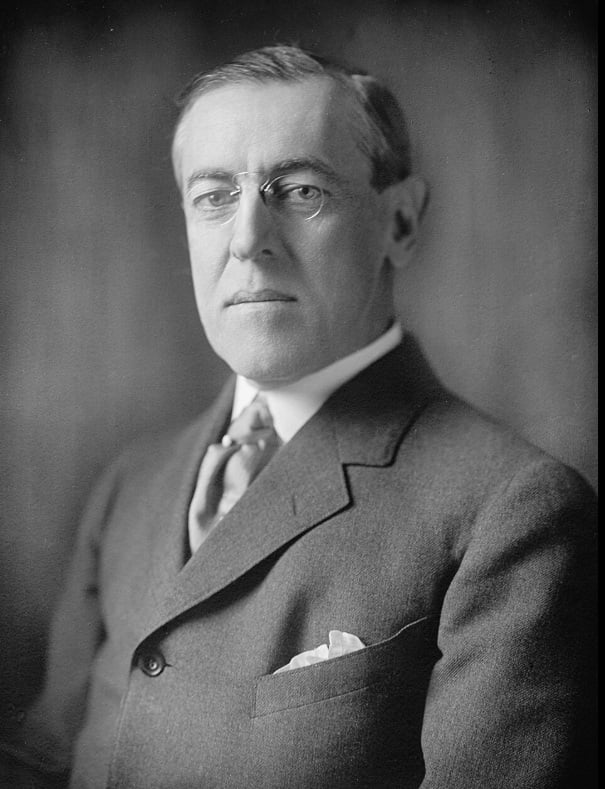
Several disastrous years later, in the subsequent peace negotiations, U.S. President Woodrow Wilson put forward 14 points for the post-war peace. One of which, not-so-incidentally, was for the freedom of navigation of the seas in peace and war, except where the seas may be closed in whole or part by international action for the enforcement of international covenants. A condition which is particularly relevant today in the Hormuz.
Among the vitally important long-term points (as opposed to the immediate needs of the warring nations), was the removal of economic barriers, equality of trade conditions, and that a great association of nations be formed for the purpose of affording mutual guarantees of political independence and territorial integrity to great and small states. This was, of course, the League of Nations, which was set up to prevent future conflict through collective security.
The concept, as Winston Churchill was to later say (albeit in a different context), was that meeting jaw to jaw would be better than war.
To prevent war, there would be jaw. And from jaw, it was hoped, would come law. Leviathans would, it was hoped, agree to be constrained by international law.
Although, unlike the subjects of Hobbes’s sovereign, countries did not swear fealty to a superior global Leviathan. They instead wove a network of institutions, treaties and reciprocal restraints, and the authority of that system was to ultimately depend upon the various Leviathans continuing to recognise it.
But, of course, what followed on from the Great War was not peace, no, nor restraint either.
When Leviathans agree: the new social contract
World War II is arguably history’s single greatest catastrophe. It broke minds and bodies, cities and countries, societies and cultures.
It was the total war that broke the world.
A new consensus formed in the shattered aftermath of World War II. It was decided that a new institutional order must be created.
And so it was written:
WE THE PEOPLES OF THE UNITED NATIONS DETERMINED
to save succeeding generations from the scourge of war, which twice in our lifetime has brought untold sorrow to mankind
to establish conditions under which justice and respect for the obligations arising from treaties and other sources of international law can be maintained
HAVE RESOLVED TO COMBINE OUR EFFORTS TO ACCOMPLISH THESE AIMS
Accordingly, our respective Governments… do hereby establish an international organization to be known as the United Nations.
Article 1
The Purposes of the United Nations are… To maintain international peace and security… to bring about by peaceful means, and in conformity with the principles of justice and international law, adjustment or settlement of international disputes or situations which might lead to a breach of the peace.
Fifty nations signed the original U.N. treaty on Jun 26, 1945. Today, there are 193 member states of the United Nations. The U.N. Charter is the embodiment of the desire of a war-plagued humanity to exit the state of nature in which the rule is bellum omnium contra omnes and to, once again, ask the Leviathans to constrain themselves by, in effect, entering into a new social contract for the preservation of the peace and for the wellbeing of all.
Once again, it was hoped that jaw and law would replace war.
International Maritime Organization and the U.N. Convention on the Law of the Sea
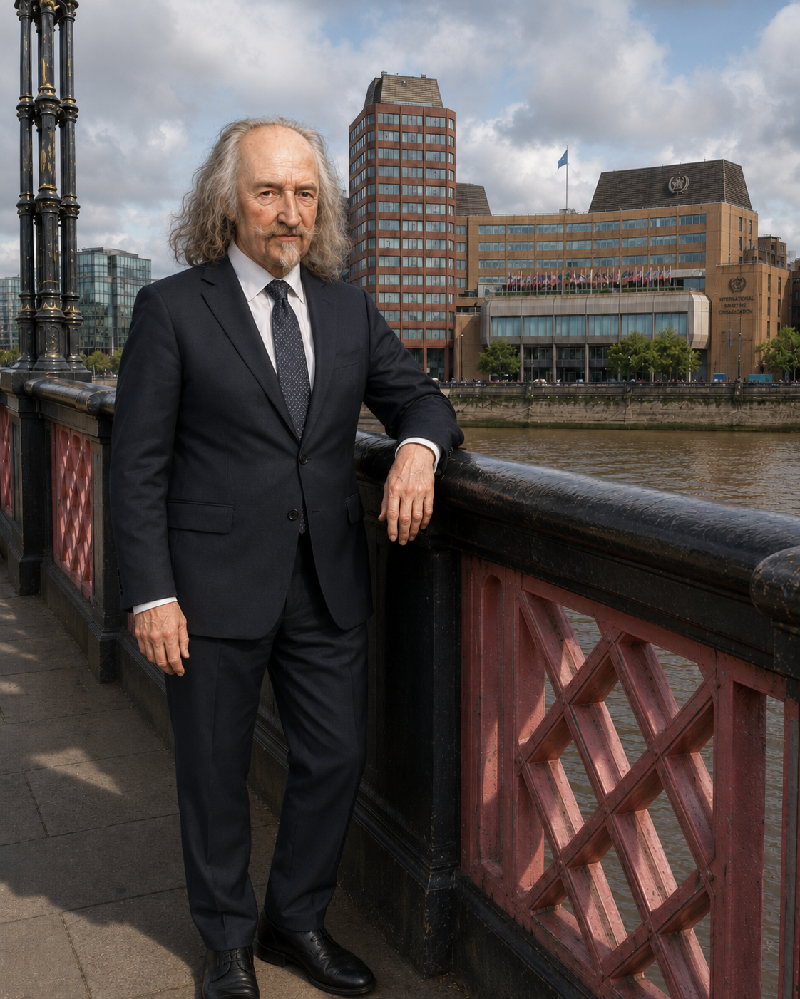
The path to modern global shipping regulation got underway at Geneva in 1948 when the convention establishing the Inter-Governmental Maritime Consultative Organization was adopted (the name was later changed in 1982 to the International Maritime Organization, we will refer to it as such).
The purpose of the IMO was to provide a way for governments to co-operate on technical shipping matters, to adopt the highest practicable standards in maritime safety and the efficiency of navigation, to remove discrimination and unnecessary restrictions by governments engaged in international trade, and to promote the availability of shipping services to the commerce of the world without discrimination.
Matters related to maritime pollution and the marine environment were added later as humanity began to appreciate the problems that unconstrained human activity presents to global ecosystems and human wellbeing. Today, about 176 sovereign states are members of the IMO.
The U.N. Convention on the Law of the Sea (UNCLOS) is a comprehensive regime of law and order for the peaceful use of the world’s oceans and their resources. UNCLOS also allocates States’ rights and jurisdictions. It was adopted in 1982 and it entered into force in 1994. As of 06 February this year, it had 172 ratifications when Cambodia ratified UNCLOS. Cambodia later entered into UNCLOS-based negotiations to resolve a maritime dispute with Thailand regarding overlapping maritime claims.
Cambodia and Thailand could have chosen to attempt to settle their dispute through the force of arms. But they didn’t. They chose a U.N. bureaucratic process instead. So conflict between Leviathans is not an inevitable outcome despite the lack of a constraint imposed by a global sovereign. And that provides for the hope of a more peaceful world.
These distant and imperfect institutions
These distant institutions and legal regimes of the U.N. system, including (in the maritime context), the IMO and UNCLOS, nonetheless remain the last, and perhaps the best, hope for humanity to resolve the problems of self-interest and conflict that have plagued us from before pre-history.
While the IMO itself was not founded specifically to prevent war and to promote the peace, its contribution to the peace is more indirect but is nonetheless substantial. The IMO creates common maritime expectations, predictable standards, and forums for negotiation and debate. We see this even today as nations of the world continue to debate at the IMO despite being at war or subject to attack.
These U.N. systems, while not perfect (and while we acknowledge the very real power-vs-power standoff of the Cold War***) have helped humanity partially escape the trap described by Hobbes. In doing so, they have helped to sustain a largely peaceful international order in which the wellbeing of literally billions of people has improved.
Earlier in this piece, we asked what the value is of missives versus missiles and denunciations versus drones.
Their value is this: when officials of the U.N. system speak out against war, and attacks on civilians, and disruptions to the peace, their words are not superficial or trite platitudes. They speak against the backdrop of centuries of war and the uncounted deaths of innocent people, and a history repeatedly created by our inability to escape the trap of fear, distrust and self-interest. Such institutions and officials identify from a neutral and independent position what the human costs are of conflict. They neutrally identify what elements of human wellbeing are being violated. And they are also among the few global voices that might actually be listened to when restraint is demanded.
They also represent an opportunity for Leviathans to choose an alternative choice: bureaucracy instead of bullets.
The human cost
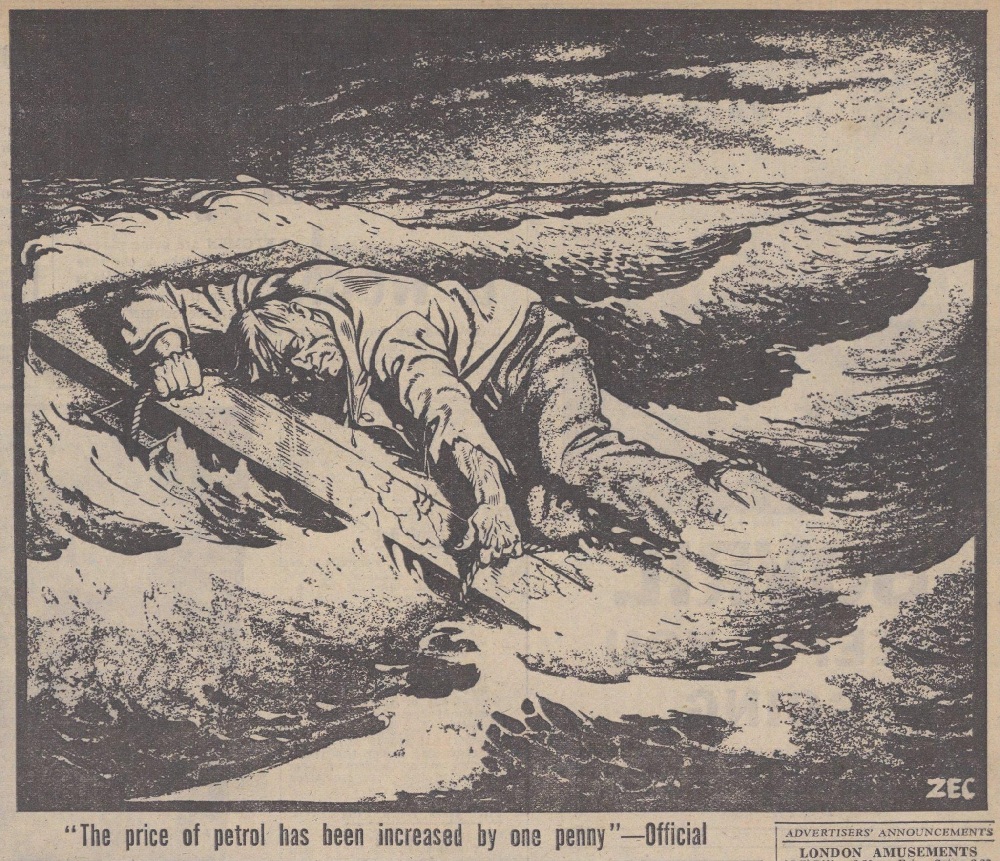
As a maritime organisation, we therefore consider it apposite to conclude with the words of Arsenio Dominguez, the IMO Secretary-General, who spoke on 08 July 2026.
“I regret that once again I am compelled to speak out following attacks on commercial ships and innocent seafarers, due to geopolitical circumstances beyond their control… These reckless attacks have again placed innocent seafarers in grave danger.
No seafarer should have to risk their life simply for doing their job. As long as the safety and security of crews cannot be assured, I urge flag States, shipowners, operators and all relevant authorities to avoid exposing seafarers to unnecessary danger by transiting the Strait.
The situation in the region remains volatile. These attacks further intensify the fear, uncertainty and psychological strain already being endured by the nearly 6,000 seafarers who remain stranded onboard vessels unable to depart the Persian Gulf safely. I call on all States concerned to exercise maximum restraint, de-escalate the situation without delay.”
*An aside: Hobbes became infamous for arguing that people were required to be obedient to an absolute power, which is a proposition that was quickly disputed by other thinkers and one that has been vigorously contested – with arms – throughout the centuries. It is a proposition that is not accepted in contemporary democracies.
** The state of war doesn’t necessarily mean continuous physical fighting, but more of a pre-disposition toward conflict. But it doesn’t rule out fighting either, as the central theme and many examples in this article show.
*** Something else also discussed by Hobbes, who was well aware of the motivating power of fear, specifically the fear that induced a desire to avoid the summum malum – the greatest evil – which is death.