
By Cam Tran, Senior Manager – Global Trade, and Crystal Paris, Associate Global Trade & Taxes, both of PwC
Australian freight volumes are projected to grow by over 35 per cent by 2040[1], and yet Australian freight data systems cannot easily exchange information due to lack of adoption of relevant standards. Our freight community is suffering because so much time and effort is wasted on manually entering and re-entering data into outdated and disparate systems. It’s also wreaking havoc on our ability to compete globally, as well. Australia’s ranking in “cross border performance” has fallen from 25th to 106th place in 2020[2].
This slip in global rankings is not surprising. In 2008, a paper by the NSW Department of Industry titled “Innovation in the NSW Freight Logistics Industry”[3] identified that the freight and logistics industry was a priority for economic growth and that the barriers to this growth were beyond the conventional areas such as cost, market related issues and skills shortages. It outlined that there was limited cooperation amongst the supply chain participants, and that the supply chain was fragmented and complex, with unsophisticated end users. It also reported that there was a significant number of transactions along the chain which had limited utilisation of modern technologies and limited access to data which already exists elsewhere in the supply chain.
The recommendations proposed in the report and the import and export industry in general were audited in 2015 by Infrastructure Australia. The audit acknowledged that there had been progress since 2008, “but it is slow”.
In 2017, the National Freight and Supply Chain Inquiry was also conducted to identify priorities for Australia for the next 20 years to improve freight and supply chain efficiency. But whilst the outcome of the inquiry was that governments committed to developing a National Freight and Supply Chain Strategy, in a follow-up audit in 2019, Infrastructure Australia determined that “many of the challenges identified in Infrastructure Australia’s 2015 Audit remain today.”
The audits and inquiry had identified a need for a national strategy, and better availability and usage of data and technology. It is no surprise then, that over the past decade with little significant progress in these areas, Australia’s global standing had slipped to 106th place whilst other countries have modernised their supply chains. Without a whole-of-ecosystem strategy to modernise the supply chain that enables industry stakeholders a better and standardised way of talking to each other, Australia’s downward movement in the global rankings was not unpredictable. This downward movement comes with a significant opportunity cost as well as a significant increase in supply chain risks, both of which affect our current and future prosperity as a nation.
What are the root causes of the underperformance, and what can be done about it?
Manual data entry wastes resources that could otherwise be deployed on more productive tasks
As many people in the freight community already know, manually and repeatedly entering the same data between different systems is an essential but laborious daily task, with the potential for errors to occur. The typical error rate in manual data entry is about 1% for “simple but nontrivial cognitive actions” tasks[4] In practical terms, consider how many freight data fields are being populated as part of your daily logistics operations. If there is 1 error for every 100 data points entered, it is easy to see just how many errors can accrue over the course of a day. Where errors are left unidentified and not corrected, how much might this cost your operations?
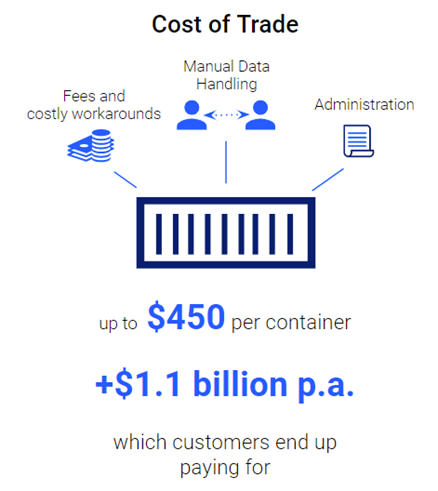
The 1-10-100 rule states that it costs $1 to check the accuracy of the data you have entered in, $10 to correct your data and $100 for uncorrected errors. Manual data handling also contributes to the “cost of trade” of up to $450 per shipment, as was reported in a previous PwC study conducted on the Trade Community System.
Repetitive, manual data entry consumes resources that could otherwise be deployed on more productive tasks. Standardising methods of freight data exchange could allow data from one source to be easily consumed by one or many, and would result in reduced time being spent on manual entries.
Instead, shippers, carriers and logistics providers could better coordinate their resources for strategic planning including looking at ways to expand operations and market share. Automated data exchange is a fundamental building block to enable efficient, automated machine-to-machine enablement required to optimise and reduce risks in modern supply chains.
Impaired decision-making due to the lack of visibility in the freight network
Data plays a large part in enabling evidenced-based decisions-making, however, a decision is no better than the data upon which it is based. At present the lack of data standards makes it difficult to collect, collate and make sense of data. This can mean that businesses are relying on inaccurate insights to inform operational and strategic decisions. For example, Environmental, Social and Governance (ESG) data is increasingly important to the freight industry as it embarks on its sustainability journey. Maersk has committed to only order new vessels that can be powered by carbon-neutral fuel, and is set to have eight container vessels which run on carbon neutral methanol by the first quarter of 2024.[5] However, because at present ESG data lacks standardisation, it means that sustainability metrics are subjective, and can be hard to accurately benchmark and measure to present to shareholders and new customers who are environmentally conscious[6]. Standardising freight data would produce consistent and comparable data to support more informed decision-making and more accurate and timely access to business intelligence reporting, forecasting and optimisation.
System miscommunication and inaccurate reporting
Since regulation of the freight industry occurs at both a country level and at an international level, many different reporting formats exist. Where data standards are not applied or not applied consistently and systems are unable to talk to each other, this results in inaccurate sharing of information between agencies and also inaccurate public reporting.
For example, not-for-profit organisation, Global Maritime Forum, manages Sea Cargo Charter reporting. The Charter requires signatories to report emissions relating to their shipping activities on a voyage basis in line with the International Maritime Organisations (IMO) emissions strategy. Signatories have found data collection and collation difficult, not least because of the lack of common standards for measuring vessel emissions.[7]
Whilst IMO reporting is not measured on a voyage basis, (instead annual aggregations for the emissions data collected), there is the potential for IMO requirements to become more stringent and granular along the lines of the current Sea Cargo charter expectations. Standardising freight data may result in improved quality and consistency of information collected and shared between agencies and publicly reported.
The first step to better communication is to standardise what is being shared.
We propose adopting a ‘whole-of-ecosystem’ approach to improving the data capture and sharing processes. We focus on the ‘whole-of-system ecosystem’ because we need industry and governments to work together to truly solve this problem. How might we standardise freight data so that when the data is captured, and the process in which it is captured, is consistent no matter who the responsible party is? Then once that is achieved, any interested parties, including domestic and foreign government agencies, would be able to easily receive and consume that data, and use it for informed decision-making, or their reporting needs. At the same time we recognise the need to protect privacy and commercial sensitivity of data and the other rights of the data owner to share in value created by sharing this data.
We could look to a model that Australia’s Asia-Pacific and ASEAN neighbours have adopted. Their public and private sectors have come together to implement data standards and connect supply chain stakeholder systems together, in the form of a national single window. Paper documentation is converted into standardised electronic messages that are sent automatically from system to system via APIs for the most efficient movement of data and therefore, cargo.
Other international efforts for improving freight data have been led by the International Chamber of Commerce and the World Trade Organisation through their Standards Toolkit. This Toolkit brings together existing digital trade standards and document and data formats so that the freight community can easily talk to each other.
A 2022 Australian freight data scoping study led by the Department of Infrastructure, Transport, Regional Development and Communications (DITRDC) and its newly established National Freight Data Hub is a strong step in the right direction.
Further nationwide investment in standardising data and interoperability in the freight sector has more far-reaching benefits, including:
- Reduced costs – companies with highly digitised supply chains and operations can expect efficiency gains of 4.1 percent annually, while boosting revenue by 2.9 percent a year
- Increased visibility and transparency across the supply chain helping reduce black spots in the supply chain related to container location and the status of goods
- Reduced errors from significantly fewer manual transactions via the rekeying of data
- Improved efficiency in the exchange of information between key stakeholders
- Competitive advantages and better risk management associated with supply chain activities
- Reduced carbon footprint, as a more efficient digital supply chain results in fewer truck movements on the roads.
Isn’t it time to stop wasting efforts on manual and repetitive data entry and improve the sustainability, competitiveness and efficiency of our supply chains in line with the modernisation occurring elsewhere in the world?
________________________________________________________________________________________
[1] Transport and Infrastructure Council (2019) National Freight and Supply Chain Strategy. https://www.freightaustralia.gov.au/sites/default/files/documents/national-freight-and-supply-chain-strategy.pdf
[2] The World Bank ‘Doing Business” was discontinued in 2020.
[3] NSW Department of Industry (2008), Innovation in the NSW Freight Logistics Industry, https://www.industry.nsw.gov.au/__data/assets/pdf_file/0004/55381/innovation_freight_logistics_industry_20080630.pdf
[4] Panko, R (2016) What We Don’t Know About Spreadsheet Errors Today: The Facts, Why We Don’t Believe Them, and What We Need to Do https://www.researchgate.net/publication/1907590_Thinking_is_Bad_Implications_of_Human_Error_Research_for_Spreadsheet_Research_and_Practice
[5] Maersk (2021) A.P. Moller – Maersk accelerates fleet decarbonisation with 8 large ocean-going vessels to operate on carbon neutral methanol https://www.maersk.com/news/articles/2021/08/24/maersk-accelerates-fleet-decarbonisation
[6] IHS Markit (2022) Measuring Up: Unlocking the Data to Power Maritime Sustainability <https://ihsmarkit.com/research-analysis/measuring-up-unlocking-the-data-to-power-maritime-sustainabili.html>.
[7] IHS Markit (2022) Vessel operators, charterers shed light on bulk shipping emissions in “unprecedented” data project <https://cleanenergynews.ihsmarkit.com/research-analysis/vessel-operators-charterers-shed-light-on-bulk-shipping-emissi.html>.