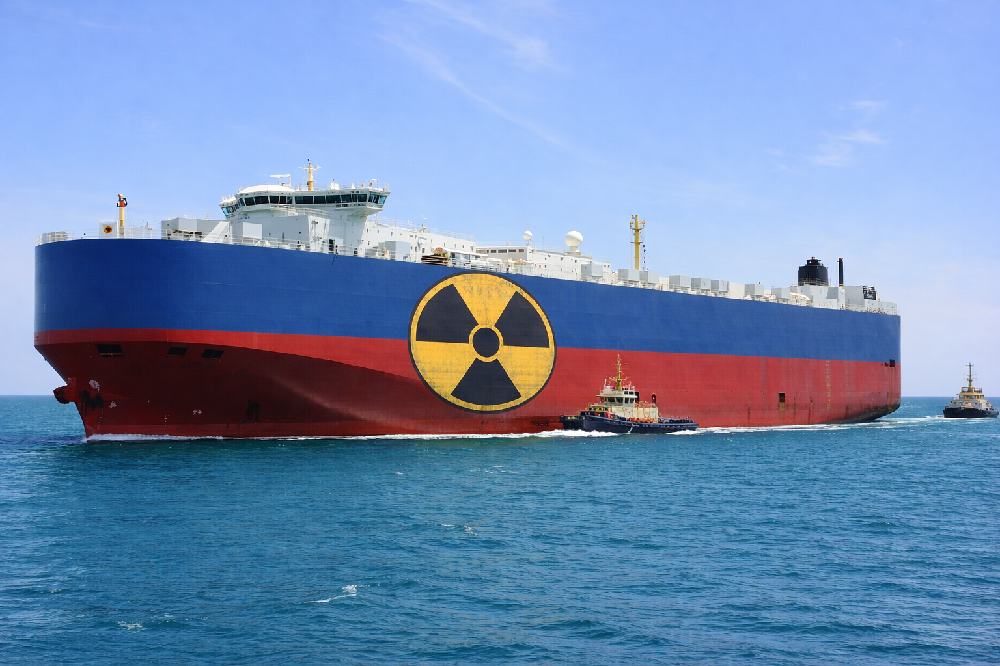
A group has been set up in the UK to set standards for nuclear-powered shipping.
Convened by the Class Society Lloyd’s Register, experts from the nuclear, maritime, insurance and regulatory sectors will meet to set international standards for safe, secure, and commercially-viable nuclear-powered shipping.
Members of the group comprise Lloyd’s Register (Secretariat, lead, and safety), Rolls Royce (reactor design), Babcock International Group (ship design, construction and support), Global Nuclear Security Partners (security and safeguards), lawyers Stephenson Harwood (legal & regulatory), and NorthStandard (Insurance).
In a joint statement, the consortium partners argue that the next generation of advanced modular nuclear reactors will enable ships to sail for years without refuelling and with zero carbon emissions. They also argue that “rigorous safety [will be] built in from the start”. They add: “Nuclear produces no CO₂. Reactors run for years, not weeks. With no need to trade efficiency for emissions standards, ships can run at full design speed instead of slow steaming.”
Of reactors and nuclear ships
The UN’s International Atomic Energy Agency (IAEA) states that small modular reactors may require refuelling every three to seven years and that some are designed to operate for up to 30 years without refuelling. It adds that advanced nuclear reactors have a designed power capacity of up to about 300 MW(e) per unit – about one third that of of traditional nuclear reactors. Microreactors have a power capacity of about 10 MW(e). To put that into a shipping perspective, the World Nuclear Association (in international industry association), notes that there are about 160 nuclear-powered marine vessels. Most are submarines, some are icebreakers and aircraft carriers.
The Yakutia is a 2022-built icebreaker which has at least one 175MWt reactor and with plans for two (so 350 MWt) which will deliver 60 MW at the shaft. It has a dual-draft of about 8.5m to about 10.5 metres, is intended to run for about 40 years and has a crew of about 50(ish) with an open-water top speed of about 20 knots. The larger modern commercial ships may be considered as a rough comparator. A 14,000 TEU boxship will have main engine power of about 55MW and a design speed of about 22 knots. It’s not an exact match, obviously, but it gives a rough comparison. Nuclear-powered merchant ships have been tried previously, in the 1950s but were not commercially successful.
Safety
The IAEA argues that safety with proposed reactor designs relies on passive systems and inherent characteristics such as low power and operating pressure.
“In such cases no human intervention or external power or force is required to shut down systems, because passive systems rely on physical phenomena, such as natural circulation, convection, gravity and self-pressurization. These increased safety margins, in some cases, eliminate or significantly lower the potential for unsafe releases of radioactivity to the environment and the public in case of an accident,” the IAEA says.
Waste not, want… well, not waste
Waste types may vary according to the UN IAEA, from low level (i.e. low energy, low danger, shorter time of radioactivity) to high level waste (i.e. highly energetic, dangerous for a long time). Radioactive waste may included everything from contaminated clothing, floor sweepings, paper, plastics, other materials, alongside such materials as resins, filters, sludges and, of course, spent nuclear fuel. The UN IAEA document mentioned above refers to all wastes from all types of atomic energy facilities and may not be entirely applicable to SMR wastes.
But there there does appear to be a problem with SMR waste. A leading 2022 scientific paper on the topic by Krall et al, observes that many designs complicate waste management by generating greater volumes of waste than other nuclear technologies.
“Results reveal that water-, molten salt–, and sodium-cooled SMR designs will increase the volume of nuclear waste in need of management and disposal by factors of 2 to 30,” the study says. Commentary by Stanford University, which carried out the research, added that (as of 2022) no SMR reactors were in operation and many were proprietary technology and so couldn’t be studied easily.
Waste will have to be addressed by disposal and defueling, transport, interim storage, final disposal. Meanwhile, the study indicates that SMR waste can create chemically / physically “reactive” waste leading to corrosion, formation of hazardous by-products when exposed to moisture, can react “vigorously” when exposed to moisture, and, so might not just be radioactive but could also be chemically dangerous too. Waste reception facilities may not be too enamoured with the idea of accepting waste that is not chemically stable, could corrode containment measures, generate flammable gas, and would be generally more difficult and costly to deal with. Then there’s the problem of secondary waste i.e. the waste created from dealing with waste. Additionally, the radiotoxicity of the waste will be 50% higher than comparable radioactive wastes so geologic disposal (burying deeply) will need to be carefully considered.
The study was led by nuclear engineer Lindsay M. Krall and co-authored by Allison Macfarlane, former Chair of the U.S. Nuclear Regulatory Commission, and Rodney C. Ewing, a leading expert on nuclear waste materials.