
Geopolitical instability is the biggest headache for the third year running and it is raising the risk of a world recession, maritime leaders believe. Regulations are a “pressing concern” and are said to have the greatest impact on operations for the fourth year running, the ICS Maritime Barometer Report 2024-2025 states.
Risks of global recession strengthen; industry confidence at an “all-time low”
“Political unpredictability has become the new normal. Not only have physical conflicts increased around the world, but we may also face escalated trade wars if the US-China relationship continues to deteriorate. Financial markets are volatile at a time where great investment is needed for a safe and greener future for our industry. This geopolitical instability is making and reshaping our business operating environments, adding caution and uncertainty to commercial decisions, in addition to rewriting long-standing trade relationships and trade routes. These all have costly implications for our industry and the wider economy, strengthening the possibility of a global recession,” Emanuele Grimaldi, the Chairman of the International Chamber of Shipping states in the foreword to the report.
However, the industry’s confidence in handling this risk is at an “all-time low,” Mr Grimaldi adds.
The ICS report also notes the finding in the GoBankingRates’ C-Suite Outlook 2025 that the prospect of a global trade war “has emerged as the most urgent and pressing matter for CEOs,” and that “rising economic tensions,” could have the most negative effect on trade.
Political risk factors include cyber attacks tied to governments and geopolitics, the increasing reliance on digital infrastructure and artificial intelligence, political polarisation, and global conflict that continues to escalate. Political instability “underpins all other top risk factors,” the report says. The report adds that maritime leaders feel that the sector is equipped to handle other major changes such as decarbonisation, new technologies and extreme weather, but political volatility persists and the sector feels dwindling confidence in mitigating those risks.
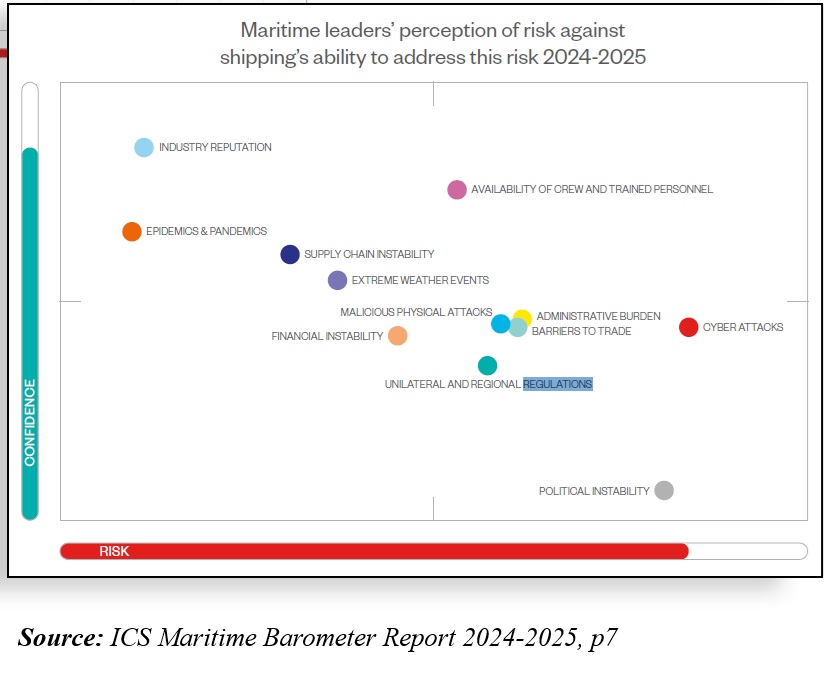
Increased political risk from political instability is no surprise – nor are surging insurance costs
Noting that there are “multiple geopolitical conflicts” underway, major government administration changes, and more than 70 national elections around the world which covered about half of the global population, the ICS said it s was “no surprise,” that political instability is the current top risk. The ICS also pointed to the U.S. Administration’s universal imposed tariff as a factor in an increasingly unpredictable and unstable picture. The body also referred to the activities of the U.S. Trade Representative as having far reaching implications for trade and maritime (find out more about these disastrous policies here, here, here, here, here, and here).
Noting that shipping business operations are “increasingly vulnerable,” to geopolitical challenges, the report notes that there has been a global interest in Trade Disruption Insurance and the the International Group of Protection and Indemnity Clubs are poised to hike rates to cope. Meanwhile, the availability of war risks insurance is declining and cost of the remaining policies are increasing owing to the presence of conflicts in Ukraine, the Middle East, and Sudan.
Regulations have the greatest impact on operations
Factors that have the greatest impact on operations have been delved into by the report since 2021, and several of these factors – such as investor requirements, or availability of crew – have changed over the years. However, one factor remains at literally the top of the list each and every years since 2021 and that factor is regulation.
Regulations can have effects for good or ill, it seems, with the ICS noting that regulations are the most significant factor in green transition issues that impact business operations, which much of the change being driven by the IMO and the European Union. However, the ICS goes on to add that the outcomes from the IMO’s MEPC 83 meeting (find more here and here) could sustain industry confident to handle the impact from regulations. Changing regulations, particularly in relation to decarbonisation, were also associated with the climate of political instability.
However, later in the ICS document, the organisation bemoans the administrative burden inflicted on shipping, which is described as “increasing”. The ICS adds that industry confidence in its ability to handling this burden is declining, and the dip in sentiment is being driven by the fact that “so many different regulatory demands [are] coming into fruition”.
Added bureaucratic demands that will affect shipping include the EU Emissions Trading Scheme, the Fuel EU Maritime Regulation, IMO regulations such as the annual carbon intensity indicator, the planned 2028 introduction of the EU’s Corporate Sustainability Reporting Directive, the Corporate Sustainability Due Diligence Directive, the Hong Kong Convention for the Safe and Environmentally Sound Recycling of Ships, and the UK Economic Crime and Corporate Transparency Act – all of which already join a long list of international and national reporting requirements.
Risks from unilateral regulation
Unilateral (i.e. country-by-country) or regional regulation is in the top five risks, the ICS notes, and maritime leaders have a lower confidence that the sector will be able to well manage this risk. Regulations cited included the EU emissions trade scheme, the Fuel EU Maritime scheme, India’s Merchant Shipping Bill, India’s Coastal Shipping Bill, the UK’s Economic Crime and Corporate Transparency Act which will criminalise a “failure to prevent fraud” – which will affect companies with business links to the UK, and Nigeria’s Tax Bill.
“The reality of what is required to comply with such regulations will be sinking in for maritime leaders. Increased administrative burden will be top of mind as companies work to ensure compliance and avoid any punitive measures or fees if found to be non-compliant,” the ICS report says.
Raising the barriers
Trade barriers have been ranked as one of the major risks in this year’s survey, the ICS reports, noting the “massive shake up” of trade because of new tariff policies and proposals, “which risk descending into a full-blown, tit-for-tat trade war”. The ICS notes that several major companies such as Nintendo and Volkswagen had suspended imports into the U.S. at the time of the writing the ICS report.
The ICS also notes fears that there could be long-term slower economic growth because of reduced purchasing power and increased inflation. The ICS cited a lowering of the 2025 real (i.e. inflation-adjusted) GDP growth from 1.6% down to 0.3%, on the back of trade policy uncertainty, by J.P. Morgan Research.
Shipping will, of course, be affected. The ICS noted the comments by the German Shipowner’s Association: “Higher tariffs and restrictive measures aimed at shielding national markets result in disrupted supply chains and rising transport costs,” VDR stated. “For shipping companies, this translates not only into potentially longer trade routes and higher operational expenses but also considerable planning uncertainty in global goods transportation.”