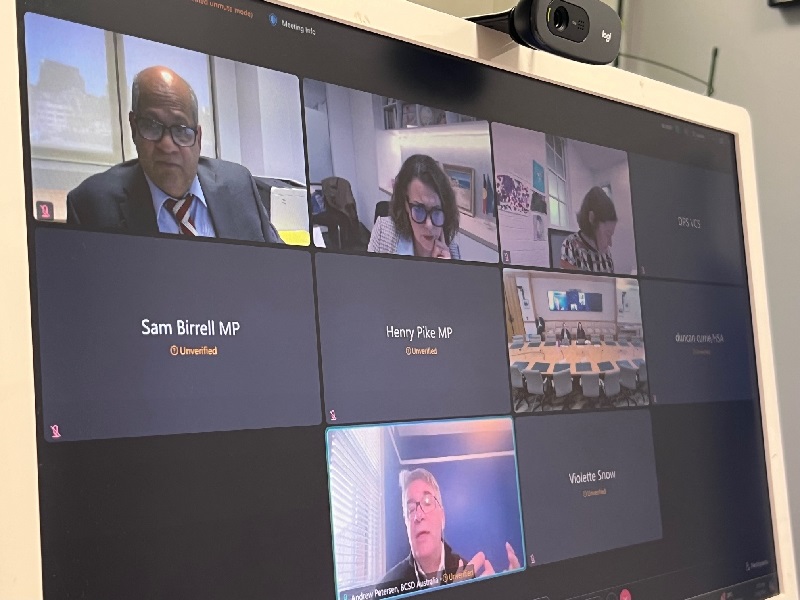
Captain Melwyn Noronha, the CEO of Shipping Australia, recently gave evidence to the Federal Joint Standing Committee on Treaties (JSCOT) a Senate-House joint Committee.
The Committee was taking evidence from witnesses on the so-called “High Seas Treaty,” which is new international law aimed at preserving bio-diversity in the high seas beyond the jurisdiction limits of countries.
A large proportion of the global eco-system is the marine environment, and a vast amount of flora and fauna live in the sea. A great part of the world’s oceans are not part of any country; the territory of any given country ends about 12 nautical miles from the coast, although each country retains certain economic rights up to the 200 nautical mile limit.
Beyond that, laws apply in certain specific ways and circumstances. For instance, the law onboard ships on the High Seas (i.e. beyond the 200 nautical mile limit) is the law of the country in which the ship is registered and there are a range of e.g. marine pollution laws that can be applicable.
Back in March 2023, the nations of the world got together at the UN and agreed the “Biodiversity Beyond Nation Jurisdiction” treaty, which aims to apply law to the natural environment of the High Seas. The International Maritime Organization formally welcomed the adoption of the BBNJ in June 2023. You can read more about the BBNJ here and here.
Shipping Australia’s submission to the JSCOT also welcomed the passage of the High Seas Treaty. Our submission focused on the interaction of different rights granted to different sea-users under different treaties and we urged that different policy goals could be achieved while still granting access to the sea for a wide variety of purposes.
“We [Shipping] recognise that there are many different users, and uses, of the sea, which is to be shared by all, for the benefit of all. These very principles are in fact written into our most basic and cherished international law, namely the UN Convention on the Law of the Sea. The freedom of navigation across the High Seas, is subject to oversight and controls. There are many areas around the world which have controls on the movement of ships – the Great Barrier Reef is one area, for example. That ships are controlled in where they go and what they do, is in fact nothing new and is not controversial,” Capt Noronha told the JSCOT.
“While shipping supports global rules to preserve the marine environment, we also consider this policy goal could be met without cutting access to the sea. For instance, off the coast of South Africa, ships sail slowly to prevent strikes on whales”.
Capt Noronha also discussed “area based management tools” under the BBNJ.
A detailed, technical discussion of area based management tools actually are and how they work is a bit out of scope for this particular article, however, suffice to say, you can think of them as being a bit like marine parks. Such areas would have rules on where ships can go and what they can do.
Shipping Australia took issue with the practice – or, rather, the lack of practice – by certain Australian jurisdictions which don’t adequately define where marine parks are in Australia and don’t adequately tell everyone where they are. Shipping wants to comply with the law, but that’s a bit hard to do when the authorities won’t tell you what the law actually is.
“Maps and information should be readily available for ships to plan their routes. But apparently there is no way to get this information. This is unsatisfactory,” Capt Noronha told the JSCOT.
“Shipping Australia calls for all jurisdictions in Australia to adequately map their protected marine areas. We also call for them to issue charts that accurately depict where those areas actually are, and what ships can and can’t do. Finally, we also urge this Senate Committee to recommend that any marine park or protected area that is created as a result of Australian efforts should be accurately charted and those details made freely available,” the Captain urged.