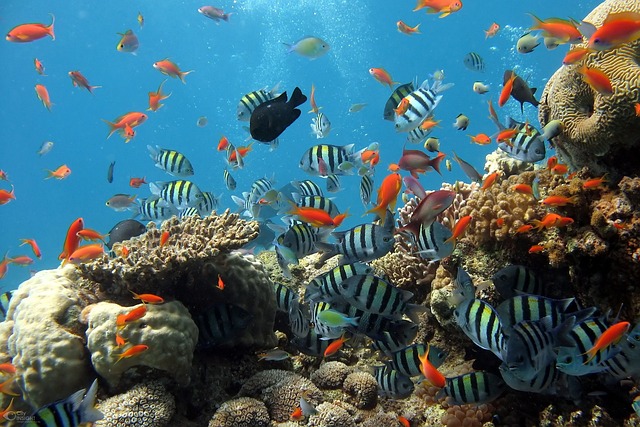
Pictured: various fish species swim over a coral reef, illustrating the biodiversity in our oceans. Photo credit: Visa Vietnam via Pixabay.
By the United Nations Conference on Trade & Development
After 15 years of negotiations, UN member states agreed on landmark new treaty on 4 March to protect marine biodiversity on the high seas. The treaty will be formally adopted soon.
When it enters into force, the Biodiversity Beyond National Jurisdiction (BBNJ) agreement will address biodiversity loss and ecosystems degradation due to climate change impacts, pollution and unsustainable use. It must be ratified by 60 member states to enter into force.
The treaty will particularly benefit developing countries, which had initiated the negotiations to regulate, among other things, the fair and equitable sharing of benefits arising from activities with respect to marine genetic resources. These have a significant potential for research and development in the biotechnological, pharmaceutical, foods and cosmetic fields.
To achieve the treaty’s objectives, parties are to be guided by principles and approaches such as the “common heritage of humankind”, “polluter pays”, “precautionary and ecosystem approach”, and “fair and equitable benefit sharing”.
Support for countries
UNCTAD will support countries on the implementation of the new agreement by providing expertise and data on ocean-based goods and services trade, Blue BioTrade and maritime trade.
“With this new treaty, trade in ocean-based goods and services can be done in a more sustainable and cooperative fashion, particularly in marine technologies and sectors,” said David Vivas Eugui, chief of the oceans and circular economy section at UNCTAD.
The treaty will also bolster efforts to make maritime transport more sustainable, as international shipping is one of the main economic activities on the high seas.
“Effective implementation and enforcement of the existing international legal framework for controlling pollution from shipping will become more important,” said Regina Asariotis, chief of UNCTAD’s policy and legislation section.
Established shipping lanes may also be affected by marine protected areas to be established under the agreement.
Areas covered by the treaty
The treaty covers, among other things, access and use of marine genetic resources and related digital sequencing information, as well as fair and equitable benefit sharing.
Marine biotechnological applications are booming. The market for marine biotechnology reached $5.9 billion in 2022 and is projected to double by 2032, according to one study. Fisheries activities are not covered by the new access and benefit sharing rules.
It also envisages the use of area-based management tools to sustainably manage activities in specific parts of the high seas, including marine protected areas to be established for long-term biodiversity conservation goals.
The treaty spells out environmental impact assessment obligations for planned activities in areas beyond national jurisdiction. This will allow identification and evaluation of potential impacts and inform decision-making, management and mitigation of risks. Decision-making on whether to proceed with an activity is left to individual states.
It also covers capacity-building to develop scientific knowledge and the transfer and sharing of marine technology and related cooperation.
For developing countries, capacity-building will be crucial to establish ecological baselines, generate benefits from marine genetic resources, enable area-based management, environmental impact assessments and facilitate the transfer of marine technologies.
Boost to global efforts
The treaty fills a significant regulatory gap and complements the existing ocean legal framework, including the 1982 UN Convention on the Law of the Sea. It gives significant impetus to global efforts under the UN Sustainable Development Goal 14 on conserving and sustainably using the ocean, seas and marine resources.
It will also support the implementation of the Kunming-Montreal Global Biodiversity Framework, which envisages, among other things, conservation and effective management of 30% of oceans and coastal areas by 2030, restoration of 30% of degraded ecosystems and measures to control invasive alien species.
To become effective, however, the treaty needs to be ratified by many states as soon as possible.