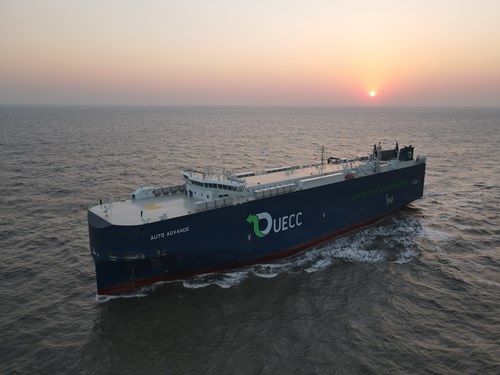
The world’s first dual-powered Liquefied Natural Gas / battery powered pure car and truck carrier (PCTC) has been launched and is ready to begin trading.
The “Auto Advance” is owned and operated by United European Car Carriers, which is itself 50 / 50 owned by NYK Lines and Wallenius Wilhelmsen.
The ship is the first in a series of three PCTCs being built by Jiangnan Shipyard of China. The two sister vessels are scheduled for delivery in 2022.
The vessel has dimensions of 169 metres by 28 metres with a capacity for 3600 vehicles on 10 cargo decks.
The LNG battery hybrid technology, together with an optimised hull design for better fuel efficiency, will enable these new ships to exceed the IMO requirement to cut carbon intensity by 40% from 2008 levels within 2030.
Emissions of carbon dioxide will be reduced by around 25%, sulphur oxides and particulate matter by 90% and nitrous oxides by 85% from the use of liquefied natural gas, while the newbuilds will also meet the IMO’s Tier 3 NOx emissions limitations for the North Sea and Baltic Sea.
The technology
The dual-fuel engine technology has now been combined with an energy storage system, supplied by Finland’s WE Tech, that incorporates a battery package from Corvus Energy. The battery will be charged by a permanent magnet, directly driven shaft generator or dual-fuelled generators.
The ESS, which will provide power to the main switchboard with a DC link for power distribution, will enable peak shaving for the main engine and auxiliaries to reduce fuel consumption and emissions, with a controllable pitch propeller, bulb rudder and dual-fuel boiler also part of the power system.
These vessels will require only two auxiliary dual-fuel gensets, in addition to the main engine, as the energy storage system and shaft generator provide a spinning reserve to eliminate the need for another genset.
Smart energy management
Battery capacity is based on modelling of the vessels’ expected operational profile and has payback time of five years for the energy storage system, according to UECC’s head of ship management and newbuilding, Jan Thore Foss.
The hybrid solution, which has DNV’s Battery Safety notation, will be steered by an energy management system, supplied by Kongsberg Maritime, that will serve as a control system for overall energy production and consumption.
Batteries will be charged while at sea, using the shaft generator, so that they are fully charged when entering port, which will allow the ship to manoeuvre in port using solely battery-powered bow thrusters. The batteries can also supply the ship’s other energy needs while it is docked.
“This will effectively eliminate emissions while in port and these vessels are also equipped to connect to green power from shore that is becoming increasingly available in order to reduce harmful emissions of NOx, SOx and particulate matter,” Foss says.
Fuel optionality
UECC’s energy and sustainability manager Daniel Gent says: “LNG is presently the most environment-friendly and widely available low-carbon fuel, with an estimated emissions reduction of around 25% compared with other fossil fuels.
“We are therefore taking advantage of the best available fuel solution now and combining this with hybrid technology to further cut emissions. But we are not locked into LNG and these dual-fuel engines are also ready to use alternative low-emission fuels such as biofuel, bio-LNG and synthetic LNG as these become commercially and technically viable.”
UECC is headquartered in Oslo, Norway, and it operates eight offices and seven port-related terminals across Europe. The company operates a fleet of 17 PCTC vessels that are deployed in the short-sea market.