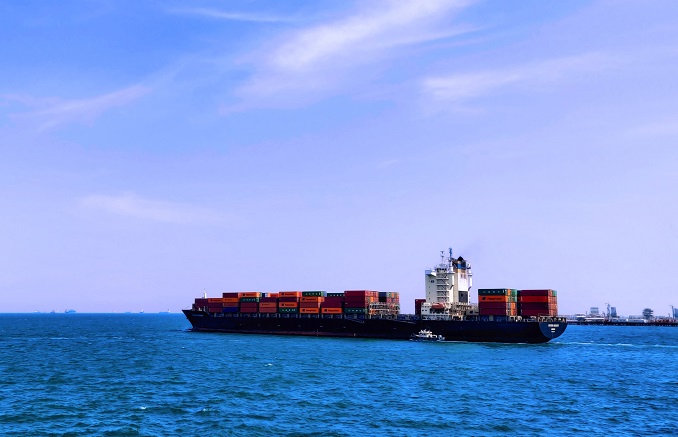
A Singapore-flagged containership ship transiting the Strait of Hormuz has been attacked and the International Maritime Organization’s evacuation scheme has been halted.
An unidentified projectile has struck a cargo ship on the starboard side near the Strait of Hormuz approximately 7.5 nautical miles southeast of Dahi, Oman, according to a report from the UK Maritime Trade Operations centre. The master of the ship has reported to the UKMTO that there are no casualties and no environmental impact. The vessel has since been confirmed to be the Ever Lovely (IMO: 9629110) by the Maritime & Port Authority of Singapore, which has also confirmed that the crew are safe, adding that the bridge sustained minor damage and that that the ship is proceeding on its voyage.
The attack on a vessel, which was apparently in Omani territorial waters, therefore seems to have violated Omani sovereignty. As the ship was operating close to the IMO-approved evacuation route, that route can be regarded as unsafe. The IMO immediately suspended its Persian Gulf evacuation plan.
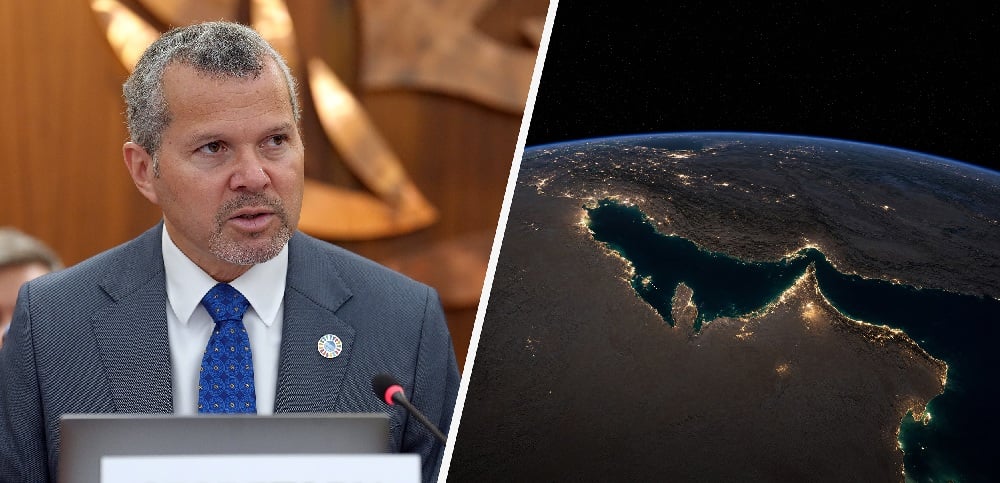
IMO Secretary-General Mr. Arsenio Dominguez commented on 25 June 2026 that:
“Following the launch of the IMO’s evacuation plan, through which several vessels have already been successfully evacuated, I have decided to temporarily pause its implementation in order to reconfirm that the necessary safety guarantees continue to be in place for the ships on our evacuation list and all those in the region. I have been informed of an attack today in the Gulf of Oman on a vessel which passed through the Strait of Hormuz. This vessel did not transit under IMO’s evacuation framework. I have always reiterated that the safety of the seafarers remains paramount. Therefore, to ensure a coordinated approach and navigational safety, the evacuation plan will be paused until further clarity is obtained”.
Meanwhile, according international trade publication, Lloyd’s List, at least two tankers have reversed course while attempting to transit Hormuz via the southern channel near the Omani coast. These vessels were reported to be the Singapore-flagged, 2010-built, tanker Azumasan (IMO 9397157) and the Togo-flagged, 2001-built, combined chemical and oil tanker Blue Star 1 (IMO 9215115), which were said to be attempting to exit the Gulf using the route approved by Oman.
According to global insurer Allianz, research data shows that around 1,150 cargo-carrying vessels (over 100 gross tons (a measure of the internal volume of a ship, not weight)) with an estimated vessel and cargo value of approximately $125 billion, a volume of 29 million GT, and as many as 20,000 seafarers are in the Persian Gulf waiting to resume operations.
Islamic Revolutionary Guard warning
According to an official statement from Iran’s Islamic Revolutionary Guard Corps on its Sepah News channel (in Farsi, machine-translated into English), there had been an announcement by some authorities for a new route for ships to transit through the Strait without co-ordinating with the Islamic Republic. This route is said to be unacceptable to the Revolutionary Guard and dangerous, with only the Iran-approved route being deemed to be acceptable. The IRGC Navy stated on Sepah that coordination with Iran is necessary and that any violators will be dealt with. The IRGC prohibited transit via any other route and warned vessels not to travel on other routes.
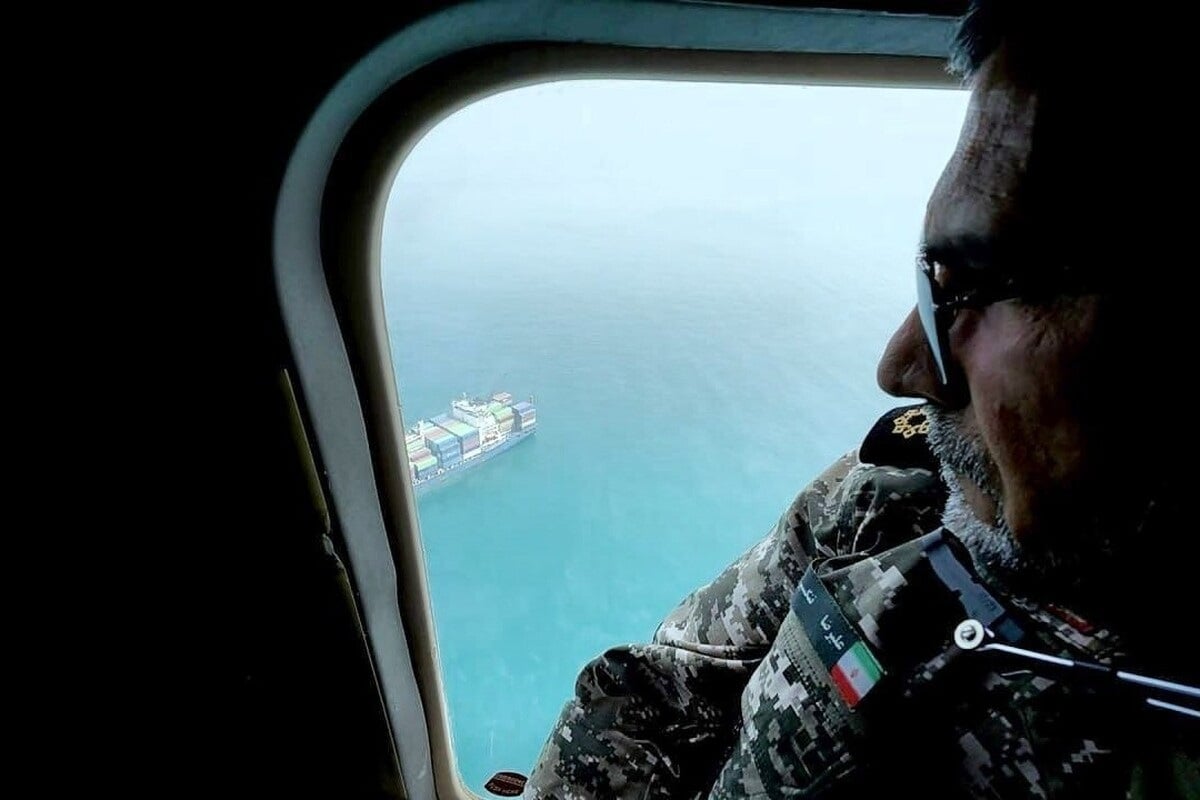 Pictured (above): Iranian naval commander, Alireza Tangsiri (now deceased), overlooks a containership that is underway from an aerial vantage point. Photo: Islamic Revolutionary Guard Corps Navy / Sepah News.
Legalities
It is arguable that Iran does not have any legal right to close the Strait nor to attack third party ships under international law. Under Article 17 of the U.N. Convention of the Law of the Sea (“UNCLOS”), ships of all States, whether coastal or land-locked, enjoy the right of innocent passage through the territorial sea. UNCLOS (Part 3) refers to straits used for international navigation Article 34(1) states that the sovereignty or jurisdiction of the States bordering a strait is exercised subject to Part 3 of UNCLOS. The rules on transit passage of international navigation take place in a strait via the Exclusive Economic Zone (Article 37). Ships travelling through Article 37 straits have a right of transit passage that shall not be impeded (Article 38(1)). Transit passage means the continuous and expeditious transit of the strait (Article 38 (2)). Any countries bordering a strait shall not hamper transit passage and there shall not be an suspension of transit passage (Article 44). The regime of innocent passage shall apply in straits used for international navigation and there shall be no suspension of innocent passage through such straits (Article 45 (1)(2)).
The Maritime & Port Authority of Singapore declared that it is “deeply concerned about the incident, which was unprovoked, unjustifiable, and a breach of international law. All actions affecting international shipping must fully comply with international law, in particular the United Nations Convention on the Law of the Sea, and not endanger the safety of seafarers and ships at sea”.
However, while Iran is a signatory to UNCLOS, it has never ratified it. Under article 18 of the Vienna Convention on the Law of Treaties 1969, says that a country that has signed a treaty, which Iran has, is obliged to refrain from acts that would defeat the object and purpose of the treaty. That said, Iran has signed the Vienna Convention, but it hasn’t ratified the Convention. So the status of the applicability of UNCLOS to Iran is a bit unclear.
There is also the concept of “customary international law,” which is basically the theory that countries repeatedly act in a given way because they feel they are legally obligated to do so and, over time, rules of international law are created by that repeated practice. It could be argued that commonly observed maritime navigation rules, such as those found in UNCLOS, are now part of customary international law. Iran has for many years complied with UNCLOS rules (as many other states have). But Iran has also repeatedly threatened to close the Strait of Hormuz (which is contrary to UNCLOS) and the nation has repeatedly argued it is not bound by UNCLOS. So it’s unclear whether customary international law requiring compliance with UNCLOS, or UNCLOS-like rules, has actually arisen. That’s one for the maritime lawyers to argue before the International Tribunal for the Law of the Sea. However, it is unlikely to be lawful for Iran to attack unrelated civilian shipping of non-belligerent third party nations or to attack or threaten shipping that is not in its territorial waters.
It is notable that the location of the attack appears to be both within Omani territorial waters and also on the evacuation route as declared by the Sultanate of Oman. Articles 2 and 3 of UNCLOS state that the sovereignty of a coastal state extends beyond its land territory to an adjacent belt of sea, the territorial sea, which can have a breadth up to but not exceeding 12 nautical miles. There is unlikely to be any doubt that the repeated practice of countries to claim an extension of their sovereignty beyond their land territory has given rise to a customary international law that national sovereignty extends over the near-shore sea. Iran has no right to interfere with the sovereignty of another non-belligerent nation (i.e. Oman) by attacking ships exercising their right of innocent passage through the territorial waters of that nation, and that’s especially true given that the ship was sailing on a route approved by the relevant legal authorities of that other nation.
IMO Evacuation Scheme
The IMO had previously announced on 23 June 2026 an evacuation scheme via Omani territorial waters following the signing of the peace deal between the USA and Iran. That deal stated that upon the signing of the MoU, that the Islamic Republic of Iran would make arrangements using its best efforts for the safe passage of commercial vessels with “no charge for 60 days only” from the Persian Gulf to the Sea of Oman and vice versa.
The IMO announced it would begin the implementation of a large-scale operation to evacuate over 11,000 seafarers stranded in the region, which would be carried out in close cooperation with Iran, Oman, the other coastal states, the United States, and the maritime industry.
“We have secured the necessary safety guarantees and have thoroughly verified the conditions for safe navigation to support these operations,” the IMO said.
The official Oman National Hydrographic Office, part of Ministry of Defence of the Sultanate of Oman had released a statement on 23 June 2026 declaring the existence of a transit corridor through its territorial sea in accordance with its “continued commitment to the international law and the law of the sea to ensure freedom of navigation in the Strait without imposing any tolls”. The statement added that Muscat had “worked in coordination with the IMO to provide all vessels with the option of a temporary maritime corridor”.
Oman indicated that a gradual and controlled evacuation of vessel traffic was required.
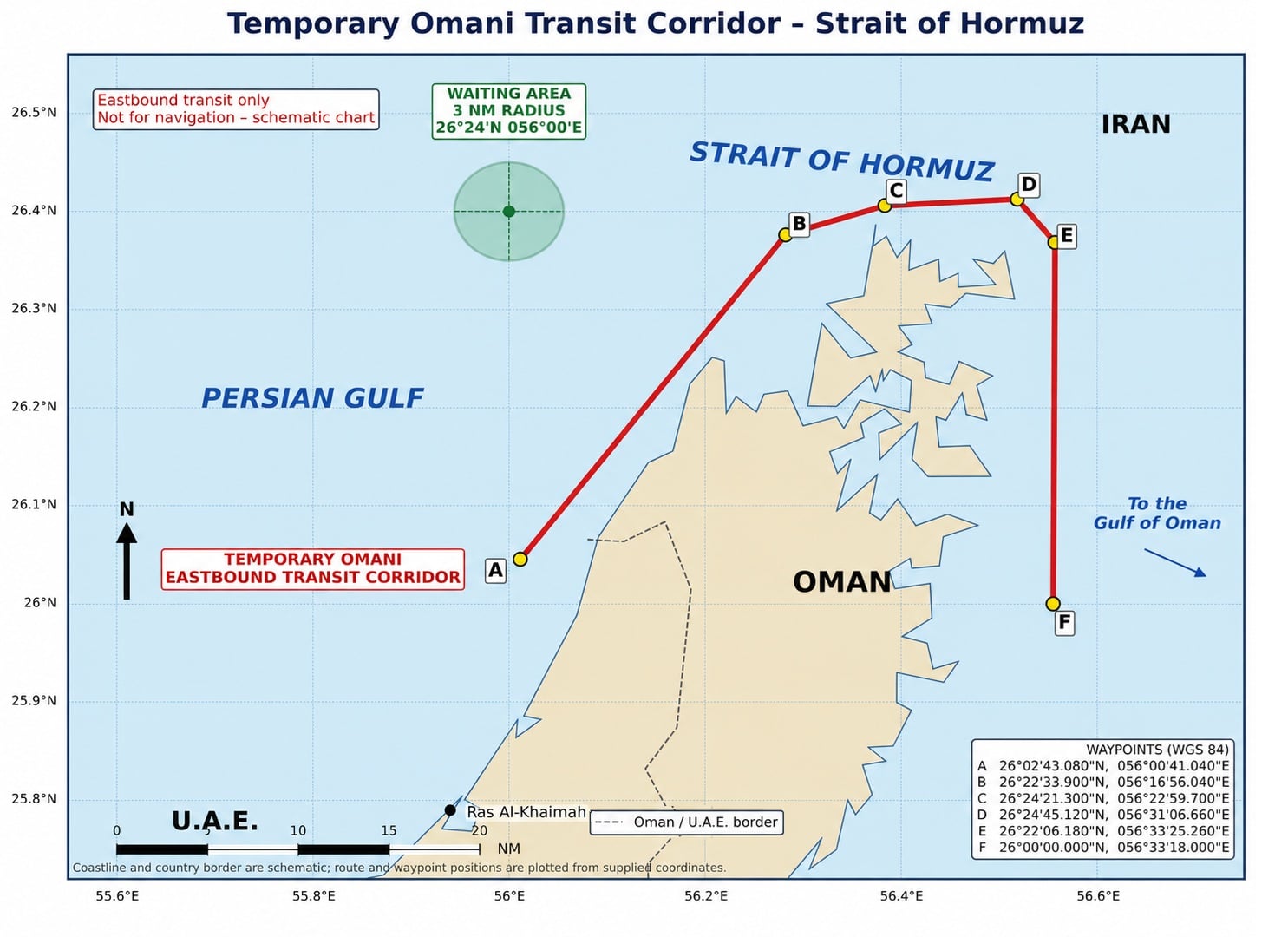
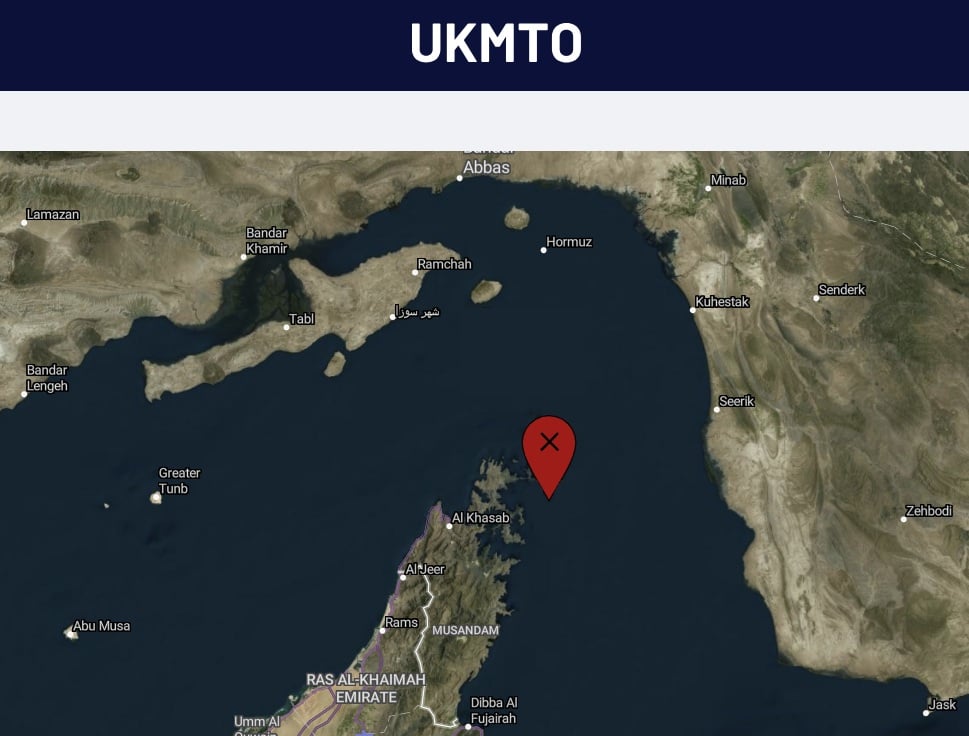
Graphic: the red marker denotes the approximate location in the Strait of Hormuz where a cargo ship, thought to be a containership was attacked recently. Graphic source: UK Maritime Trade Operations (note, the graphic has been lightly edited by Shipping Australia).