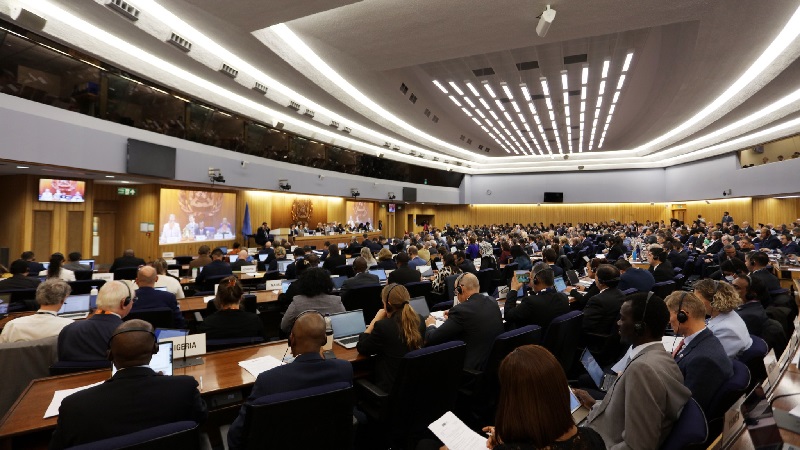
Government delegates to the International Maritime Organization (IMO) have crept closer toward global greenhouse gas regulations aiming at cutting the carbon intensity of shipping by 40% by 2023.
Governments, which are the voting members at the IMO, had identified “further areas of convergence in their positions,” the IMO reports, and have produced a draft legal text to use as a basis for ongoing talks on the “mid-term” measures (i.e. regulations), which are expected to be adopted in 2025.
Draft legal text
“The draft legal text produced by MEPC 82 integrates inputs and proposals from Member States and international organizations on possible amendments to be made to the International Convention for the Prevention of Pollution from Ships (MARPOL, Annex VI). If adopted, these amendments would incorporate the proposed new measures into international law,” the IMO states.
The Maritime Environment Protection Committee (the main economic committee at the IMO and which met recently) will hold its next session in April 2025 and government delegates to the IMO are expected to approve the amendments ahead of formal adoption in October 2025.
The IMO adds that “a period of negotiations” lies ahead before the next meeting of the Marine Environment Protection Committee.
At the conclusion of MEPC 82 (the recent meeting in London), IMO Secretary-General Mr. Arsenio Dominguez gave a speech to the government delegates.
“At the start of this week, one of the comments I heard from the press was that IMO is an organization “where time doesn’t move.” I hope so, because if that is true then we have even more time to go on working in the very hard and dedicated way we do,” he quipped, before continuing, “I am convinced that at the next session, you will reach an agreement. These negotiations do not take place only in the course of the meetings in the building… Focus on solutions and come along prepared to agree to the architecture of the technical and economic measures… I am sure that you will reach that midpoint where we can continue to show that when we set goals, we achieve them. If not, I am closing the doors next year and we will have to stay here until we do agree”.
Technical and financial measures
There are two main mid-term measures under consideration. Firstly, through the introduction of a global marine fuel standard (the “technical element”) that will regulate the phased reduction of a marine fuel’s greenhouse gas intensity. Secondly, there will some kind of greenhouse gas emissions pricing. There are currently several different types of pricing mechanisms under consideration.
The pricing mechanism would theoretically raise revenues that could be distributed in a variety of ways including but not limited to using revenue to lower other taxes, promoting renewable energy and energy efficiency, using emission offsets, financing climate and environmental projects, constructing new infrastructure and retrofitting existing infrastructure, earmarking revenues for administrative costs, funding of research and development (R&D), adapting to the impacts of climate change, allocating revenue into general national budgets, and funding of cross-cutting measures, according to the “Comprehensive impact assessment of the basket of candidate GHG reduction mid-term measures”, a literature review carried out by the World Maritime University on behalf of the IMO.
The Impact Assessment noted that there a a wide range of projected carbon revenues in different studies and proposals because there is a wide range of recommended carbon prices and assumptions in the available literature.
Ultimately, the goal is to phase out GHG emissions from shipping by or about the year 2050.


