
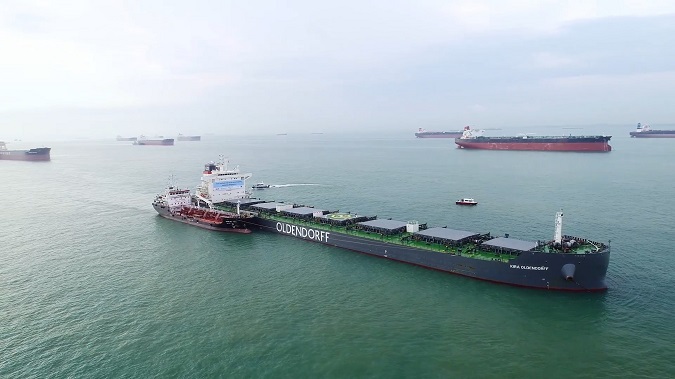
Australian mining giant BHP and major dry bulk operator, Oldendorff Carriers (a Shipping Australia member) have successfully completed an important biofuel trial.
Advanced and sustainable biofuels provider, GoodFuels, supplied the fuel for the trial, which was held with the assistance of the Maritime & Port Authority of Singapore.
The advanced biofuel reduces carbon dioxide emissions by 80-90% on a well-to-exhaust basis compared with heavy fuel oil and very low sulphur fuel oil. It uses sustainable waste and residue streams as feedstock. The supplied fuel is “drop-in” meaning it can be blended with conventional biofuels.
Oldendorff is thought to be the world’s largest operator of dry bulk ships. The company operates 750 ships and carries about 330 million tonnes of per annum of cargo between 120 countries involving 14,000 port calls each year.
The vessel selected for the trial was one of Oldendorff’s eco-Kamsarmaxes, the Kira Oldendorff, an 81,290 deadweight tonnes dry bulker. Oldendorff reports that minor modifications were made to enable efficient combustion of the biofuel blend and that monitoring instruments were installed to capture trial data.
The objectives of the biofuel bunkering trial included developing a further understanding of the behaviour of the fuel, assessing engine and vessel operation performance during the trial and exploring the technical and commercial merits and challenges of biofuel as a marine fuel.
Oldendorff said that, in line with its decarbonisation strategy, the company is committed to working with partners, authorities and stakeholders to find the best ways to reduce greenhouse gas emissions in its shipping operations.
Oldendorff Singapore’s Managing Director, Alexander Vajsova-Jones stressed the importance of collaborating with the right partners: “Oldendorff Carriers and BHP’s views on a greener future are mutually aligned and being historically close partners, it made this trial a natural fit. GF are leaders in biofuels and early movers in this segment and felt they were an excellent choice, while MPA are strong supporters of green initiatives and are always instrumental in supporting industry participants in the ‘shipping capital of the world’. We are thrilled to have been selected to participate in this biofuel trial with our close partners, and pleased that the bunkering happened in Singapore. It’s a small but necessary step in our common goal to reduce our carbon footprint.”
Meanwhile, earlier this year in January, Oldendorff signed a “joint development project” with Anemoi Marine Technologies, Lloyd’s Register and the Shanghai Merchant Ship Design and Research Institute, to explore wind-assisted propulsion for dry bulk carriers.
The project scheduled for completion in 2020 will see the installation of several rotor sails. These are mechanically spinning tubes that are installed on the deck. When the wind blows side-on to the tube, the spinning motion causes a variation in air-pressure behind and in-front of the tube (relative to the forward direction of motion) which creates propulsion thereby reducing fuel consumption. Fuel savings can vary greatly depending on ship type, route, load status, location, seasonality (winds tend to be stronger in winter) and wind speed, among other factors.


