Members of the European Parliament (MEPs) have adopted the reform of the EU’s Emissions Trading System, which will include the maritime sector. The reform also covers aviation, the Carbon Border Adjustment Mechanism and a new Social Climate fund.
In mid-April the Euro-Parliament approved deals made with EU member states in late 2022 in relation to the “Fit for 55” Package. That’s a plan to reduce greenhouse gas emissions by at least 55% by 2030 when compared to 1990 levels.
A reform of the Union’s Emission Trading System was adopted which increases the ambition of the scheme. The reform requires greenhouse gas emissions in sectors in the trading scheme to be cut by 62% by 2030 when compared to 2005 levels.
The Emissions Trading System works by putting a price on carbon and by lowering a cap on emissions every year. The EU reports that the ETS has brought down emissions from power generation and energy-intensive industries by 42.8%.
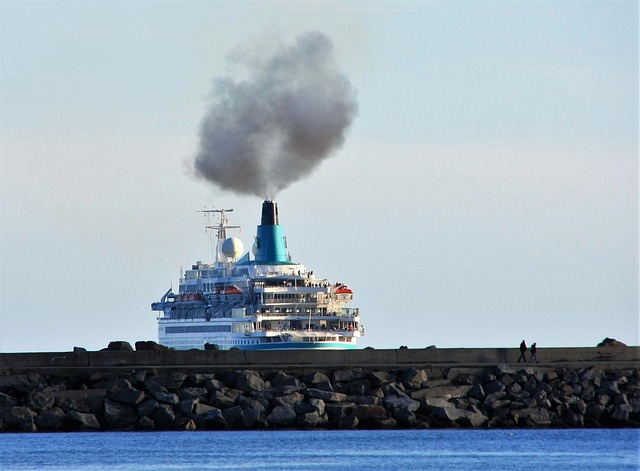
For the first time, greenhouse gas emissions from the maritime sector will be included in the Emission Trading System.
An official with the Euro-Parliament had earlier state that “It is an important achievement to include ships in the EU ETS because that will encourage ship owners and operators to use the best available technology and to innovate and this will not only help the climate but also improve air pollution in cities close to rivers and the coastline. Compared to the Commission proposal, we agreed on substantial improvements. First, we include methane and N2O in addition to CO2. Second, we increased the scope by including offshore vessels bigger than 5000 gross tonnage. This will bring a net benefit for the climate of 20 million tonnes of CO2. It will also increase the revenues and 20 million allowances will be earmarked for specific projects in the shipping sector via the Innovation Fund/Climate Investment Fund”.
The Euro-Parliament is not the supreme law-making body in the European Union. The Council of the European Union (informally known as the Council of Ministers) is generally considered to be the most powerful institution as it is the voice of EU member governments. Its membership according to the policy to be discussed and is composed government ministers from each member state. So a transport minister will be present for discussions on transport matters, an agriculture minister for agriculture matters and so on. The ministers meet to discuss, amend and adopt laws, co-ordinate policies and to commit their governments to actions agreed upon in the meetings.
The texts as voted upon and passed by the Euro-Parliament have to be formally endorsed by the Council of the European Union (which next meets in late June this year) and then published in the EU Official Journal. The texts would then enter into legal force 20 days later.
The EU maritime sector contributes to about 75% of the EU’s external trade volumes and 31% of its internal trade volumes, carrying about 400 million passengers each year.
There was an agreement between the Euro-Parliament, the Council and the European Commission (the Executive arm of the EU) late in November 2022. After that meeting , the World Shipping Council (which represents the global ocean container shipping sector) commented that “Liner shipping is already investing in the transition to zero GHG fuels, and is eager to operate vessels using renewably derived marine fuels distributed through a sustainable supply network. We are ready, and we hope that the EU ETS for maritime will help drive investment in renewable energy as well as in the supply networks needed for the alternative maritime fuels necessary to make the transition”.
The International Maritime Organization has a substantial plan of work underway in relation to Greenhouse Gas Emission, having adopted energy efficiency standards for new ships and existing ships (which slowly reduces the amount of allowable carbon emitted over time). These matters were discussed at the IMO’s Marine Environment Protection Committee (#. 79) of December 2022 and will further discussions and meetings are due at MEPC 80 in June this year.