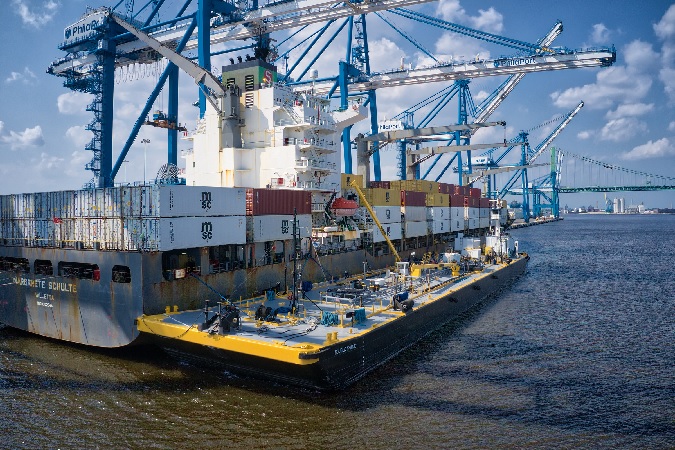
Every day it seems that there is a new and exciting development related to methanol as a marine fuel. Just consider the following developments, all of which occurred within the last few days and weeks.
At the time of writing, the international class society Korean Register and the Ulsan Port Authority have just announced that they have agreed to support methanol-fuelled ships in South Korea. Global shipping company Maersk has announced an eighth partnership for methanol production, and a few days before that, it signed a methanol memorandum of understanding with the country of Jordan. Even global entertainment company, Disney, has just announced that it is getting in on the methanol-act with an order for a methanol fuelled cruise ship.
Fuel transporter Stena Oil ordered its first methanol bunker delivery tanker. Bio-methanol producer WasteFuel announced plans to build the Middle East’s first bio-methanol plant in the United Arab Emirates near the port of Jebel Ali (close to Dubai). On the other side of the planet, in the Lion City, marine fuel supplier Global Energy Trading has ordered Singapore’s first methanol bunker vessel.
It was recently announced that more than twice as many methanol-fuelled ships were ordered in the previous month than liquefied natural gas (LNG) powered ships. Eight LNG vessels were added to the global orderbook according to global class society DNV in October but 18 methanol fuelled vessels were added in the same month. That said, DNV’s Alternative Fuel Initiative platform reports that there are about 256 methanol-fuelled vessels on order versus 2,691 LNG-fuelled ships on order, so the methanol fuelled fleet has some way to go to catch up. That data is back-loaded, and extends to 2028 though, so it will be interesting to see if all of those LNG-fuelled orders translate into actual deliveries.
And we haven’t even got into October’s methanol news, At the very end of October, China’s Cosco announced what appears to be the world’s largest order of methanol fuelled vessels – a purchase request for twelve vessels of 24,000 TEU. There are many, many more developments of this nature.
While it is appropriate to speculate as to whether methanol has reached a tipping point, it certainly looks safe to say that methanol appears to be gaining the lead as the future fuel for ocean shipping, at least for the intermediate future.
Methanol – a recent history
Interest in methanol was sparked by the conversion in 2015 of the Stena Germanica, a Swedish ro-pax ferry, to run on methanol. Interest was muted. But then, global-scale ocean shipping company, Maersk, announced in February 2021 that it would build and operate the world’s first carbon-neutral container ship, a 2,000 TEU feeder vessel that could operate on methanol.
It was the first of a flurry of announcements from the Danish ocean carrier. More orders followed – for eight massive ships, for six even-bigger ships, for the issue of a world-first EUR500m bond (AUD$777m at today’s prices) for the building of methanol ships, the signing of global-scale methanol production facilities, and many more such announcements.
So why all the excitement?
Methanol is potentially a very low carbon-fuel if it is is made in the right way (see below). It is potentially a net-zero fuel – the carbon used to make green methanol originates from the atmosphere so combustion merely puts the carbon dioxide back where it came from – the atmosphere. Green methanol combustion does not add new carbon dioxide to the atmosphere unlike the burning of fossil fuels. Methanol combustion with carbon off-setting could remove carbon dioxide from the atmosphere temporarily and, in the case of onboard carbon capture and storage followed by mineralisation, marine methanol combustion could remove carbon dioxide from the atmosphere permanently.
Building methanol-powered vessels is also cheaper than building vessels powered by the other front-runner, liquefied natural gas (LNG). Methanol-powered vessels are (currently) about 11% to 12% more expensive to build than a conventional ship but are about one third as expensive as building an LNG-powered vessel.
Meanwhile, LNG is difficult and costly to handle. LNG is super-cooled to about 161.5 degrees Celsius; LNG boils which releases gas that has to be managed (tanks must not become over-pressured), and the tanks have to remain very cold to prevent heat ingress. Pipes have to be double layered and insulated. In other words, LNG’s pretty difficult and costly to handle, although, to be completely fair, a lot of these challenges are well understood and the problems have been solved.
But methanol doesn’t have those problems. It is a liquid at ambient temperatures and atmospheric pressure. It has its difficulties – it is a toxic chemical if it is ingested or if volumes of fumes are absorbed through the skin. That said, it’s already an internationally traded chemical with 90 production plants around the world and a worldwide supply of about 110 million tonnes. So there is already plenty of understanding on how to safely handle and store methanol.
There’s also plenty of information on the safety performance of methanol as a marine fuel as the methanol-powered ro-pax ferry, Stena Germanica, has logged thousands of hours of safe operations.
Basics of methanol
Methanol is a form of alcohol (don’t drink it though, it’s horribly toxic!). It has been considered for use in road transport since the oil shocks of the 1970s – it has been blended into conventional fuels in various parts of the world – and it has been used in cars in China.
Graph: Well to Wake greenhouse gas emissions of methanol
relative to marine gas oil, assuming a slow-speed ship
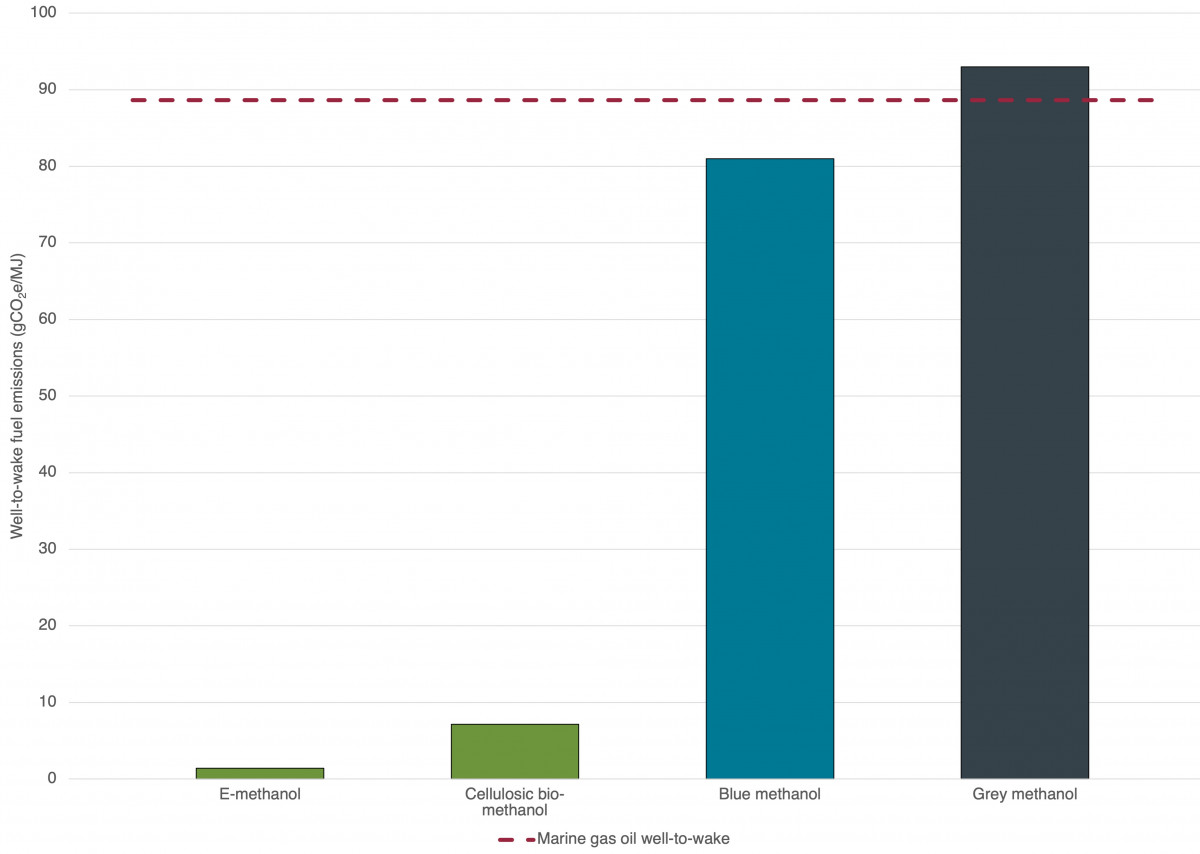
Source: International Council on Clean Transportation, A Martin, 1 September 2022.
Combustion of this alcohol produces 99% less sulphur oxides (SOx), 80% less nitrogen oxides (NOx) and, theoretically, less greenhouse gas emissions compared to conventional heavy marine fuel oil.
However, in practice, the overall carbon saving very much depends upon how the methanol has been produced. If coal is used as a feedstock, then methanol probably produces more carbon dioxide than simply using heavy fuel oil. There may well be a discount in emissions if it is made from a natural gas feedstock.
Methanol’s saving grace is that it can be manufactured in a very low-carbon manner. Methanol’s formula is CH3OH, which means that it is composed of one carbon atom, four hydrogen atoms and one oxygen atom. So it follows that, to make methanol, a producer needs access to large volumes of oxygen, carbon, and hydrogen.
Oxygen and hydrogen are both industrially-produced gases; both can be produced by the electrolysis of water (zap electricity through a water molecule (H20) and it will split into oxygen and hydrogen). Electrolysis can be powered by renewable energy.
Biogenic carbon dioxide can be obtained by feeding agricultural waste, municipal waste, sewage, non-food crops, industrial wastes, black liquor, or animal wastes (among other things), into a bio-reactor. Micro-organisms break down the feedstock, which releases carbon dioxide.
So there are potentially huge discounts on carbon emissions (over 80% or 90%; see graph above) if the feedstocks of methanol are obtained from electrolysis and biomass. Combine the various gases in the appropriate way, in the appropriate proportions, using environmentally-friendly power, and, et voila, environmentally-friendly methanol. Combustion of methanol would then restore carbon dioxide to the place from which it originated – the atmosphere. This is why methanol is regarded as net-carbon neutral.
Methanol and carbon capture and storage
Meanwhile, there have also been a range of carbon capture and storage (CCS) technology trials aboard ships, and the subject of marine CCS is due to be discussed this December at the United Nation’s International Maritime Organization (think of it as the international assembly for ocean shipping) after lobbying efforts by various countries around the world.
As a quick aside, we note that many commentators are, for various reasons, completely opposed to CCS (and also to “CCU” – carbon capture and utilization). However, we would point out that CCS is generally considered to be important in enabling the global energy transition.
Global engineering company Wärtsilä has been working on a small, modular, carbon capture system that would use solvents to capture carbon from exhaust gases. Pilot projects are due in 2023 and 2024 with a more full release of the technology pencilled-in for 2025. The company reportedly told trade media that the cost of capture would be in the range of EUR 50 to 70 (AUD$78 to AUD$109 at current rates) inclusive of capital and running costs. Those figures do not include the cost of landside logistics once the captured carbon once it is sent ashore. As Wärtsilä reckons that about 70% of carbon can be captured at the exhaust there are a couple of interesting possibilities.
Firstly, if that volume of carbon can be captured and handled economically, then it might be returnable to the global methanol producers who could then re-use the carbon to create more methanol thereby reducing pressure on the supply of carbon for marine fuel. Secondly, and much more intriguingly, if green methanol pulls carbon out of the air during its production, and if onboard technologies can economically capture carbon from the exhaust gases, and if that carbon can economically be handled on the landside, and if it can be economically mineralised into stone, then the cycle could become carbon-negative.
Or, to put it another way, the global ocean shipping industry could become a giant global machine that helps to decarbonise the planetary atmosphere. A lot of “ifs” there, but, intriguing nonetheless. Certainly a development to watch.
Further reading:
“Decarbonisation of shipping: an overview” – Shipping Australia, 11 October 2022.
An overview of existing and new energy efficiency rules, how shipping can meet the new requirements through (a) management (b) technology, and (c) alternative sources of propulsion and fuels; an overview of the main new fuels.